Gabon awaits word on its future after end of Bongo era / Photo: - - Gabon 24/AFP
People in the central African state of Gabon awaited a steer on their future on Thursday after rebel army officers brought the curtain down on 55 years of rule by the Bongo family.
President Ali Bongo Ondimba, whose father Omar had ruled for more than four decades, was toppled on Wednesday, moments after being declared outright winner in bitterly disputed elections.
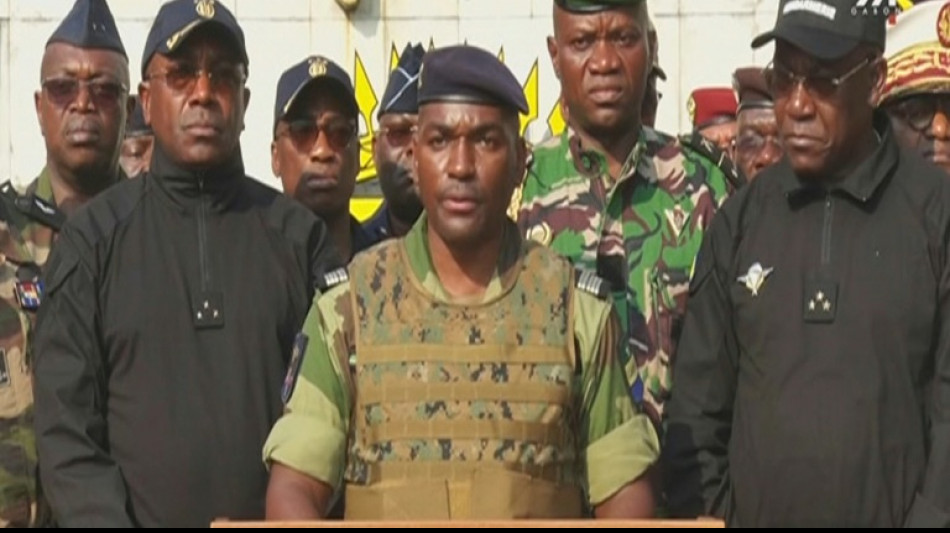
Amid scenes of joy in the oil-rich state, the coup leaders named the head of the elite Republican Guard, General Brice Oligui Nguema, as Gabon's "transitional president."
They also restored internet access and broadcasts by three influential French media that had been cut off by Bongo's government on Saturday evening.
But they kept a 6:00pm-6:00am curfew "to maintain calm and serenity" and Gabon's borders remained closed.
The Gabonese public and the international community are eager to know how long military rule will last and how the return to civilian governance will unfold.
Five other countries in Africa -- Mali, Guinea, Sudan, Burkina Faso and Niger -- have undergone coups in the last three years, with their new rulers resisting demands for a short timetable for returning to barracks.
- Bongo question -
Another question is the future of Bongo himself, and the United Nations and China are among those that have demanded guarantees for his safety.
After decades as a man with a playboy image, Bongo was elected in 2009 following the death of his father, who reputedly amassed a fortune from Gabon's oil wealth.
In 2016 he was re-elected -- again in fiercely disputed conditions -- before suffering a stroke in 2018 that weakened his grip on power.
The coup leaders declared on Wednesday that Bongo had been put under house arrest and "placed in retirement."
But during those tumultuous first hours, Bongo was able to release a video in which he appealed to "all friends that we have all over the world... to make noise" on his behalf.
His son and close adviser Noureddin Bongo Valentin, his chief of staff Ian Ghislain Ngoulou, his deputy, two other presidential advisers and the two top officials in the ruling Gabonese Democratic Party (PDG) "have been arrested", a military leader said.
They are accused of treason, embezzlement, corruption and falsifying the president's signature, among other allegations, he said.
- Election trigger -
The coup announcement came just moments after the national election authority declared Bongo had won a third term in Saturday's election with 64.27 percent of the vote.
The poll, condemned as bogus by the opposition, was declared cancelled by new leaders, who have called themselves the Committee for the Transition and Restoration of Institutions (CTRI).
The elections "did not meet the conditions for a transparent, credible and inclusive ballot so much hoped for by the people of Gabon," they said in a statement.
"Added to this is irresponsible and unpredictable governance, resulting in a continuing deterioration in social cohesion, with the risk of leading the country in chaos."
The claimed takeover sparked condemnation from the African Union and alarm from Nigeria, which warned of Africa's "contagious autocracy."
In France, where Bongo's loss would mark a further blow to Paris' influence in Africa, the government said it "condemns the coup" and reiterated its desire "to see the results of the election respected, once they are known".
But other reactions were more nuanced, focussing particularly on the credibility of the vote itself.
"Naturally, military coups are not the solution, but we must not forget that in Gabon there had been elections full of irregularities," said the European Union's foreign policy chief, Josep Borrell.
A rigged vote could amount to a civilian "institutional coup," he said.
In the three Sahel countries of Mali, Burkina Faso and Niger, democratically elected presidents were toppled by troops angered at failures to roll back a bloody jihadist insurgency.
The US State Department said it was "strongly opposed to military seizures" but voiced concerns over the "lack of transparency and reports of irregularities surrounding the election".
B.Hendrix--LCdB