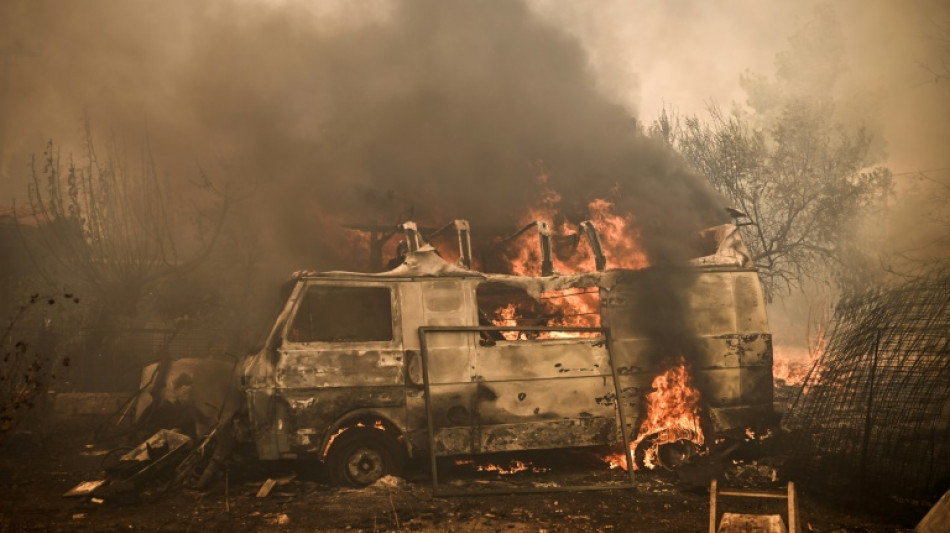
Greek summer wildfires will burn over 150,000 hectares: PM / Photo: Angelos Tzortzinis - AFP
Devastating wildfires in Greece will ravage more than 150,000 hectares (370,600 acres) by the end of the summer, Prime Minister Kyriakos Mitsotakis estimated Thursday, blaming the climate crisis for the disaster.
Like many countries around the Mediterranean, Greece has been plagued by wildfires since the start of the summer, with 26 people dying in forest fires fanned by dry, windy and hot conditions.
A massive blaze in Dadia forest, which the EU has branded the largest ever wildfire recorded in the bloc, was still burning for a 13th day.
The area burned by fires "will exceed 1,500,000,000 square metres (150,000 hectares) including the fire in the Dadia forest", Mitsotakis told parliament.
"Is the climate crisis the alibi for everything? No, it is not an alibi, but it is part of the interpretation," he said.
Around 600 firefighters, backed up by 10 fixed-wing aircraft and seven helicopters, are battling the fire, which broke out on August 19 in a forest protected by the European Natura 2000 network and a habitat or hibernation area for birds of prey.
A European Commission spokesman said Tuesday that the Dadia blaze is "the largest wildfire ever recorded in the EU".
The bloc recently sent 11 planes, a helicopter and 407 firefighters from the European fleet to help Greece.
The fire has claimed the lives of 20 people, most likely migrants, whose bodies were found in a northeastern region that is often used as an entry point from neighbouring Turkey.
It has burned more than 81,000 hectares to date, according to the European observatory Copernicus, an area larger than New York City.
- 'Ecological and economic disaster' -
According to experts, the Dadia fire in Evros has already caused "an ecological and economic disaster" in one of the country's poorest departments.
Greece's World Wildlife Fund branch said at least 30 percent of Dadia forest had been lost. Mitsotakis said he would request European experts to suggest ways to help reforest ravaged areas.
Residents of more communities were alerted to be on standby for a possible evacuation.
Another fire was blazing in Messinia region in the Peloponnese, prompting evacuations, but it was largely contained on Thursday afternoon.
The parliament observed a minute's silence for the victims at the start of a debate after a request from the leader of the centre-left opposition party Kinal-Pasok, Nikos Androulakis.
Faced with criticism from left-wing opposition parties for the lack of coordination between the authorities to extinguish the fires, Mitsotakis reiterated that the "mega fires", like the one in Evros, were mainly due to "extreme conditions" and "the climatic crisis".
"We had extremely unusual winds in Evros", "small fires that took on nightmarish dimensions", noted the prime minister.
He pointed out that "there were weeks this summer with more than 500 fires" and that the country was on several occasions "at the highest alert level in many regions".
- 'Unprecedented disaster' -
Left-wing Syriza, the main opposition party, claimed that Mitsotakis was "responsible for this unprecedented natural disaster", recalling the devastating fires of 2021 during which more than 100,000 hectares went up in smoke.
"After four years of governance, there is no time or space for excuses," said Socratis Famellos, head of Syriza's parliamentary group. "You left the country unprepared and defenceless against this danger."
Last week, another fire on Mount Parnitha near Athens burnt more than 6,000 hectares, according to the Copernicus Emergency Management Service.
Firefighters are still on the warpath in the region where outbreaks remain active, according to the authorities.
In July, when Greece was hit by a prolonged heatwave with temperatures reaching 46 degrees Celsius (115 degrees Fahrenheit) in the south of the country, multiple forest fires broke out.
The largest affected the tourist islands of Rhodes and Corfu.
According to the EMS, more than 50,000 hectares were affected by the flames on these islands, sparking the evacuation of thousands of holidaymakers and villages.
C.Adam--LCdB