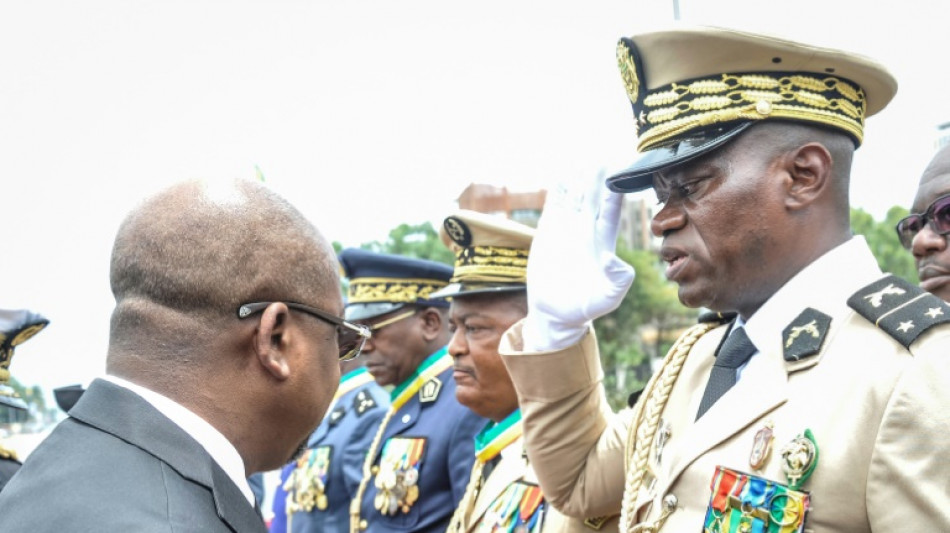
Gabon strongman to be sworn in as president, opposition seeks vote win / Photo: - - AFP/File
The general who overthrew Gabon's 55-year Bongo dynasty will be sworn in on Monday as transitional president, the army said, as the opposition called for its candidate to be recognised as the winner of weekend elections.
The military sought to reassure donors they would "respect all commitments" at home and abroad and "phase in" transitional institutions, Colonel Ulrich Manfoumbi Manfoumbi, spokesman for the new regime, said on state television.
The swearing in of General Brice Oligui Nguema will take place at the constitutional court, said the spokesman, providing the first indication of how the Committee for the Transition and Restoration of Institutions (CTRI) would operate following Wednesday's putsch.
But the African Union's Peace and Security Council strongly condemned the coup and said it decided to "immediately suspend" Gabon until the restoration of constitutional order in the country.
Gabon's opposition Alternance 2023 alliance had remained silent since the coup, but on Thursday called on the military leaders to acknowledge its victory in the election.
The alliance "invited the defence and security forces to the discussion so as to work out... the best solution," following the vote.
Led by university professor Albert Ondo Ossa, Alternance had earlier accused President Ali Bongo Ondimba of "fraud" and demanded he hand over power "without bloodshed".
- Bongo 'retired' -
Ali Bongo, whose father Omar held power for more than four decades, was toppled moments after being declared outright winner in bitterly disputed weekend elections.
Amid scenes of joy in the oil-rich state, the coup leaders had named the head of the elite Republican Guard, General Oligui Nguema, as transitional president.
But they imposed a nighttime curfew "to maintain calm and serenity" and Gabon's borders remained closed.
"The transition must happen quickly," said Jasmine Assala Biyogo, 35, who owns a small central Libreville bar.
There were few outward signs of the political turmoil on the capital's streets on Thursday.
Bongo's fate remains unclear but the CTRI, which includes the heads of all army corps, said he had been put under house arrest and "placed in retirement".
After decades with a playboy image, Bongo was elected in 2009 following the death of his father, who reputedly amassed a fortune from Gabon's oil wealth.
In 2016 he was re-elected -- again in fiercely disputed conditions -- before suffering a stroke in 2018 that weakened his grip on power.
- Election trigger -
The coup announcement came just moments after the national election authority declared Bongo had won a third term in Saturday's election with 64.27 percent of the vote.
The poll, condemned as bogus by the opposition, was declared cancelled by the new CTRI leaders.
The elections "did not meet the conditions for a transparent, credible and inclusive ballot so much hoped for by the people of Gabon", they said in a statement.
"Added to this is irresponsible and unpredictable governance, resulting in a continuing deterioration in social cohesion, with the risk of leading the country into chaos."
The takeover sparked broad condemnation and Nigeria warned of Africa's "contagious autocracy".
France renewed calls "to see the results of the election respected, once they are known".
But other reactions were more nuanced, focussing on the credibility of the vote itself.
"Naturally, military coups are not the solution, but we must not forget that in Gabon there had been elections full of irregularities," said the European Union's foreign policy chief, Josep Borrell.
The US State Department said it was "strongly opposed to military seizures" but voiced concerns over the "lack of transparency and reports of irregularities surrounding the election".
The vote was held without international observers, and foreign journalists had been restricted from covering the event, said media watchdog Reporters Without Borders (RSF).
Five other countries in Africa -- Mali, Guinea, Sudan, Burkina Faso and Niger -- have undergone coups in the last three years, with their new rulers resisting demands to quickly return to barracks.
Y.Simons--LCdB