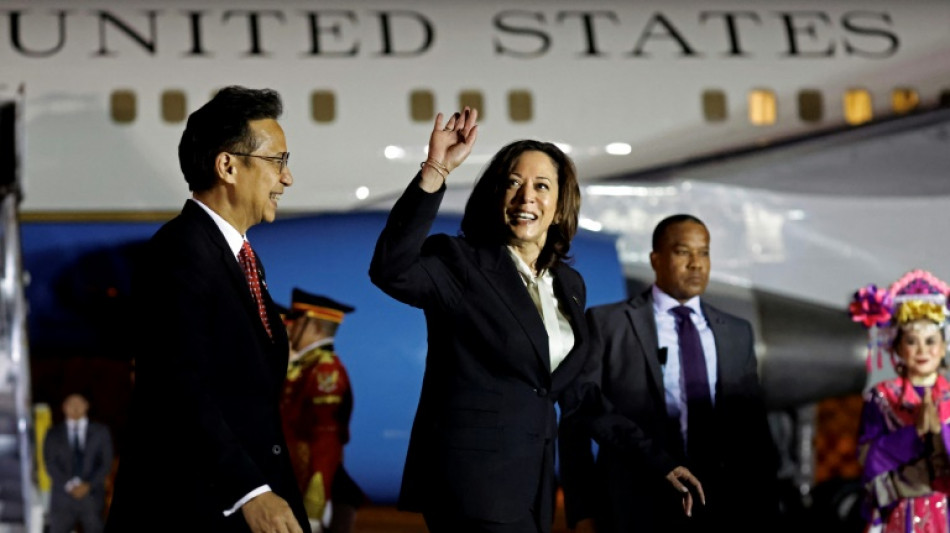
Big power disputes cast shadow on Southeast Asia summits / Photo: WILLY KURNIAWAN - POOL/AFP
Southeast Asian leaders meet with top US, Chinese and Japanese officials at a series of summits in Indonesia on Wednesday, where big power rivalries and regional issues from the South China Sea to North Korean missiles will be on the table.
The 10-member Association of Southeast Asia Nations (ASEAN) will hold separate summits with China, Japan, South Korea and the United States, providing an arena for big powers to lobby the bloc.
US Vice President Kamala Harris is attending in place of President Joe Biden, while Chinese Premier Li Qiang is taking part instead of President Xi Jinping.
Wednesday's meetings will be more regional in scope before an 18-member East Asia Summit on Thursday to be attended by Russian Foreign Minister Sergei Lavrov, where broader geopolitical issues are expected to top the agenda.
"At both summits, the vice president will underscore the United States' enduring commitment to the Indo-Pacific generally and to ASEAN centrality specifically," US National Security Advisor Jake Sullivan told reporters Tuesday, using another term for the Asia-Pacific region.
Japanese Prime Minister Fumio Kishida and South Korean President Yoon Suk Yeol will also attend.
They will meet with Li at an ASEAN plus three summit where a row between China and Japan over the release of treated wastewater from the Fukushima nuclear plant could again come to the fore.
Host Indonesia told an ASEAN leaders' summit on Tuesday that the bloc would not become a proxy for big power competition as US-China tensions continue to flare over Taiwan, the South China Sea and Russia's invasion of Ukraine.
The roundtable including Lavrov and Harris would be the first high-level US-Russia encounter since a foreign ministers' meeting in Jakarta in July, where US and European officials rounded on Moscow's top diplomat over the invasion of Ukraine.
A Southeast Asian diplomat who will be present in Wednesday's meetings told AFP they would conclude with a series of joint statements about closer diplomatic, economic and food security collaboration between the powers and ASEAN.
- North Korea, Myanmar -
Other regional issues such as North Korea's ballistic missile launches are expected to feature prominently.
South Korea's Yoon, in an interview with Indonesian newspaper Kompas on Tuesday, said he would push for ASEAN to "join forces" with Seoul to counter Pyongyang's nuclear threats.
Myanmar will also be a key issue at the summits with China -- a key diplomatic ally of the junta.
On Tuesday, Southeast Asian leaders strongly condemned the violence and attacks on civilians in Myanmar, directly blaming the junta. Indonesia said there had been scant progress on an agreed peace plan.
China also upset several ASEAN members last week when it released a new official map claiming sovereignty over the majority of the South China Sea.
It sparked sharp rebukes from across the region, including Malaysia, Vietnam and the Philippines.
The Southeast Asian diplomat who spoke to AFP said joint statements from the meetings will "contain references to the South China Sea and Myanmar".
"I predict economic priority will be maintained and the leaders will avoid discussing confrontational issues such as China's new map," Aleksius Jemadu, a foreign affairs expert at Indonesia's Pelita Harapan University, told AFP.
"They won't risk the relationship with big powers."
A.Peeters--LCdB