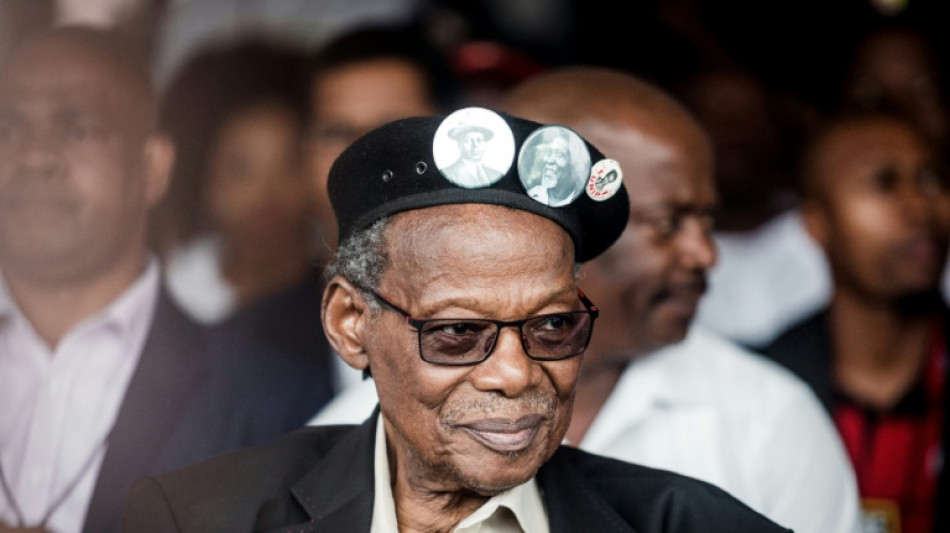
S.Africa holds state funeral for divisive Zulu leader Buthelezi / Photo: RAJESH JANTILAL - AFP/File
Thousands of people, some dressed in traditional warrior clothes, on Saturday attended the funeral of South Africa's divisive Zulu leader Mangosuthu Buthelezi, who was implicated in a wave of deadly violence that marked the country's emergence from apartheid.
Mourners crowded a small stadium in Ulundi, the ancient capital of the Zulu kingdom in eastern South Africa, to pay tribute to the founder of the Inkatha Freedom Party (IFP), who died on September 9 aged 95.
"The sun has set on an era and on a life that witnessed and had an impact on much of our country's modern history", President Cyril Ramaphosa said in a eulogy.
Earlier, family members dressed in black led a coffin covered by an animal skin and an IFP flag across a red carpet before it was placed under a black canopy on the pitch.
Around it sat mourners, some wearing traditional leopard skins and holding spears and shields made from cow hides, others in white IFP t-shirts bearing a portrait of the late leader.
"He treated all of us Zulus as one person. That is why I am here," said Bonga Makhoba, 31, who said he drove 150 kilometres (90 miles) and slept in his car to attend the service.
"I just respect him and I want him to... rest in peace."
During the ceremony, which started in the morning and continued well into the afternoon, the IFP Women's Brigade chanted "he has led us this far" in Zulu while other mourners paid tribute to "Shenge", as Buthelezi was known after his clan name.
Guests sitting under white marquees opposite an altar included former presidents Jacob Zuma and Thabo Mbeki.
Buthelezi was once a rival of Ramaphosa and his former boss Nelson Mandela, as the pair led negotiations to end white rule in South Africa. For years, he was locked in a bitter rivalry with the ruling African National Congress (ANC).
The party had been his political home until he broke away to form the Inkatha movement in 1975.
Born of royal blood, he was to some the embodiment of a proud and feisty Zulu spirit, while to others he often acted as a warlord.
- A contested legacy -
As premier of the "independent" homeland of KwaZulu, a political creation of the apartheid government, Buthelezi was often regarded as an ally of the racist regime.
He was dogged by allegations of collaborating with the white government to fuel violence and derail the ANC's liberation struggle -- a claim he furiously denied.
Violence between Inkatha supporters and rival liberation groups claimed about 12,000 lives, as unrest between the ANC and IFP escalated in the run-up to the democratic elections in 1994.
Ramaphosa conceded he and Buthelezi "did not always agree" but speaking of the violence said it was "not the day to point fingers and cast blame".
"South Africa might be a vastly different place today" had Buthelezi not taken an 11th-hour decision to participate in the vote, Ramaphosa said.
He was later appointed home affairs minister in the national unity government led by Mandela.
Admired as a charismatic speaker, Buthelezi went on to become one of the country's longest-serving lawmakers, widely recognisable with his slender silhouette and distinctive rectangular glasses.
But while considered a cultural protector for the more than 11 million Zulus, his legacy remains contested.
Buthelezi's epitaph should read "Chief apartheid collaborator and mass murderer", wrote Mondli Makhanya, editor of the City Press newspaper.
The Sowetan, a daily paper born out of the liberation struggle, wrote that "For his supporters, who worshipped the ground he walked on, he is held in high regard as a hero".
However he would "remain a despised figure in the eyes of those who suffered brutality and violence in the hands of his party henchmen".
The Prince Mangosuthu Buthelezi Foundation rejected such criticism as "unspeakably evil" and "old lies".
"Everybody has their past but Buthelezi to me, he was the best," Fisokhule Buthelezi, 45, a distant relative sporting a black IFP beret, who sat on the stands.
After the ceremony, the body was taken for burial in the family homestead.
J.Hermans--LCdB