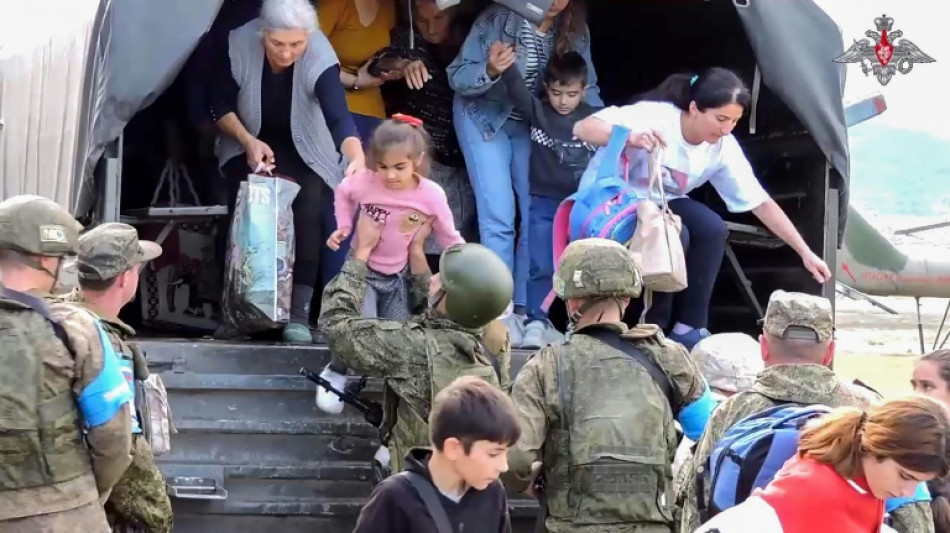
Azerbaijan halts Karabakh operation as separatists vow to disarm / Photo: - - Russian Defence Ministry/AFP
Azerbaijan on Wednesday announced it had halted its military operation in the disputed region of Nagorno-Karabakh, after separatist Armenian forces agreed to lay down their arms and hold reintegration talks.
Baku and the ethnic-Armenian authorities in Karabakh said a ceasefire deal had been brokered by Russian peacekeepers to stop the fighting a day after Azerbaijan launched an "anti-terrorist operation".
The separatists said they had committed to a "full dismantlement" of their forces and the withdrawal of Armenian army units from the region, at the centre of two wars between Armenia and Azerbaijan since the collapse of the Soviet Union.
Azerbaijan's defence ministry said in addition that "all weapons and heavy armaments are to be surrendered" under the supervision of Russia's 2,000-strong peacekeeping force on the ground.
Both sides said talks on reintegrating the breakaway territory into the rest of Azerbaijan would be held on Thursday in the city of Yevlakh.
The stunning collapse of separatist resistance represents a major victory for Azerbaijan's President Ilham Aliyev in his quest to bring Armenian-majority Nagorno-Karabakh back under Baku's control.
Armenian Prime Minister Nikol Pashinyan said in a televised address that fighting appeared to have largely subsided and insisted it was "very important" the ceasefire hold.
He repeated a denial that his country's army was in the enclave and said he expected Russia's peacekeepers to ensure Karabakh's ethnic-Armenian residents could stay "in their homes, on their land".
The latest flare-up comes three years after Azerbaijan recaptured swathes of territory in and around the region in a brief war that dealt a bitter defeat to Armenia.
Armenia said that at least 32 people had been killed and more than 200 wounded by the shelling in Karabakh as the latest onslaught from Azerbaijan saw artillery, aircraft and drone strikes rock the region.
Baku said Tuesday it had taken control of more than 60 military positions during "localised anti-terrorist measures".
Russian peacekeepers and separatist forces evacuated thousands of civilians from the fighting.
- International pressure -
The announcement of the ceasefire came after Aliyev warned the military operation would continue until the separatists laid down their weapons, in the face of mounting international pressure to halt fighting.
Russia, the United Nations and Pope Francis added to calls to stop the violence, after the United States and France reached out to the leaders of both Azerbaijan and Armenia.
The fresh outburst of fighting comes as Moscow, the traditional power broker in the region, is bogged down and distracted by its war on Ukraine, which has left it isolated by the West.
But its peacekeepers on the ground appeared to have played a key role in helping to negotiate the ceasefire and will now oversee its implementation.
Russian President Vladimir Putin said he now hoped for a "peaceful" resolution in Karabakh, adding that Moscow has been in contact with all sides in the conflict.
Fears of a fresh war in the volatile Caucasus region have been growing recently, with Armenia accusing Azerbaijan of a troop build-up around the disputed territory.
Fuelled by the vast income from its energy resources, Azerbaijan has spent years building up its forces as it harboured the goal of one day retaking the territory it lost to Armenian forces in a war in the 1990s.
Turkey, a historic ally of predominantly Muslim Azerbaijan that views mostly Christian Armenia as one of its main regional rivals, had called the operation "justified", while urging "comprehensive negotiations".
- Armenia protests -
The latest offensive raised fears that the unrest could destabilise the broader region.
Angry protesters had clashed with police in Armenia's capital Yerevan, calling on Pashinyan to resign, while the country's security council warned of large-scale unrest, vowing to take "effective measures" to maintain constitutional order.
More than 30 people were injured in the clashes, the health ministry said.
The fighting in Karabakh erupted hours after Azerbaijan said four police officers and two civilians were killed in mine blasts in Nagorno-Karabakh, with authorities blaming separatists.
Azerbaijan justified its operation citing "systematic" shelling by Armenian-backed forces and accusing them of carrying out "reconnaissance activities" and fortifying defensive positions, accusing separatists of "a high level of combat readiness".
When the Soviet Union collapsed in 1991, ethnic Armenian separatists in Karabakh broke away from Azerbaijan.
The ensuing conflict claimed some 30,000 lives.
A six-week war in 2020 saw Armenia cede swathes of territory it had controlled since the 1990s.
C.Timmermans--LCdB