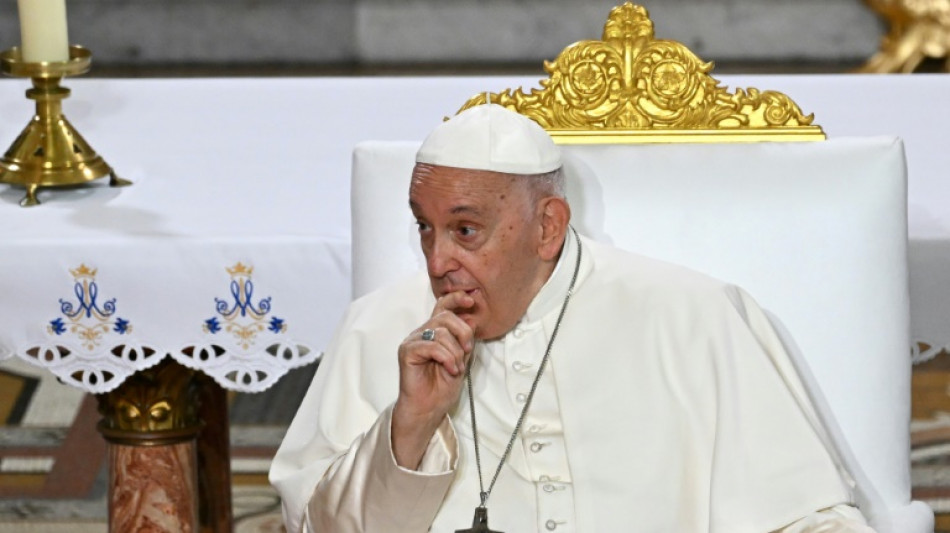
Pope set to draw Marseille crowds after pro-migrant plea / Photo: Andreas SOLARO - AFP
Tens of thousands of people are expected to watch Pope Francis process through the streets and celebrate mass in the French Mediterranean city of Marseille Saturday, where the pontiff has waded into an inflamed European debate about accepting migrants.
The Velodrome stadium in France's second city will be packed with almost 60,000 people, while as many as 100,000 could line the Avenue du Prado for his "popemobile" tour ahead of the mass.
Francky Domingo, a Beninese man who heads a group of undocumented migrants in Marseille, said he hoped the pontiff's visit would "give us back a little hope" and "calm the political tensions".
The Mediterranean port is a "cosmopolitan, multicultural, multireligious" hub but "faces huge difficulties, drug trafficking that costs human lives every day, the problem of housing", Domingo added.
Around 40 people have been killed in shootings in Marseille this year, and President Emmanuel Macron has promised billions of euros to upgrade city infrastructure in a bid to stop the downward spiral.
But not everyone has welcomed the Pope's visit.
Some politicians on the left have criticised Macron's decision to attend Saturday's mass as an infringement of state secularism.
Others on the right have attacked Francis for "interfering" in domestic politics.
The pope made an impassioned appeal on his arrival Friday for Europe to take in migrants rather than succumb to a "fanaticism of indifference" and "paralysis of fear".
The migration debate has been stoked by mass arrivals on the Italian island of Lampedusa last week.
French Interior Minister Gerald Darmanin -- who greeted the pope on his arrival -- has vowed not to take in a single one.
- 'Must be rescued' -
Francis' first stop in Marseille was the city's landmark Notre Dame de la Garde church, where sailors have traditionally prayed for protection, and model ships given in thanks hang from the ceiling.
At a monument overlooking city rooftops and the glinting Mediterranean, the pontiff insisted that "people who are at risk of drowning when abandoned on the waves must be rescued".
In unprepared remarks added at the end of his speech, the pope thanked aid groups rescuing migrants in danger at sea, condemning efforts to prevent their activity as "gestures of hate".
Francois Thomas, president one such group, SOS Mediterranee, was grateful for the papal backing.
"These hindrances to our mission, this criticism is very violent, and to have a message from the pope himself, here in Marseille... in view of the sea, it's very powerful," he told AFP after Francis' speech.
The rescuers have been running missions in the Mediterranean since 2015. But their ship the Ocean Viking has sometimes been held in port by authorities or denied permission to dock after pulling people from the water.
- Religious heritage -
Francis' official business in Marseille is to take part in the closing session of the "Mediterranean Meetings" event bringing together bishops from countries around the sea and young people.
As well as migration, it will cover issues such as economic inequality and climate change -- also themes close to the pope's heart.
His message may have less resonance given Catholicism's long decline in France.
The country's religious heritage nevertheless still has enormous weight, with Macron showing off progress in restoring fire-ravaged Paris cathedral Notre Dame to King Charles III this week.
He has also announced tax breaks for contributions to a fund to renovate church buildings in villages too small to take on the repairs themselves.
burs-tgb/jj/leg
I.Kusters--LCdB