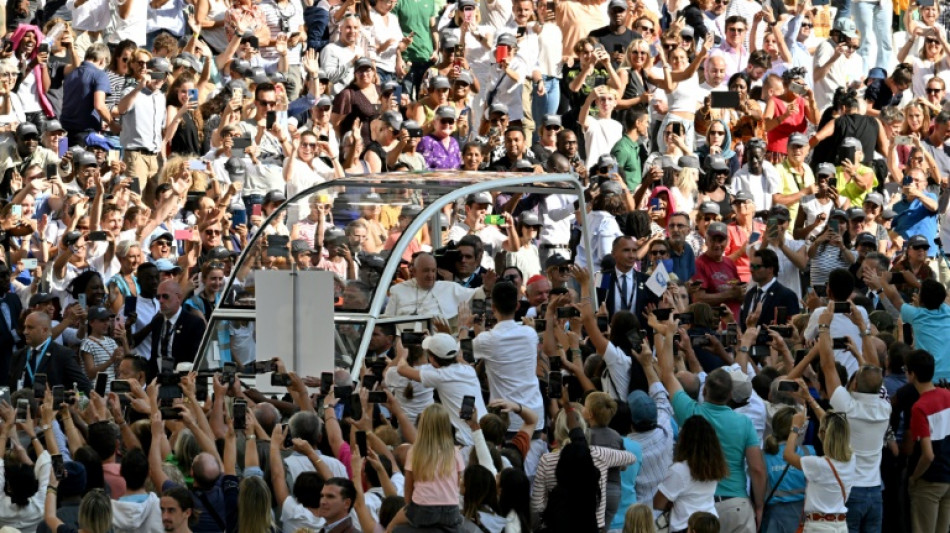
Pope leads stadium mass in France after urging welcome for migrants / Photo: Andreas SOLARO - AFP
Pope Francis on Saturday led tens of thousands of worshippers packed into a stadium for a mass in Marseille after earlier striding into a politically loaded debate in the French Mediterranean city by urging European states not to treat migrants as invaders.
The visit by Francis has been shadowed by the controversy over migrant arrivals in Europe, and his plea to welcome people puts him at odds with most EU governments in countries including Italy and France.
But the centrepiece of the visit was the mass at Marseille's main stadium the Velodrome stadium -- usually the venue for rugby or football matches.
"Bonjour Marseille, bonjour la France!" the pontiff said in French as he opened the mass, which was also attended by President Emmanuel Macron.
Francis entered the stadium aboard his popemobile after being driven at walking pace in the open-top vehicle through the streets of the city to receive the greetings of residents waving Vatican and French flags, AFP correspondents said.
Clutches of black- or white-robed priests and nuns were scattered through the crowds during the service, while volunteers distributed communion wafers.
According to local authorities there were 50,000 people in the stadium while 100,000 had lined the streets during the pope's tour.
Fans of the much-loved Olympique de Marseille football team meanwhile lifted up at the stadium a giant banner of a smiling Francis and the hilltop basilica of Notre-Dame-de-la-Garde, which he visited on Friday.
- 'Graveyard of dignity' -
The pontiff, 86, who looked sprightly despite often using a wheelchair between engagements, meanwhile showed no fear in entering the fraught debate on migrants.
"Those who risk their lives at sea do not invade, they look for welcome," Francis said in a speech earlier Saturday, closing a conference of bishops and young people from around the Mediterranean.
Migration is "a reality of our times, a process that involves three continents around the Mediterranean and that must be governed with wise foresight, including a European response," he added.
Noting the risk to the lives of migrants if they are not taken to safety, he warned against turning "the Mediterranean, the mare nostrum, from the cradle of civilisation into the mare mortuum, the graveyard of dignity".
The pope's forceful interventions ame as the migration debate has been stoked by mass arrivals on the Italian island of Lampedusa earlier this month.
Speaking at a monument to people lost at sea on his arrival in Marseille on Friday, the pontiff insisted that "people who are at risk of drowning when abandoned on the waves must be rescued".
He thanked aid groups rescuing migrants in danger at sea, condemning efforts to prevent their work as "gestures of hate".
His comments did not appear in any way an endorsement of the policy of the French government, which is seeking tighter immigration controls.
A French presidential official, who asked not to be identified by name, said that Macron and the pope had discussed migration in bilateral talks earlier. "France has nothing to be embarrassed about, it's a country of welcome and integration," the official said.
- 'Pushed aside' -
Some politicians on the left have criticised Macron's decision to attend Saturday's mass as an infringement of state secularism.
Others on the right have attacked Francis for interfering in domestic politics.
The pontiff did nothing Saturday to dodge such allegations, appearing to weigh in on two of Macron's projects -- assisted dying and inscribing the right to abortion in the constitution.
Old people risk being "pushed aside, under the false pretences of a supposedly dignified and 'sweet' death that is more 'salty' than the waters of the sea", Francis warned.
He also spoke of "unborn children, rejected in the name of a false right to progress, which is instead a retreat into the selfish needs of the individual".
The French presidential official said that Macron discussed the "methodology" and the "calendar" of a bill on the end of life that the government wants to present to parliament in the next weeks.
Fewer than a third of people still say they are Catholic, and only a small fraction of those regularly attend mass.
The country's religious heritage nevertheless still has enormous weight, with Macron showing off progress in restoring the fire-ravaged Notre-Dame cathedral in central Paris to Britain's King Charles III earlier this week.
burs-tgb-sjw/js
F.Cornelis--LCdB