Azerbaijan seizes arms from Nagorno Karabakh rebels / Photo: EMMANUEL DUNAND - AFP
Azerbaijan forces tightened their grip on the breakaway region of Nagorno-Karabakh on Saturday as international concern mounted over the plight of ethnic Armenian civilians trapped there.
As the first Red Cross aid convoy crossed into the disputed enclave since Azerbaijan launched this week's lightning offensive, government forces said rebel "demilitarisation" had begun.
Moscow announced on Friday that ethnic Armenian separatist fighters had begun to surrender weapons under a Russian-mediated agreement, and on Saturday the Azerbaijan forces were keen to show off a captured rebel arsenal.
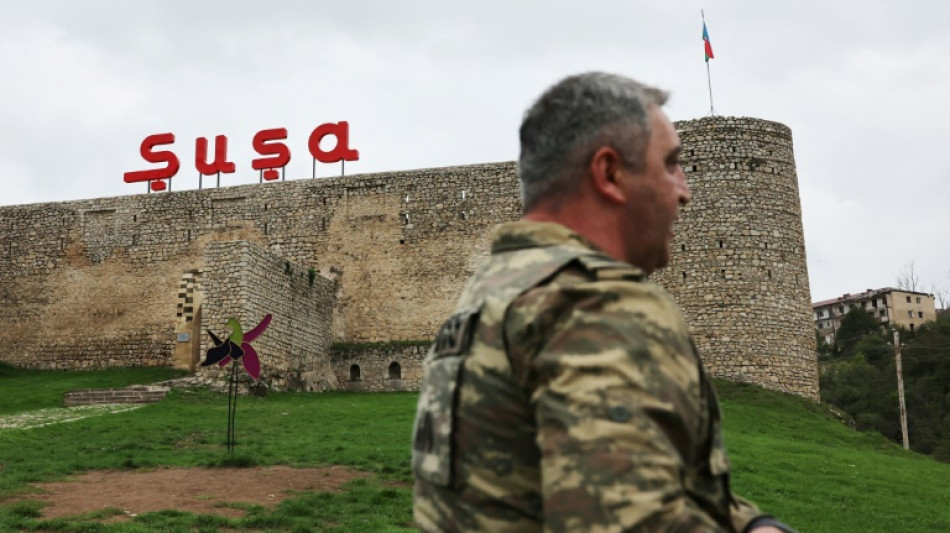
"We are in close cooperation with the Russian peacekeepers who are conducting the demilitarisation" and giving "support to civilians", Azerbaijani military spokesman Colonel Anar Eyvazov said in the Shusha district, outside the regional capital Stepanekert.
Azerbaijani forces now control the area and the town of Shusha appears deserted. Troops have mortar positions on high ground overlooking the approach to Stepanekert, AFP reporters saw.
Government forces displayed an arsenal of infantry weapons, including sniper rifles, hundreds of Kalashnikov rifles, rocket-propelled grenades and four tanks painted with cross insignia, that they said they had seized from the separatists.
"We have more like that in the forest, but we can't bring them all here," said Lieutenant General Mais Barkhudarov, commander of Azerbaijan's 2nd Army Corps.
To the southwest, the so-called Lachin Corridor that once connected the breakaway region to Armenia is also controlled by government forces, which have mounted a de facto blockade for the past nine months.
- Food convoy -
A humanitarian convoy of the International Committee of the Red Cross was nevertheless able to cross into the area on Saturday -- the first since fighting erupted earlier this week.
On the Armenian side of the border, at the Kornidzor checkpoint, local ICRC spokesman Zara Amatuni told AFP that 70 metric tonnes of food and humanitarian aid "have passed through the Lachin Corridor".
If the ceasefire holds it could mark the end of a conflict between Caucasus rivals Armenia and Azerbaijan that has raged, off and on, through the three decades since the collapse of the Soviet Union.
On Friday, Moscow confirmed that the rebels had surrendered their first batch of weapons and the process is expected to continue through the weekend, as international bodies -- including the German government -- expressed concern for civilians.
A US congressional delegation was in Armenia to meet Prime Minister Nikol Pashinyan and travelled up to the closed border to inspect the blockade with the head of Armenia's Syunik region, Robert Ghukasyan, and the American ambassador Kristina Kvien.
Senator Gary Peters of Michigan used binoculars to look across the border towards Russian peacekeeper positions, as Azerbaijani trucks could be seen transporting material for a new highway being built as the government secures the region.
"Certainly people are very fearful of what could be occurring in there, and I think the world needs to know exactly what's happening," Peters told reporters at the border.
"We've heard from the Azerbaijani government that there's nothing to see, nothing to worry about. If that's the case, we should allow international observers in to see for themselves," he argued.
The senator called for the people of Nagorno-Karabakh to be "treated with dignity, respect".
The years of fighting in Nagorno-Karabakh have been marked by abuses on both sides and there are fears of a new refugee crisis. This week's Azerbaijani offensive left tens of thousands of ethnic Armenians cut off from electricity in the disputed enclave.
In the Armenian border town of Kornidzor, civilians have been gathering, some of them waiting for days, at the last checkpoint before Azerbaijani territory hoping for news of relatives.
- Trapped civilians -
"I've been here for three days and nights, sleeping in my car," said 28-year-old Garik Zakaryan, as displaced Armenians borrowed a soldier's telescope to scan a village across the valley.
It was shelled by Azerbaijani forces on Tuesday. No-one was killed, but witnesses who managed to escape report that 150 inhabitants were forced to take refuge close to a Russian peacekeeper base a kilometre from the last Armenian positions.
Zakaryan got his family out in December, three days before Azerbaijan blockaded the area, but he is worried for friends and family still across the border.
"I don't have much hope of seeing them soon, but I couldn't just do nothing. Just being here, being able to see the Russian base, I feel better," he said.
Separatist leaders have said they are in Russian-mediated talks with Baku to organise the withdrawal process and the return of civilians displaced by the fighting.
P.Matthys--LCdB