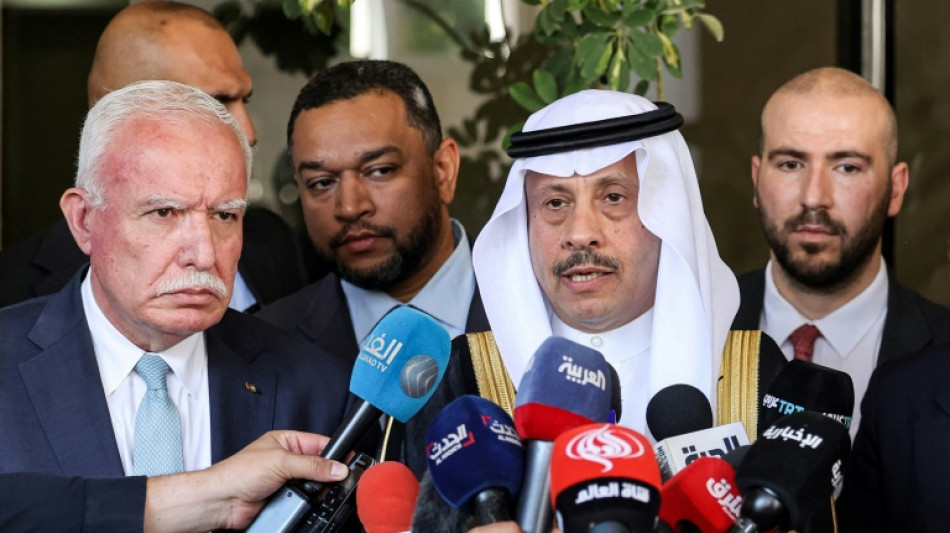
Saudi envoy seeks to reassure Palestinians amid Israel talks / Photo: AHMAD GHARABLI - AFP
Saudi Arabia on Tuesday sent its first delegation in three decades to the occupied West Bank to reassure Palestinians that it will defend their cause even as it forges closer ties with Israel.
In a sign of the thaw, Israel's Tourism Minister Haim Katz visited Riyadh on the same day, for the first such high-level public mission to the oil-rich kingdom.
Washington has urged its Middle East allies Israel and Saudi Arabia to normalise diplomatic relations, following on from similar deals involving the United Arab Emirates, Bahrain and Morocco.
The Palestinians have labelled those US-brokered agreements a betrayal of their plight and quest for statehood -- but Nayef al-Sudairi, who headed the Saudi delegation, sought to reassure them that Riyadh stands by their side.
"The Palestinian matter is a fundamental pillar," Sudairi, the new ambassador to the Palestinians, said after meeting top Palestinian diplomat Riyad al-Maliki in Ramallah for talks and to present his credentials.
"And it's certain that the Arab initiative, which was presented by the kingdom in 2002, is a cornerstone of any upcoming deal."
The 2002 initiative proposed Arab relations with Israel in exchange for its withdrawal from the West Bank, east Jerusalem, Gaza and the Golan Heights, and a just resolution for the Palestinians.
Palestinian leader Mahmud Abbas, 87, last week again stressed strong reservations to Arab countries building ties with Israel.
"Those who think that peace can prevail in the Middle East without the Palestinian people enjoying their full, legitimate national rights would be mistaken," Abbas told the UN General Assembly in New York.
- 'Getting closer' -
Sudairi's delegation, which crossed overland from Jordan, was the first from Saudi Arabia to visit the West Bank since the 1993 Oslo Accords, which had aimed to pave the way for an end to the Israel-Palestinian conflict.
When asked whether there will be a Saudi embassy in Jerusalem, Sudairi recalled that there used to be a one in the Jerusalem district of Sheikh Jarrah, and said that "hopefully there will be an embassy there" again.
Washington has been leading the talks between Israel and Saudi Arabia -- the guardian of Islam's two holiest sites -- on a potential normalisation seen as a political game changer for the Middle East.
The talks have covered security guarantees for Saudi Arabia and assistance with a civilian nuclear programme, according to officials familiar with the negotiations who spoke to AFP on condition of anonymity.
The Saudi crown prince and de facto ruler, Mohammed bin Salman, last week told US network Fox that the kingdom was getting "closer" to a deal with Israel but insisted that the Palestinian cause remains "very important" for Riyadh.
In recent months Israel has already sent delegations to Saudi Arabia to participate in sports and other events, including a UNESCO meeting.
On Tuesday, Katz reached Riyadh leading a delegation to attend a United Nations World Tourism Organisation event, the minister's office said.
"I will act to create cooperation to advance tourism and Israel's foreign relations," Katz said in a statement.
- 'Circle of peace' -
Israeli Prime Minister Benjamin Netanyahu told the United Nations on Friday that he believes "we are at the cusp" of "a historic peace between Israel and Saudi Arabia".
Speaking Tuesday at a ceremony to mark the 1973 Arab-Israeli war, he said "many states in the Middle East want peace with Israel".
"Increasing the circle of peace is a historic opportunity and I'm committed to it."
The 1993 Oslo Accords were meant to lead to an independent Palestinian state, but years of stalled negotiations and deadly violence have left any peaceful resolution a distant dream.
Netanyahu's hard-right government has been expanding Israeli settlements in the West Bank which are deemed illegal under international law.
A recent escalation in violence has seen at least 242 Palestinians and 32 Israelis killed so far this year, according to official sources on both sides.
The United States, which has brokered talks between Israel and the Palestinians in the past, has made no major push toward a two-state solution since a failed effort nearly a decade ago.
It also maintains a blockade on the Palestinian coastal territory of Gaza, which is ruled by militant group Hamas.
he-jjm-rsc-jd/fz
B.Janssens--LCdB