Erdogan says 'terrorists' will never achieve aims after Turkey attack / Photo: Adem ALTAN - AFP
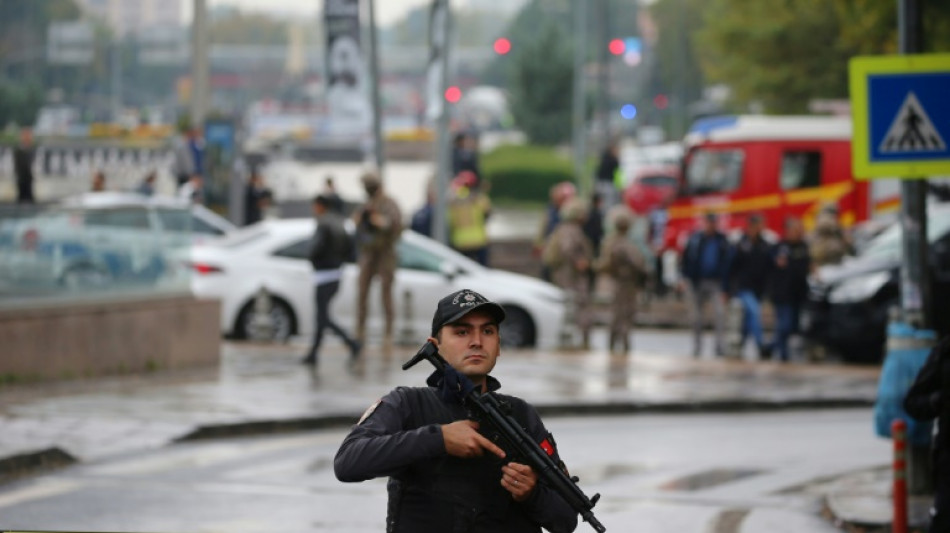
Turkish President Recep Tayyip Erdogan said Sunday that "terrorists" will never achieve their aims, hours after a blast near the parliament in Ankara injured two police officers.
The powerful explosion outside the interior ministry, which was followed by large flames, was heard for several kilometres from the site of the attack.
The targeted district is home to several other ministries and the Turkish parliament, which reopened as planned in the afternoon with an address from President Erdogan.
"The villains who threaten the peace and security of citizens have not achieved their objectives and will never achieve them," Erdogan told the parliament.
The interior ministry said two attackers arrived in a commercial vehicle around 9:30 am (0630 GMT) in front of "the entrance gate of the General Directorate of Security of our Ministry of the Interior, and carried out a bomb attack."
"One of the terrorists blew himself up. The other was killed by a bullet to the head before he had a chance to blow himself up," Interior Minister Ali Yerlikaya said in a press statement outside the ministry.
"Two of our police officers were lightly injured" in the exchange of fire, but their lives were not in danger, he added.
The Ankara police headquarters said on the social media platform X, formerly known as Twitter, that it was carrying out "controlled explosions" of "suspicious packages" to prevent other explosions.
The Ankara prosecutor's office said it was opening an investigation and banned access to the area. Local media was asked to stop broadcasting images from the scene of the attack.
Nobody immediately claimed responsibility for the blast.
- Erdogan slams EU -
Erdogan later opened the parliamentary session by slamming his country's long wait for accession to the EU, stating that Turkey "no longer expects anything from the European Union, which has kept us waiting at its door for 40 years".
"We have kept all the promises we have made to the EU but they have kept almost none of theirs," he said, adding that he would not "tolerate any new demands or conditions" for his country to join the bloc.
This session of Turkey's parliament must also validate Sweden's entry into the NATO alliance.
Hungary and Turkey in July lifted their vetoes against Sweden's entry into the Atlantic alliance, but have been slow to ratify its membership.
Erdogan indicated in July that ratification by the Turkish parliament would not take place before October, but it is expected to be approved during this parliamentary year.
For months, Erdogan has been putting pressure on Sweden to take action against Koran desecrations that have strained relations between the two countries.
Sweden's prime minister Ulf Kristersson was quick to assure in a statement that his country "once again confirms its commitment to long-term cooperation with Turkey in the fight against terrorism".
Numerous foreign leaders also voiced support for Turkey after the attack, with messages of support coming from Germany, the United Kingdom and the US embassy in Ankara.
The Turkish capital has been the scene of several attacks, particularly during the years 2015 and 2016 -- many claimed by the outlawed separatist group the Kurdistan Workers' Party (PKK), or the Islamic State group.
The PKK, which has waged an insurgency against the Turkish state since 1984, is blacklisted as a terror group by Ankara and its Western allies.
In October 2015 an attack in front of a central station in Ankara claimed by the Islamic State group killed 109 people.
The most recent bomb attack in Turkey was in a shopping street in Istanbul in November 2022, where six were killed and 81 were injured.
There was no claim of responsibility, but Turkey accused the outlawed PKK of being behind the attack and said it had detained 46 people including a Syrian woman suspected of planting the device.
A.Louis--LCdB