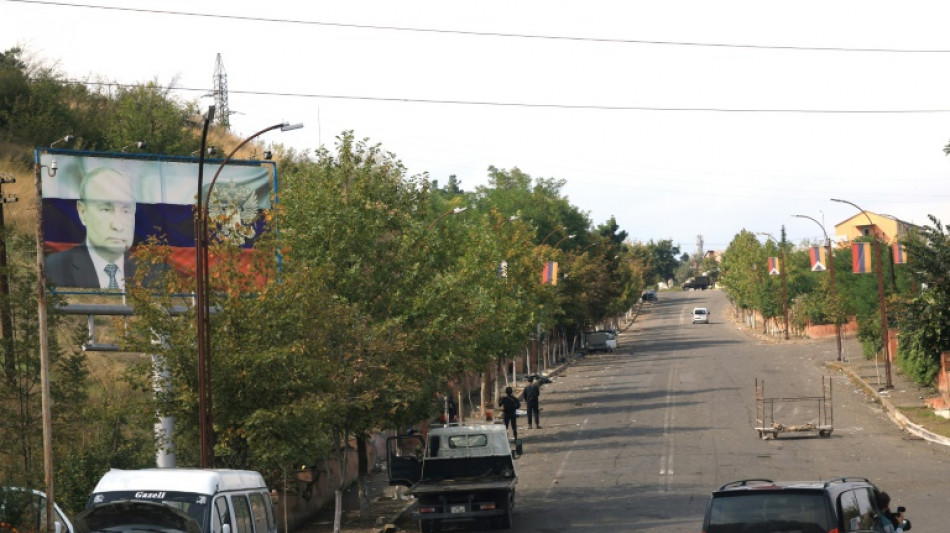
Gunfire around Karabakh persists between Armenian, Azerbaijani forces / Photo: EMMANUEL DUNAND - AFP
Moscow said Russian and Azerbaijani forces on Monday came under sniper fire in Nagorno-Karabakh, days after Baku secured the surrender of Armenian separatists in an offensive to regain control of the mountainous territory.
The report came as Armenia said one serviceman was killed along its shared border with Azerbaijan, underscoring the volatility of the region even after Karabakh's capitulation last week.
"In the city of Stepanakert (Khankendi) a joint Russian-Azerbaijani patrol was shot at by an unknown person using a sniper weapon. There were no casualties," the Russian defence ministry said.
Russia deployed its peacekeepers to the mountainous region in 2020 as part of a ceasefire deal it had brokered between Azerbaijan and Armenia.
But mired in its war in Ukraine, Moscow refused to intervene when Azerbaijan launched a lightning offensive at the end of September.
Separatists capitulated and said 220 were killed in the fighting, while Azerbaijan reported 199 dead.
Another Armenian serviceman was killed when Azerbaijani forces opened fire near the eastern village of Kut on Monday, Armenia's defence ministry said.
It also announced two were wounded. Azerbaijan had rejected the claim.
Days after the lightning offensive, fighting has nevertheless subsided.
- Eerily silent -
Almost all ethnic Armenians -- over 100,000 people -- have fled the breakaway territory over fears of ethnic cleansing.
After nine days of fear and panic, the exodus of Armenians is over with the Lachin corridor that links Karabakh to Armenia mostly deserted.
AFP journalists on a tour organised by Azerbaijani forces in the rebel stronghold of Stepanakert saw an eerily empty city.
Buildings, restaurants, hotels and supermarkets laid deserted in a city that once had 55,000 inhabitants.
Many were smashed up with empty shelves -- signs of looting or hasty departures.
After three decades of Armenian control, the separatist authorities have agreed to disarm, dissolve their government and reintegrate with Azerbaijan.
The separatist government however said some officials would stay to oversee rescue operations.
President Samvel Shahramanyan "will stay in (Karabakh's main city of) Stepanakert with a group of officials until the search and rescue operations for the remainder of those killed and those missing... are completed," the separatist government said.
In addition to the toll from the fighting itself, another 170 people died when a fuel depot exploded during the massive exodus.
Separatist official Artak Beglaryan said "a few hundred" Armenian representatives remained in Karabakh.
He said they included "officials, emergency service, volunteers, some persons with special needs."
- Separatists in jail -
Yerevan has accused Azerbaijan of conducting a campaign of "ethnic cleansing" to clear Karabakh of its Armenian population.
Baku has denied the claim and called on Armenian residents of the territory to stay and "re-integrate" into Azerbaijan, saying their rights would be guaranteed.
AFP journalists on Monday saw a convoy carrying water and communications workers that was allowed to enter Stepanakert.
The convoy was escorted by the Azerbaijani army.
They also saw a bus carrying officials who planned to open a "re-integration" office in the city for any ethnic Armenians wishing to register with Azerbaijani authorities.
Several senior representatives of its former government and military command have been detained, including Ruben Vardanyan -- a reported billionaire who headed the Nagorno-Karabakh government between November 2022 and February.
His four children released a statement on social media demanding his release "from the illegal imprisonment on the territory of Azerbaijan", saying they "feared for his life and health".
Azerbaijan's Prosecutor General Kamran Aliyev said criminal investigations had been initiated into war crimes committed by 300 separatist officials.
"I urge those persons to surrender voluntarily," he told journalists on Sunday.
K.Cox--LCdB