What are Azerbaijan's plans for Nagorno-Karabakh? / Photo: Emmanuel Dunand - AFP
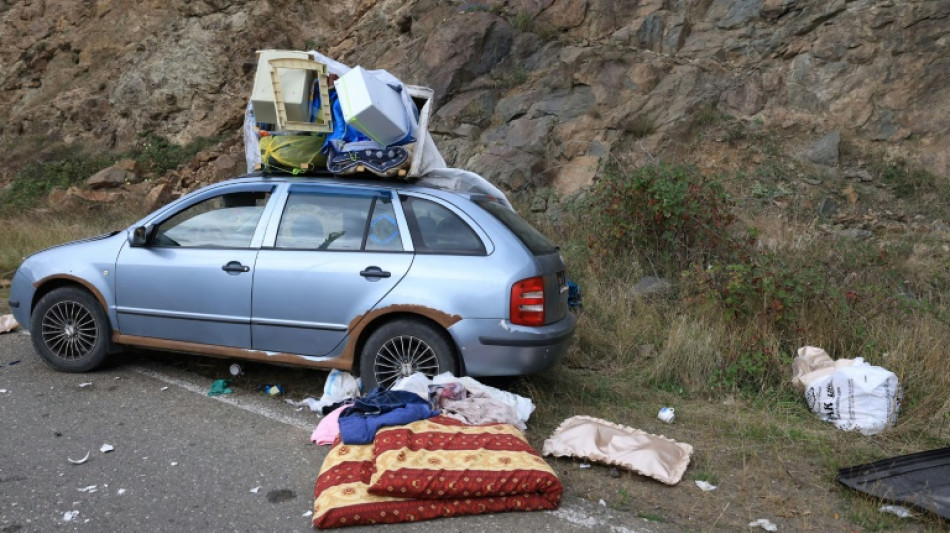
Nagorno-Karabakh now stands practically empty after almost all ethnic Armenians fled the self-proclaimed republic following Azerbaijan's lightning military offensive in late September.
After three decades of struggle, Karabakh separatists agreed to disarm, dissolve their government and reintegrate with Baku, which is now preparing to retake control of the breakaway territory.
- Reintegration -
Nearly all of Karabakh's estimated 120,000 residents have now left, with Yerevan accusing Azerbaijan of conducting a campaign of "ethnic cleansing" to clear the territory.
But Baku has denied the claim and called on Armenian residents of the territory to stay and "reintegrate" into Azerbaijan, saying their rights would be upheld.
"The equality of rights and freedoms, including security, is guaranteed to everyone regardless of their ethnic, religious or linguistic affiliation," Azerbaijan's presidency said in a statement.
But Karabakh now stands empty and virtually no Armenians live or have returned to areas which were taken back by Azerbaijan after fighting in 2020.
Baku has also spoken of "a great return" of the 750,000 Azerbaijanis who fled Karabakh, Armenia and the surrounding territories after the first conflict in the 1980s and 90s.
- Disarming after 30 years -
While the bulk of fighting has ceased in Nagorno-Karabakh, scattered incidents have still taken place.
Moscow said Russian and Azerbaijani forces on Monday came under sniper fire, while Armenia reported one serviceman killed along the shared border with Azerbaijan.
Baku claims "the process of disarmament and disbandment is completed" in the territory.
"There are no (longer) any illegal Armenian armed forces in combat outposts. Similarly, many bases, military bases, have already been liberated," Azerbaijani army spokesman Colonel Anar Eyvazov told AFP.
An arsenal of over 2,000 rifles and 22 armoured vehicles has been seized, according to a provisional count.
But the main concern is the presence of mines in the area, with demining just starting.
In the absence of precise mapping, estimates on the scale of the issue vary widely.
Azerbaijan has reported millions of mines, while other sources suggest at least 100,000.
The future of Russia's 2,000-strong peacekeeping mission in Nagorno-Karabakh is also yet to be determined.
The Kremlin has said the future of the mission, which was deployed to the mountainous region as part of a brokered ceasefire deal in 2020, would be determined by Russia and Azerbaijan.
- Economic integration -
The hundreds of thousands of Armenians who fled Karabakh have left behind homes, livestock and livelihoods.
Baku has said that property matters would be "regulated in accordance with the laws of the Republic of Azerbaijan," without giving further detail.
It also said physical and social infrastructure in Karabakh would be brought into line with the average level across Azerbaijan, ensuring the full circulation of the national currency.
And the territory would be connected to national services, with water, electricity and telecommunications among the first to be installed.
H.Vermeulen--LCdB