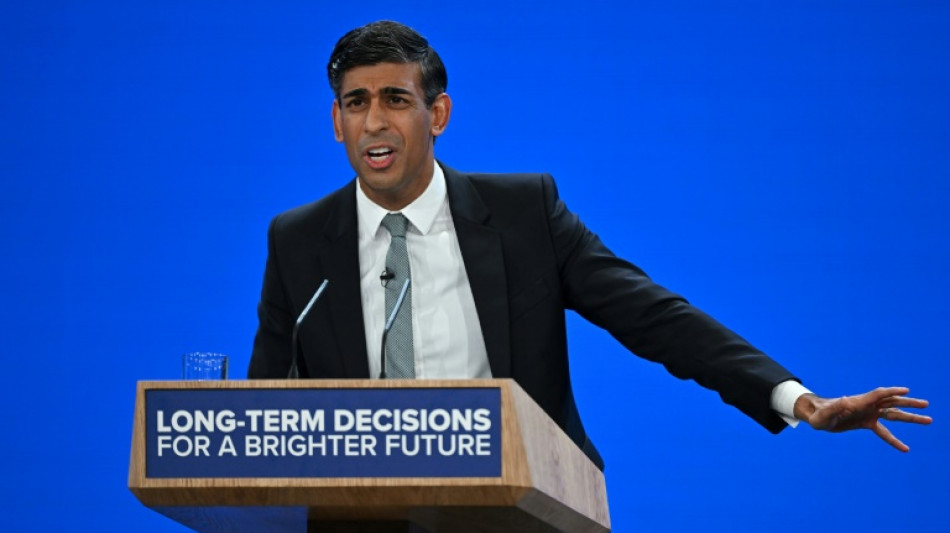
PM Sunak kickstarts UK election campaign with promise of 'change' / Photo: JUSTIN TALLIS - AFP
Prime Minister Rishi Sunak on Wednesday rallied his ruling Conservatives for the next general election, positioning them as a force for change, even after 13 years in power and increasing disaffection among voters.
In a speech lasting more than an hour to the party's annual conference, he promised that the Tories -- on course for defeat at the next vote, according to opinion polls -- would break the mould of the last 30 years of government.
"We will be bold, we will be radical. We will face resistance and we will meet it," he told delegates.
"We will give the country what it sorely needs and yet too often has been denied."
He added: "It's time for change and we are it."
Sunak's speech -- peppered with major policy announcements including the widely expected scrapping of part of a high-speed rail project -- effectively fires the starting gun on the election campaign.
The conference, which began on Sunday, has seen the Conservatives try to put clear water between themselves and the main opposition Labour party. That has included stoking "culture war" issues such as the environment and trans rights.
But the latest opinion polls indicate that the Tories have a mountain to climb if they are to secure a sixth term of office.
A new Savanta poll published before Sunak took to the stage put Labour out in front by 20 percentage points, with Sunak trailing Labour's Keir Starmer in the personal popularity stakes by 12 points.
Sunak, a former finance minister who was only voted in as Tory leader last October by party members, has to call an election by January 2025 at the latest.
Speculation is rife about when he might seek to confirm his party's mandate with the wider electorate, as he tries to bring down sky-high inflation that has caused a cost-of-living crisis and industrial unrest.
- Major rail project cancelled -
As expected, Sunak confirmed rumours that he would scrap the second leg of the HS2 rail project between Birmingham in central England and Manchester.
"I'm cancelling the rest of the HS2 project and in its place we will reinvest every single penny, £36 billion ($43.6 billion), in hundreds of new transport projects in the north, in the Midlands, across the country," he said.
Manchester had been due to be a terminus for the massive infrastructure project, which has been plagued by huge cost and delivery overruns.
The decision has angered local politicians in the north of England, many areas of which switched from Labour to the Conservatives at the last election in 2019 on a promise that long-standing regional economic inequalities would be addressed.
Sunak said he was prepared for brickbats, insisting: "The facts have changed and the right thing to do when the facts change is having the courage to change direction."
Elsewhere in the largely domestic focused speech, Sunak proposed a tougher crackdown on smoking, with a New Zealand-style model of raising the minimum age on the sale of cigarettes by one year every year.
There was also a pledge to overhaul 16-19 education with a new Baccalaureate-style qualification in England combining academic and technical courses, increasing teaching time and subjects taught, including compulsory maths and English.
- Out of time? -
Sunak was unexpectedly introduced on stage by his wife, Akshata Murty, who praised his qualities, making his speech -- his first as prime minister -- more like a wider leadership pitch to the public.
Convincing voters to stick with the Tories is an ominous task, given voter apathy with a party in power since 2010 and damaging periods of turmoil under his predecessors Liz Truss and Boris Johnson.
Sunak's speech appeared well received among the party faithful, with rapturous applause and a sustained standing ovation from members.
But experts said it was outside the hall that counted.
"The reality is that they've (the Conservatives) have run out of room," Richard Carr, an associate professor in public policy and strategy at Anglia Ruskin University, told AFP.
"Their agenda of talking about long-term decisions whilst engaging in easy choices that seem purely designed to appease the party base is barely coherent," added Carr, who edited a volume on the modern Conservative party.
"Faced by a Labour opposition which has got its act together, the most likely outcome is a significant election defeat."
D.Moerman--LCdB