EU to host Armenia-Azerbaijan talks this month / Photo: EMMANUEL DUNAND - AFP
The European Union will host talks between the leaders of Armenia and Azerbaijan this month to try to reduce tensions between the arch-foes following Baku's lightning offensive in Nagorno-Karabakh, EU chief Charles Michel told AFP on Thursday.
"The goal is to have this meeting by the end of October and we will fix the date together, with (Armenian) Prime Minister (Nikol) Pashinyan and (Azerbaijani) President (Ilham) Aliyev," Michel said on the sidelines of a summit of the 47-nation European Political Community in Spain.
Two weeks ago, Azerbaijan took control of the breakaway Nagorno-Karabakh region for the first time in three decades after a one-day offensive.
The operation sparked a mass exodus of ethnic Armenians, the vast majority of the estimated 120,000 who had been living in the territory fleeing into Armenia.
European leaders, who have taken a growing role in the Caucasus, had hoped to host Aliyev's first meeting with Pashinyan since the Karabakh offensive in Spain.
But the Azerbaijan leader turned down the talks, Baku citing France's "militarisation policy" in the Caucasus, the European Union's attitude towards the region, and the absence of Turkey -- a traditional ally of Baku.
On Thursday however, presidential aide Hikmet Hajiyev said on social media that "Azerbaijan stands ready for tripartite meetings in Brussels soon in the format of the European Union, Azerbaijan and Armenia".
He said Baku "supports the tripartite Brussels process and the regional peace agenda in the format of the European Union, Azerbaijan and Armenia" as well as bilateral "peace treaty talks" with Yerevan.
Russia, the traditional power in the region, has been bogged down in its assault in Ukraine and Europe has increasingly started mediating the decades-old dispute between Armenia and Azerbaijan.
Moscow refused to intervene when Azerbaijan launched its offensive in late September.
- 'Ineffective' -
France has pledged military support to Yerevan in the wake of Azerbaijan's offensive, but has not elaborated on what this entails.
On Thursday, French President Emmanuel Macron said that European leaders should continue to discuss the crisis with Azerbaijan in order to "best protect" Armenia, rather than resorting to sanctions against Baku.
On the ground, Armenia and Azerbaijan accused each other of opening cross-border fire Thursday.
Armenia was relying on Russia as its security guarantor but Pashinyan has increasingly questioned Russia's historic role as his small country's main security guarantor.
He has been critical of Moscow's refusal to intervene during Azerbaijan's offensive and has described the security alliance with Russia as "ineffective".
Moscow has said that Armenia has no alternative to a Russia-led security alliance known as the Collective Security Treaty Organisation (CSTO).
Russian President Vladimir Putin said Thursday that Azerbaijan's takeover of the region was "inevitable", adding: "It was only a matter of time before Azerbaijan started to restore constitutional order there."
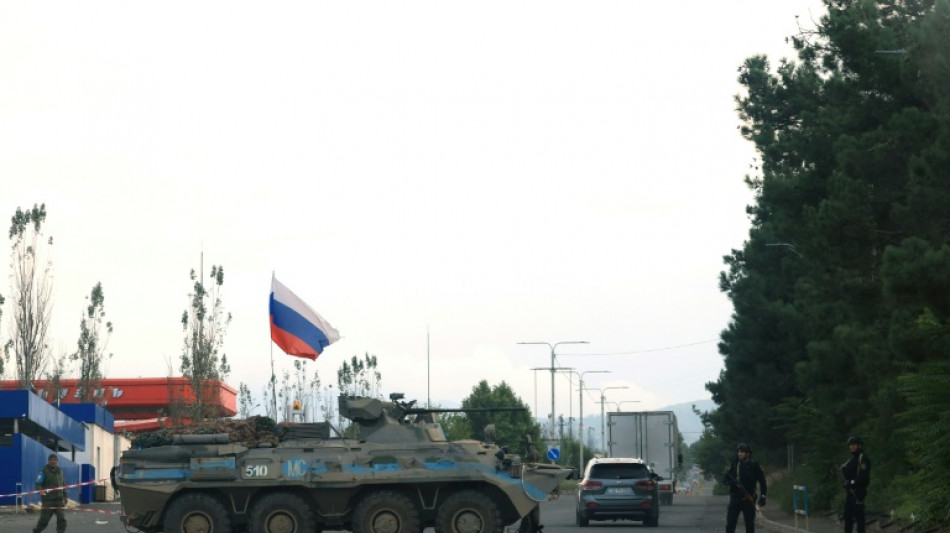
Russian peacekeepers on Thursday finished dismantling frontline observation posts in the region, Russia's defence ministry said in a statement.
- Pashinyan meets Zelensky -
But Pashinyan -- who has faced criticism at home over the crisis -- travelled to Granada to meet with European leaders.
The meeting between Pashinyan and Zelensky came two days after the Armenian parliament moved to join the International Criminal Court, which has issued an arrest warrant against Russian President Vladimir Putin.
The move angered Moscow, Kremlin spokesman Dmitry Peskov calling it the "wrong decision".
Armenia and Azerbaijan have fought two wars over Nagorno-Karabakh since the late 1980s.
It unilaterally proclaimed its independence with the support of Armenia when the Soviet Union collapsed in 1991.
Karabakh separatists resisted Baku with the support of Yerevan for three decades, notably during the first Karabakh war from 1988 to 1994 and the second in 2020.
burs-yad/jj
C.Maes--LCdB