Israel army says defeated Hamas fighters in towns near Gaza / Photo: MAHMUD HAMS - AFP
Israel's army declared Monday it had regained control of southern areas near the Gaza Strip on the third day of gruelling gun battles to dislodge holdout Hamas fighters whose surprise attack the shocked nation has likened to 9/11.
"We are in control of the communities," said military spokesman Daniel Hagari, cautioning that individual Palestinian "terrorists" may remain in the region where Israel was massing tens of thousands of troops and heavy armour.
Stunned by the unprecedented assault on its territory, a grieving Israel has counted over 700 dead and launched a withering barrage of strikes on Gaza that have raised the death toll there to 493 according to Palestinian officials.
Defence Minister Yoav Gallant said Israel would impose a "complete siege" on the long blockaded enclave, spelling out the impact on its 2.3 million people: "No electricity, no food, no water, no gas -- it's all closed."
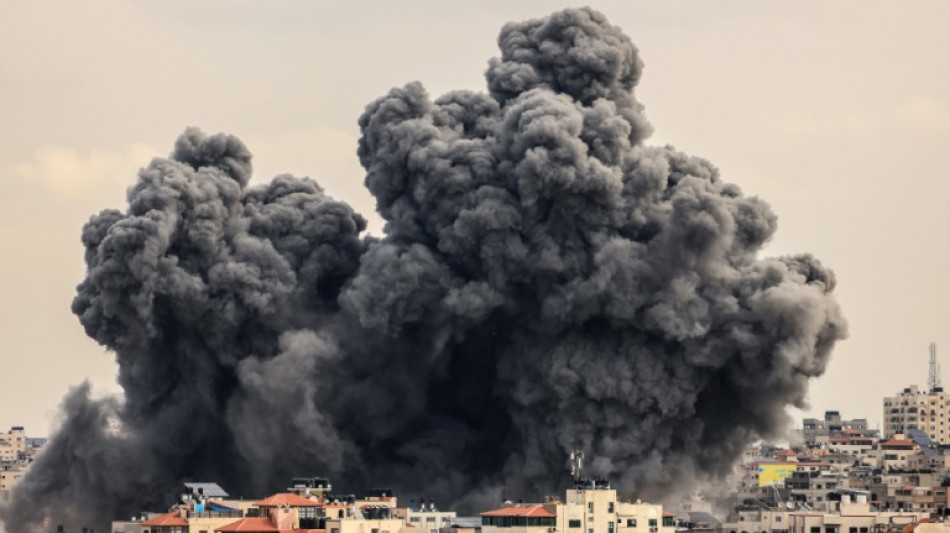
The skies over Gaza were blackened by plumes of smoke and fighter jets roared above, even as Hamas kept firing rockets as far as Jerusalem, where air raid sirens blared and detonations were heard.
Palestinians in the impoverished and crowded coastal territory braced for what many feared will be an Israeli ground attack aiming to defeat Hamas and liberate at least 100 hostages.
Middle East tensions have spiked as Israel's arch enemy Iran and its Lebanese ally Hezbollah have praised the Hamas attack, although Tehran on Monday rejected any role in the military operation.
Hamas has called on "resistance fighters" in the occupied West Bank and in Arab and Islamic nations to join its "Operation Al-Aqsa Flood", launched half a century after the 1973 Arab-Israel war.
The United States has pledged "rock solid" support for Israel and said it would send munitions and military hardware to its key ally and divert an aircraft carrier group to the eastern Mediterranean.
- Alarm and revulsion -
Israel, which has long prided itself on its high-tech military and intelligence edge in its many conflicts, has been shaken to the core by Hamas's unprecedented ground, air and sea attack on the Jewish Sabbath.
It now faces the threat of a multi-front war after Hezbollah launched guided missiles and artillery shells from the north Sunday "in solidarity" with Hamas, in what some observers considered a warning shot.
Israel has voiced alarm and revulsion after more than 1,000 militants broke through the border fence Israel had deemed impregnable and swarmed out into nearby Jewish communities.
Among the hostages taken back into Gaza were children and a Holocaust survivor in a wheelchair, Israeli officials have said.
Up to 250 bodies were strewn across the site of a music festival in a Negev desert kibbutz, mostly young people, while other revellers were feared to be among the hostages abducted into Gaza.
"They butchered people in cold blood in an inconceivable way," said Moti Bukjin, a spokesman for the Zaka volunteer group which helped to collect the bodies.
Israelis have voiced anger at the intelligence failure that blindsided the nation, but have attempted to put aside for now deep political divisions of recent years as they braced for what Netanyahu has warned would be a "long and difficult war".
- 'Worst in Israeli history' -
"Never before have so many Israelis been killed by one single thing, let alone enemy activity in one day," said army spokesman Lieutenant Colonel Jonathan Conricus.
The multi-pronged attack had brought "by far the worst day in Israeli history", he said, likening it to a combination of the "9/11 and Pearl Harbour" attacks.
Retaliatory air and drone strikes continued on Gaza early Monday, AFP correspondents reported.
"Overnight IDF fighter jets, helicopters, aircraft and artillery struck over 500 Hamas and Islamic Jihad terrorist targets in the Gaza Strip," said a statement by the Israeli Defense Forces.
The situation was dire inside Gaza, which has been blockaded by Israel since Hamas assumed control there 15 years ago, a period that has seen multiple wars with Israel.
Air strikes have levelled residential tower blocks, mosques and the central bank. More than 120,000 people in Gaza have been displaced, said the United Nations.
"The situation is unbearable psychologically and economically," said Amal al-Sarsawi, 37, as she took shelter in a school classroom with her terrified children.
- Global shock waves -
Many Gaza residents have voiced defiance. "We will not give up, and we are here to stay," said Mohammed Saq Allah, 23. "This is our land, and we will not abandon our land."
Palestinians in the occupied West Bank have rallied in support and clashed with Israeli security forces in violence that has killed 15 Palestinians since Saturday.
Pro-Palestinian groups have also demonstrated in Iraq, Pakistan, the United States and other countries, while Germany and France were among nations stepping up security around Jewish temples and schools.
The spiralling conflict has sent shock waves around the world amid fears of a wider escalation, sparking a morning surge in oil prices.
Western capitals have condemned the attack by Hamas, which the United States and European Union consider a terrorist group.
Foreign or dual nationals have been reported killed, abducted or missing in the war by countries including Brazil, Britain, Canada, France, Germany, Ireland, Mexico, Nepal, Thailand, Ukraine and the United States.
In the Egyptian city of Alexandria a police officer opened fire "at random" on Israeli tourists Sunday, killing two of them and their Egyptian guide before he was arrested.
Israel, which has struck a series of US-brokered normalisation deals with several Arab nations in recent years, has issued a travel warning for its citizens, especially in the Middle East.
burs-jmm-jd/fz/
Y.Simons--LCdB