Israel says 1,500 Hamas militants dead after battles near Gaza / Photo: MOHAMMED ABED - AFP
Israel pounded Hamas targets in Gaza Tuesday and said the bodies of 1,500 Islamist militants were found in southern towns recaptured by the army in gruelling battles near the Palestinian enclave.
Prime Minister Benjamin Netanyahu has warned Israel's military campaign following Saturday's surprise mass onslaught was only the start of a sustained war to destroy Hamas and "change the Middle East".
Fears of a regional conflagration have surged amid expectations of an Israeli ground incursion into the crowded Palestinian Gaza Strip from where Hamas launched its land, air and sea attack on the Jewish Sabbath.
The death toll in Israel has surged above 900 from the worst attack in the country's 75-year history, while Gaza officials have reported 687 people killed so far.
Netanyahu compared the large-scale slaughter of Israeli civilians to the atrocities committed by the Islamic State group, also known as ISIS, when they controlled vast swathes of Syria and Iraq.
"Hamas terrorists bound, burned and executed children," a seething Netanyahu said in a televised address to the grieving nation late Monday. "They are savages. Hamas is ISIS."
The veteran leader at the helm of Israel's hard-right coalition also called for an "emergency government of national unity" after years of political crisis and bitter societal divisions.
The Israeli army has called up 300,000 reservists for its "Swords of Iron" campaign and massed tanks and other heavy armour both near Gaza, and on the northern border with Lebanon.
"Around 1,500 bodies of Hamas (fighters) have been found in Israel around the Gaza Strip," said army spokesman Richard Hecht.
- Threat to kill hostages -
Key ally the United States -- which reported 11 of its own citizens killed, and more missing in the spiralling conflict -- stressed its full support for Israel, as did Britain, France, Germany and Italy.
The five Western powers and many other nations have reported citizens killed, abducted or missing, also including Brazil, Cambodia, Canada, Ireland, Mexico, Nepal, Panama, Paraguay, Russia, Thailand and Ukraine.
Hamas has held around 150 hostages since its ground incursion, among them children, elderly and young people who were captured at a music festival where some 270 died.
On Monday, Hamas warned it would start killing hostages every time Israel launches a strike on a civilian target in Gaza without warning.
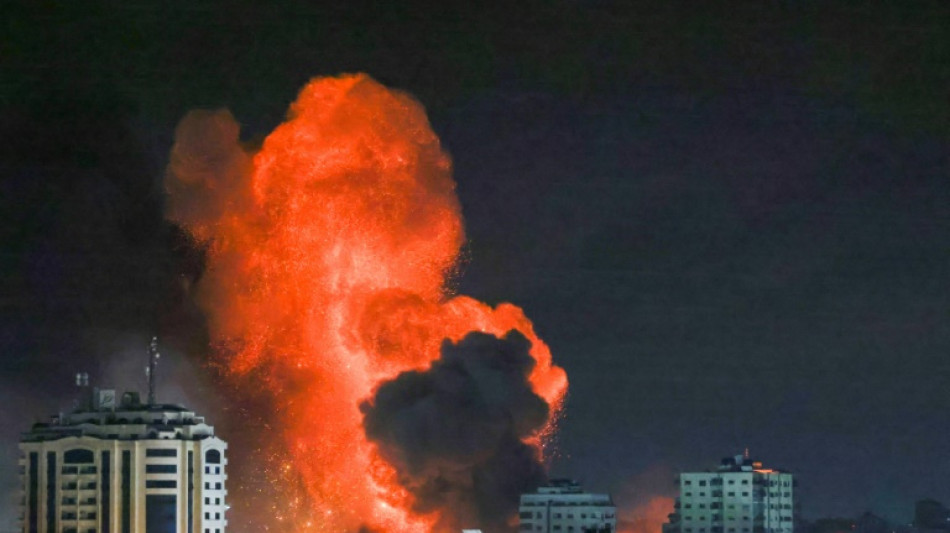
Fireballs repeatedly lit up Gaza City before dawn on Tuesday as explosions shook the ground and sirens wailed.
Israel imposed a total siege on long-blockaded Gaza on Monday, cutting off the water supply, food, electricity and other essential supplies.
United Nations chief Antonio Guterres said he was "deeply distressed" by the siege announcement and warned Gaza's already dire humanitarian situation will now "only deteriorate exponentially".
The UN human rights chief Volker Turk said Tuesday that imposing "sieges that endanger the lives of civilians by depriving them of goods essential for their survival is prohibited under international humanitarian law".
Israeli strikes have levelled residential tower blocks and mosques and wrought widespread destruction in Gaza's Jabalia refugee camp, where on Monday many charred bodies were pulled from the rubble.
Three Palestinian journalists were killed early Tuesday in an Israeli air strike that hit a Gaza City residential building, a media union and an Hamas official said.
- 'ISIS-level savagery' -
The small country, which has long prided itself on a high-tech military and intelligence edge, has been shaken to the core after being blindsided by the massive attack.
Washington has pledged to send munitions and military equipment to back Israel and deployed an aircraft carrier group to the eastern Mediterranean.
The White House said there was no intention to put US boots on the ground, while also condemning the "ISIS-level savagery" of the Hamas attack.
Israel faced the threat of a multi-front war after two days of clashes on the northern border with Lebanon with militants from the Iran-backed Hezbollah movements.
Unrest has also surged in the occupied West Bank, where 15 Palestinians have died since Saturday.
Iran -- which is openly committed to Israel's destruction -- has praised the surprise attack by Hamas but repeatedly denied playing any role in it.
Hamas has called on "resistance fighters" in the West Bank and in Arab and Islamic nations to join what it has dubbed "Operation Al-Aqsa Flood".
A senior US defence official said "we are deeply concerned about Hezbollah making the wrong decision and choosing to open a second front to this conflict".
Global powers and regional governments including Egypt, Turkey and Gulf states, have engaged in frantic diplomacy seeking to prevent any further escalation.
Saudi Arabia's de facto ruler Crown Prince Mohammed bin Salman told Palestinian president Mahmud Abbas that the kingdom was working to ensure the conflict does not spread across the region, state media said Tuesday.
Turkey's President Recep Tayyip Erdogan warned Israel against "indiscriminately" attacking civilians and also delivered measured criticism of Hamas, urging both sides to respect the "ethics" of war.
burs-jd/fz/jkb
C.Adam--LCdB