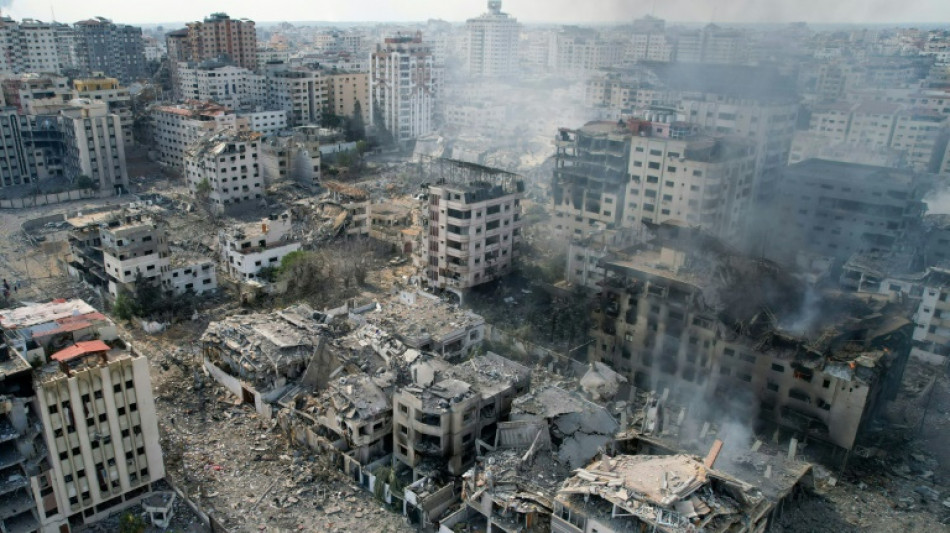
Israel pounds Gaza targets as PM condemns Hamas 'savagery' / Photo: BELAL AL SABBAGH - AFP
Israel kept pounding Hamas targets in Gaza, where entire districts lay in rubble Wednesday, as its forces found more victims five days after the Islamist militants' onslaught on its southern towns.
The army said a "staggering 1,200" bodies had been discovered, mostly of unarmed civilians, while Gaza officials reported more than 900 people killed in a withering campaign of air and artillery strikes on the crowded Palestinian enclave.
Israel has massed forces, tanks and other heavy armour around Gaza in its retaliatory campaign against what Prime Minister Benjamin Netanyahu labelled "an attack whose savagery ... we have not seen since the Holocaust".
US President Joe Biden has pledged to send more munitions and military hardware to its close ally Israel and expressed revulsion at the "sheer evil" of the slaughter of civilians in the unprecedented Hamas assault launched Saturday.
Fears have mounted of a worsening humanitarian crisis in war-torn Gaza, where Israel had levelled over 1,000 buildings and imposed a total siege, cutting off water, food and power for 2.3 million people.
More than 260,000 Gaza residents have been forced from their homes, the United Nations said, while the European Union called for a "humanitarian corridor" to allow civilians to flee during the enclave's fifth war in 15 years.
Israel appeared to be readying for a possible ground invasion of Gaza, but faces the threat of a multi-front war after also coming under rockets attack from militant groups in neighbouring Lebanon and Syria.
Israel again struck targets Wednesday in southern Lebanon, an area controlled by Hezbollah, an ally of Israel's arch enemy Iran.
Biden, who has diverted an aircraft carrier battle group to the eastern Mediterranean, issued a stern warning to Israel's foes: "To any country, any organisation, anyone thinking of taking advantage of this situation, I have one word: don't."
- 'Staggering' death toll -
Israel has been badly shaken by the deadliest attack in its 75-year history and the intelligence failure that allowed more than 1,500 militants to storm through the Gaza security barrier in their coordinated land, air and sea attack on the Jewish Sabbath.
Hamas gunmen swept into small towns and kibbutzim and killed indiscriminately, including the very young, the very old and entire families who tried to hide in their homes, say traumatised survivors.
"We are discovering bodies of dead Israelis in the various communities that Hamas infiltrated and where they conducted their massacres," said army spokesman Jonathan Conricus.
"The death toll is a staggering 1,200 dead Israelis ... the overwhelming majority of them" civilians, he said, with the army later also reporting 169 fallen soldiers so far.
Fears have been intense in Israel for the fate of at least 150 hostages -- mostly Israelis but also including foreign and dual nationals -- being held in Gaza by Hamas, the Islamist movement that runs the territory.
Hamas has claimed four of the captives died in Israeli strikes and has threatened to kill hostages if Gaza civilian targets are bombed without advance warning.
- 'In a ghost town' -
The Israeli army has called up 300,000 reservists for what Netanyahu has said will be a "long and difficult" war.
Heavy fighting raged again Wednesday in Gaza, where the sky was blackened after the air force launched hundreds more strikes and Hamas said at least 30 people were killed.
Rubble, burnt out cars and broken glass covered roads in Gaza City, where bombs struck the Hamas-linked Islamic University.
Also targeted were residential buildings, mosques, factories and shops, said Salama Marouf of the Gaza government's media office.
One Gaza resident, Mazen Mohammad, said his terrified family had spent the night huddled together on the ground floor as explosions shook the area, before emerging in the morning to assess the total devastation of their neighbourhood.
"We felt like we were in a ghost town, as if we were the only survivors," Mohammad, 38, told AFP.
The Israeli army said fighter jets also destroyed a Hamas anti-aircraft detection system and 80 Hamas targets in the northern Beit Hanoun area, including two banks used to "fund terrorism".
Medical supplies, including oxygen, were running low at Gaza's overwhelmed Al-Shifa hospital, said emergency room physician Mohammed Ghonim.
- Fear and distrust -
Unrest has flared in the occupied West Bank, where 15 Palestinians have been killed since Saturday and protest have been held in solidarity with Gaza.
"My entire life, I have seen Israel kill us, confiscate our lands and arrest our children," said Ramallah coffee vendor Farah al-Saadi, 52, who praised the Hamas assault.
Israeli cities have been eerily quiet and tense, with some residents noting a growing sense of fear and distrust between Jews and members of the Arab-Israeli minority.
"Israeli people are scared of the Arabs and the Arabs are scared of the Jews... everybody is scared of each other," said Ahmed Karkash, a shopkeeper in the Old City of Jerusalem.
Israeli border police shot dead two Palestinians in annexed east Jerusalem after they threw fireworks and rocks at fellow officers, the force said on Wednesday.
Frantic diplomacy has continued as international and regional powers sought to prevent a wider conflagration in the Middle East.
US Secretary of State Antony Blinken was expected in Israel on Thursday to discuss support in the war in which 14 Americans were killed and several captured as hostages.
Many other nations have reported citizens killed, abducted or missing, including Brazil, Cambodia, Canada, Ireland, Mexico, Nepal, Panama, Paraguay, Russia, Sri Lanka, Thailand and Ukraine.
burs-jd/fz
B.Janssens--LCdB