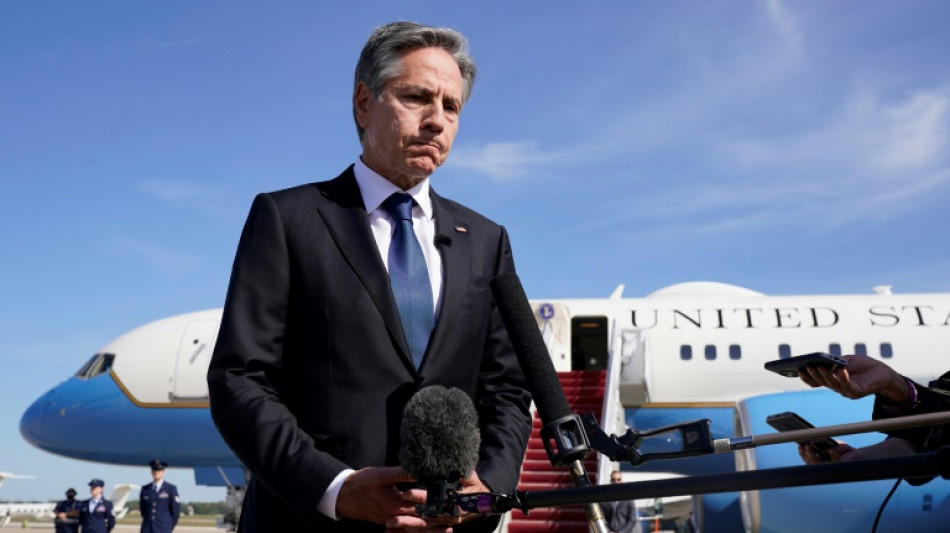
Blinken visits Israel to stress US support for war on Hamas / Photo: Jacquelyn Martin - POOL/AFP
Israel and Hamas traded more heavy fire Thursday in the Gaza war that has killed thousands as US Secretary of State Antony Blinken visited to stress strong solidarity but also urge restraint to protect Palestinian civilians.
Israel's army has hammered Hamas with thousands of strikes ahead of what is widely expected to be a ground invasion of the crowded territory, after Hamas gunmen killed 1,200 Israelis, mostly civilians, and took about 150 hostages.
"Every Hamas member is a dead man," Prime Minister Benjamin Netanyahu told the traumatised nation after forming a wartime government Wednesday, likening Hamas to the Islamic State group and vowing to "crush them and destroy them".
US President Joe Biden -- who has strongly backed Israel and started sending military aid -- also cautioned on Wednesday that Israel must, despite "all the anger and frustration ... operate by the rules of war".
Fears have grown for Gaza's 2.4 million residents now enduring the fifth war in 15 years in the long-blockaded territory, which has also seen seen Israel cut off water, food and power supplies.
UN Secretary General Antonio Guterres voiced concern about the "supercharged cycle of violence and horror". He urged the release of all hostages and the lifting of the siege and stressed that "civilians must be protected at all times".
There have been calls for the establishment of a humanitarian corridor to allow Palestinians to escape ahead of a possible Israeli ground invasion that would spell brutal urban combat and house to house fighting.
Israeli Energy Minister Israel Katz vowed Thursday the total siege of Gaza would continue until the hostages are freed.
"Humanitarian aid to Gaza?" he wrote in a statement. "No electric switch will be turned on, no water tap will be opened and no fuel truck will enter until the Israeli abductees are returned home."
- 'All I do is cry' -
Israel has called up 300,000 reservists and rushed forces, tanks and heavy armour to the southern desert areas around Gaza from where Hamas launched their unprecedented attack on October 7.
Israeli soldiers have since then cleared the southern towns and kibbutz communities and killed 1,500 of the militants, while making ever more shocking discoveries of large numbers of dead civilians, including children.
"I would never have been able to imagine .. something like this," Doron Spielman, an Israeli army spokesman, said at one gated community where more than 100 residents were killed.
"It looks like... an atomic bomb just landed here."
Netanyahu has said the Hamas onslaught was of a level of "savagery... we have not seen since the Holocaust".
Israeli outrage has been fuelled by Hamas's capture of at least 150 hostages -- mostly Israelis but also foreign and dual nationals -- now being held in Gaza.
"I know he's out there somewhere," one of the affected Israelis, Ausa Meir, said of her brother Michael, who is among the captives. "It's very, very painful."
Hamas has threatened to kill hostages if Israel bombs Gaza civilian targets without advance warning -- deepening the anger and fear in shell-shocked Israel.
"Everybody is impacted in Israel," said Joana Ouisman, 38, a finance executive. "I've been watching TV all day for the past three to four days. All I do is cry."
- 'We must win' -
Israel's war now flaring in the south is further complicated by a threat from the north, the Iran-backed Hezbollah group based in Lebanon.
Israel has massed tanks on the northern border after repeated clashes with Hezbollah in recent days, including cross-border rockets and shelling.
The United States has deployed an aircraft carrier battle group to the eastern Mediterranean in a show of support and warned Israel's other enemies not to enter the conflict.
Israel's arch foe Iran has long financially and militarily backed Hamas but insists it had no involvement in Saturday's assault.
Unrest has also flared in the occupied West Bank, where protests have been held in solidarity with Gaza and 27 Palestinians have been killed in clashes since Saturday.
The conflict has prompted Netanyahu to set aside for now his political differences and form an emergency government including centrist former defence minister Benny Gantz for the duration of the crisis.
"Israel before anything else," Gantz wrote in a social media post Wednesday, while the far-right National Security Minister Itamar Ben-Gvir wrote that he "welcomes the unity, now we must win".
burs-jd/fz/
N.Lambert--LCdB