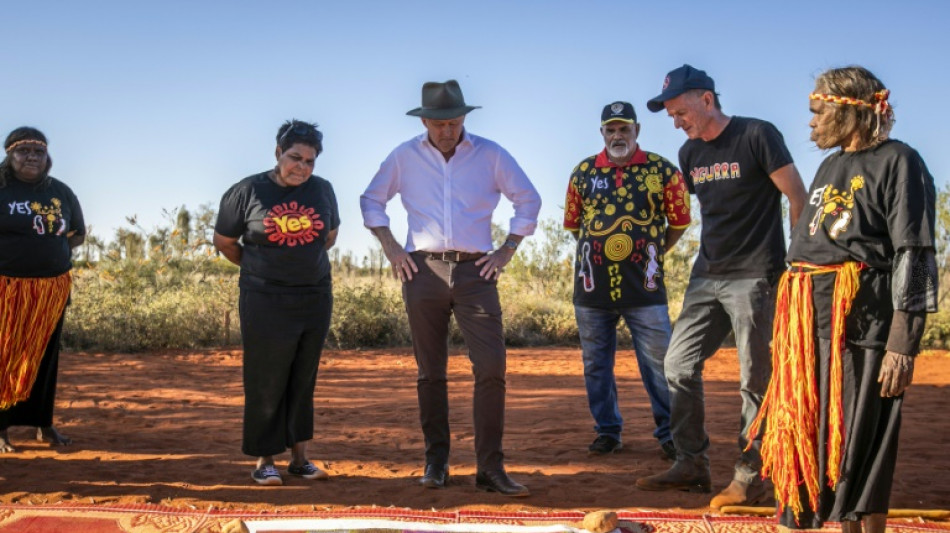
Australian PM fights to save Indigenous referendum / Photo: STR - AFP
Australia's Prime Minister Anthony Albanese on Friday issued an emotional, final-day plea to salvage a landmark referendum on Indigenous rights, his voice trembling as he told voters: "Kindness costs nothing."
On Saturday, Australians will decide whether to recognise First Nations peoples for the first time in the 1901 constitution and create an Indigenous advisory body -- a so-called "Voice" -- for policies that affect their communities.
Opinion polls give the reforms little hope, with recent surveys indicating the "yes" camp is polling at just over 40 percent and the "no" side at nearly 60 percent.
"There is nothing, no cost to Australians showing kindness, thinking with their heart, as well as their head when they enter the polling booth tomorrow -- and voting 'yes'," Albanese said.
"My goodness, kindness costs nothing. Thinking of others costs nothing," he told journalists in the South Australian state capital of Adelaide.
"This is a time where Australians have that opportunity to show the generosity of spirit that I see in the Australian character."
The Australian leader reminded people of the harsh lives endured by many First Nations peoples, whose ancestors lived on the continent for more than 60,000 years before white settlement.
- 'We can do better' -
More than 200 years since British colonisation, Aboriginal and Torres Strait Islander peoples have lifespans eight years shorter than other Australians, a suicide rate twice as high, and double the mortality rate for mothers in childbirth, Albanese said.
"We can do better," he said, arguing that most Australians' lives would not be impacted if a "Voice" was created to help craft better policies for Indigenous peoples.
There are about 984,000 Aboriginal and Torres Strait Islander people in Australia, representing 3.8 percent of the population.
A victory for the "yes" camp "may just make life better" for Indigenous people, the prime minister said. "'No' takes us nowhere -- we are living in 'no' right now."
Support for the "yes" camp has slumped since the opposition conservative Liberal Party, led by ex-police officer Peter Dutton, announced its opposition.
The "no" campaign has thrived on concern about the powers the "Voice" body would wield, warning it would divide Australians and embracing uninformed voters with the slogan: "If you don't know, vote no".
- 'Not factual' -
The Indigenous advisory body "would have been a very significant and detrimental change to our system of government", Dutton told public broadcaster ABC.
He blamed the prime minister for the divisiveness of the campaign.
"I think there is a lot of regret in terms of the division that has been created, the money that has been expended and no practical outcome that was going to be delivered for Indigenous Australians."
Ken Wyatt, a former Indigenous affairs minister who resigned from the Liberal Party this year over its stance on the Voice, criticised Dutton's position.
"They are contentious in order to create fear and division and they are intended fundamentally to sink the Voice."
F.Cornelis--LCdB