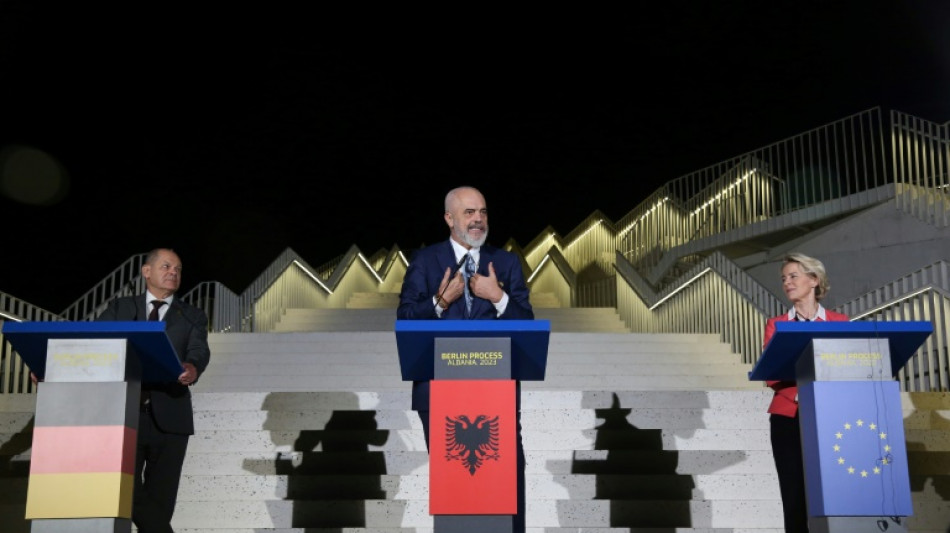
European leaders urge Serbia-Kosovo dialogue at Balkan summit / Photo: Adnan Beci - AFP
European leaders urged dialogue between Kosovo and Serbia after a recent spike in tensions, as they gathered at a regional Balkan summit on Monday in the Albanian capital Tirana.
Following the killing of a Kosovo police officer and three Serb gunmen in clashes in Kosovo's volatile north, simmering friction escalated to the highest level in years.
"It is time to overcome conflicts that have continued for far too long," German Chancellor Olaf Scholz told the summit.
"The recent escalation of the situation in north Kosovo has proven just how important that is".
Brussels strongly condemns the "horrible attack" that occurred on September 24, European Commission President Ursula von der Leyen told a joint press conference after the meeting.
"We are in a process where the facts about the attack need to be established so we wait for the outcome of the investigation and based on that one we will decide on the next steps."
On the eve of the event, she urged Belgrade and Pristina to return to a Brussels-sponsored dialogue on normalisation of ties.
"This is the way towards a future where Kosovo and Serbia will be part of the European Union," she said in Tirana on Sunday.
But Serbian President Aleksandar Vucic did not attend this year's edition of the annual summit. He travelled instead to Beijing for the Belt and Road Forum, where he is due to sign a free trade agreement with China.
Serbia's Prime Minister Ana Brnabic, however was attending the summit in Tirana.
A greater convergence with the European Union and "supporting ecological and digital transition" were discussed at the one-day meeting.
Leaders also ratified an agreement on the mutual recognition of professional qualifications, and announced the opening of a College of Europe campus in Tirana.
- 'No rigid date' -
Monday's meeting was the ninth summit of the Berlin Process, launched in 2014 by then-German chancellor Angela Merkel.
The Berlin Process aims to promote political dialogue, cooperation and reconciliation between six West Balkan countries -- Albania, Bosnia-Hercegovina, Kosovo, North Macedonia, Montenegro and Serbia.
It is also a space to foster closer ties with the EU -- with nine member states including France and Germany involved in the annual summit.
The six Western Balkans nations are in different phases on their EU path.
"There cannot be a rigid (accession) date where regardless of how you reformed or not", von der Leyen, whose officials are in charge of evaluating that candidate states' progress in meeting membership criteria, said on Monday.
She stressed that EU membership was a "merits-based process".
European Council president Charles Michel caused a stir when Brussels returned to work after the summer break by calling for the EU to be ready to expand by 2030.
Hungary, the Netherlands, Romania and Spain also joined the summit this year, at the invitation of Albanian Prime Minister Edi Rama.
Last year's meeting produced several agreements on free movement and residence in the region, as well as the recognition of university and certain professional qualifications.
Von der Leyen also announced a one-billion-euro ($1.1 billion) energy support plan.
"The Berlin process in the past decade has produced a lot of agreements, but little follow up," said Florian Bieber from the Balkans in Europe Policy Advisory Group (BiEPAG).
"In Vienna, in 2015, the foreign ministers of all six countries signed a declaration to not have bilateral disputes stand in the way of the EU path," he added.
In the aftermath of recent tensions, Kosovo's government displayed a large arsenal of weapons and equipment and accused the government in Belgrade of backing Serb gunmen in clashes in the volatile north.
"We've got plenty to do," said an advisor to French President Emmanuel Macron, "with concerns about both Serbia and Kosovo, as well as Bosnia".
Macron is due to arrive on Monday evening and will stay in Albania on Tuesday for bilateral meetings.
O.Dupont--LCdB