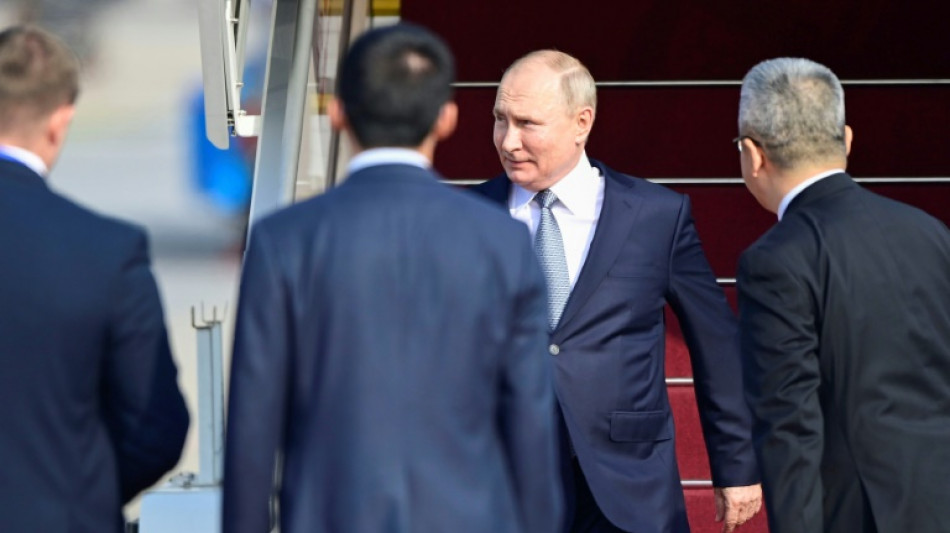
Putin in China to meet 'dear friend' Xi / Photo: Parker Song - POOL/AFP
Russian President Vladimir Putin arrived in China on Tuesday to meet his "dear friend" Xi Jinping and bolster their relationship at a summit that will be overshadowed by the Israel-Hamas war.
China this week welcomes representatives of 130 countries for a forum of President Xi's vast trade and infrastructure Belt and Road Initiative (BRI).
At the top of the guest list is Putin, who is on his first trip to a major global power since the Ukraine invasion threw his regime into international isolation.
He is due to hold talks with Xi on the sidelines of the forum on Wednesday, the Kremlin said, with the war raging between Israel and Palestinian militant organisation Hamas looming large over the summit.
"During the talks, special attention will be paid to international and regional issues," the Kremlin said in a statement, without elaborating.
Western countries led by the United States have rallied to Israel's side since October 7, when Hamas launched the deadliest attack in Israel's history, shooting, stabbing and burning to death more than 1,400 people, mostly civilians, in a shock offensive.
The United States has asked China to use its influence to help de-escalate the war, which has seen more than a million people in the blockaded Gaza Strip flee their homes under the relentless bombardment that Israel launched in retaliation for the attack.
China brokered an entente between key Hamas backer Iran and its regional foe Saudi Arabia earlier this year, and will send its Middle East envoy Zhai Jun to the volatile region this week.
No details have been given about where or when exactly Zhai would travel, though China's state broadcaster CCTV has said he will push for a ceasefire and peace talks.
Russia, which has traditionally maintained good relations with both Israeli and Palestinian authorities, has called for an "immediate ceasefire" in the conflict.
In Beijing, Putin is on a mission to strengthen the already strong bond with his communist neighbour, though experts say Moscow is increasingly the junior partner in the relationship.
China is Russia's largest trading partner, with trade between the nations reaching a record $190 billion last year, Beijing customs data shows.
Beijing has drawn criticism from Western countries for its stance on the Ukraine war, on which China insists it is neutral even as it refuses to criticise Moscow for launching its invasion.
While the BRI forum provides a fresh opportunity for Putin and Xi to showcase their alliance, experts do not expect any new major agreements to be announced.
"Russia is aware that China doesn't want to sign any high publicity deals," Alexander Gabuev, director of the Carnegie Russia Eurasia Center, told AFP.
"China holds all of the cards," he said.
- Friends reunited -
Xi kicked off the summit Tuesday with talks with Chilean and Kazakhstan Presidents Gabriel Boric and Kassym-Jomart Tokayev, Chinese state media reported.
Ahead of the forum, China and Russia's top diplomats were singing from the same song sheet when they met in Beijing on Monday.
Russian Foreign Minister Sergei Lavrov thanked China for inviting Putin as the summit's "chief guest", according to a readout from Moscow, which later said the top diplomat would head to North Korea after Beijing.
Putin and Xi will discuss the countries' ties "in their entirety" when they meet this week, Lavrov told Wang.
Wang, in turn, said China "appreciates" Russia's support for the BRI.
The two nations share a symbiotic alliance, with China appreciating Russia's role as a bulwark against the West, and Moscow increasingly reliant on Beijing's largesse in trade and geopolitical backing.
"Since Moscow embarked on its all-out invasion of Ukraine, it has been put in a position where it is unprecedentedly dependent on China," Bjorn Alexander Duben of China's Jilin University told AFP.
"President Xi Jinping calls me his friend, and I call him my friend, too," Putin told Chinese state broadcaster CGTN ahead of his visit, according to a Kremlin readout.
I.Kusters--LCdB