Biden to visit Israel as Gaza ground invasion looms / Photo: MOHAMMED ABED - AFP
US President Joe Biden will visit Israel Wednesday in a show of "ironclad" support as Washington tries to prevent the escalating war against Hamas in Gaza from spilling over into a wider Middle East conflict.
The trip will come 12 days after the Palestinian militants burst through Israel's heavily fortified Gaza border, shooting, stabbing and burning to death more than 1,400 people, most of them civilians.
Shell-shocked Israel has responded with withering air strikes that have killed more than 2,700 people, also mainly civilians. It has also imposed a crippling siege on Gaza and deployed tens of thousands of troops to the border in preparation for a full-scale ground offensive.
Israel has vowed to destroy Hamas while also seeking to rescue the at least 199 hostages taken into Gaza by the Islamist Hamas, which has released a video of one of the captives, French-Israeli woman Mia Shem.
Her mother, Keren Shem, made an emotional plea for her safe return, at a Tel Aviv press conference.
"I ask world leaders that my daughter be returned to us in the state that she is today, as well as the other hostages," she said. "I am begging the world to bring my baby back home."
Israel army spokesman Jonathan Conricus said Tuesday that its forces "will commence the enhanced military activities when the timing suits the goal".
He stressed that "if hostages are dead, that is the responsibility of Hamas and Hamas will pay the price".
Israelis are still reeling from the worst attack in the country's 75-year history, which has brought a mass mobilisation of reservists and the evacuation of about 500,000 people from areas near Gaza and Lebanon.
US Secretary of State Antony Blinken, back in Israel after a whistlestop regional tour, said Biden's visit would be a statement of "solidarity with Israel" and an "ironclad commitment to its security".
Washington has already sent two aircraft carrier strike groups to the eastern Mediterranean "to deter hostile actions against Israel".
Iran's supreme leader Ayatollah Ali Khamenei said Tuesday that "no one can stop resistance forces" if Israel keeps up its bombardment of Gaza.
Deadly flare-ups have rocked Israel's northern border with Lebanon, where the Iran-backed Hezbollah militant movement is based. Israel said Tuesday it had again launched strikes on militants trying to cross and on "terrorist" targets.
- 'Corpses in the streets' -
While signalling support, Biden will also try to quietly steer Israeli's military response, as international alarm has grown about the devastating impact of the war on Palestinian civilians.
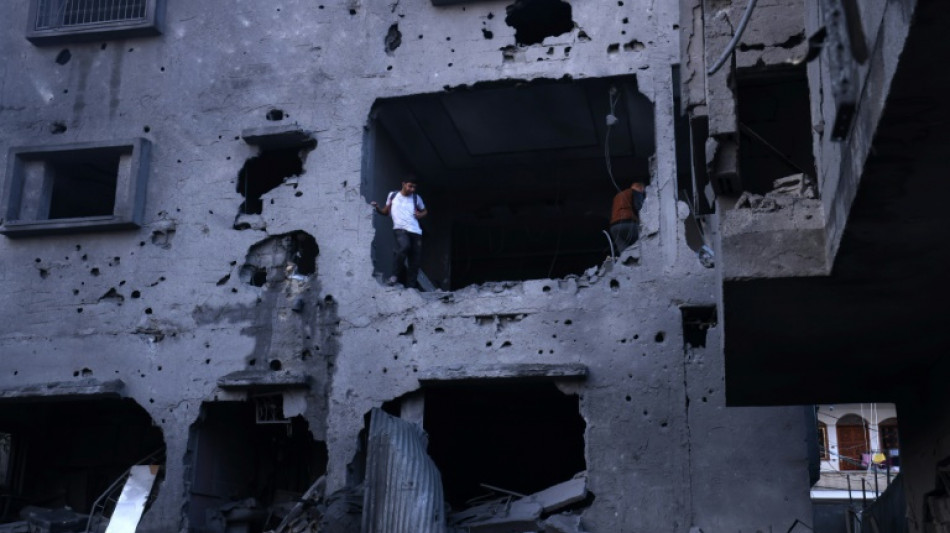
At least 2,750 Palestinians -- mostly civilians -- have been killed, entire neighbourhoods have been razed and survivors are left with dwindling supplies of food, water and fuel.
"The situation is catastrophic beyond what I could have imagined," said Jamil Abdullah, a Palestinian-Swede, hoping to flee the blockaded enclave.
"There are corpses in the streets. Buildings are crashing down on their inhabitants. Blood is everywhere. The smell of the dead is everywhere."
AFP reporters in Gaza said mortuaries were overflowing, and corpses wrapped in white body bags were even being stored in an ice cream truck.
The UN agency for Palestinian refugees says more than one million Palestinians -- almost half of Gaza's population of 2.4 million -- have fled their homes.
World Health Organization regional director Ahmed Al-Mandhari told AFP that Gaza was barrelling towards "real catastrophe".
"There are 24 hours of water, electricity and fuel left," he said.
Israel has demanded that residents of north Gaza leave for the south, hoping to clear the area of civilians in preparation for a perilous ground assault that would involve gruelling urban combat.
- No escape -
Since Israel's evacuation order in north Gaza, entire families, young children and the elderly have gathered belongings and fled to southern Gaza, bedding down in any available space, indoors and out.
In the city of Khan Yunis in southern Gaza the normal population of 400,000 has roughly doubled.
Egypt has so far kept closed Gaza's only border crossing not controlled by Israel, Rafah. Israel has repeatedly struck the area on the Palestinian side and Monday denied reports of any temporary ceasefire deal to open it.
Rafah's closure has so far prevented the escape of thousands of Palestinian-Americans and others hoping to flee Gaza, or the entry of relief goods now loaded on truck convoys waiting in Egypt.
For now Gazans remain trapped, with neighbouring Arab nations also fearful that if Palestinians leave the territory they could be permanently exiled.
Blinken, after talks with Israeli Prime Minister Benjamin Netanyahu, signalled there was no firm agreement yet on humanitarian relief, but that there was a "commitment" to work on a plan ahead of and during Biden's visit.
He also said the two sides were discussing the "possibility of creating areas to help keep civilians out of harm's way".
Blinken said the US president hopes to "hear from Israel how it will conduct its operations in a way that minimises civilian casualties and enables humanitarian assistance to flow to civilians in Gaza in a way that does not benefit Hamas."
burs-jd-fz/dv
U.Laurent--LCdB