'This is a massacre': Gaza takes stock after deadly hospital strike / Photo: MAHMUD HAMS - AFP
Gazans combed through the debris of the devastated hospital, collecting the bodies of the dead in the battered enclave Wednesday, hours after a strike killed hundreds sheltering at the facility.
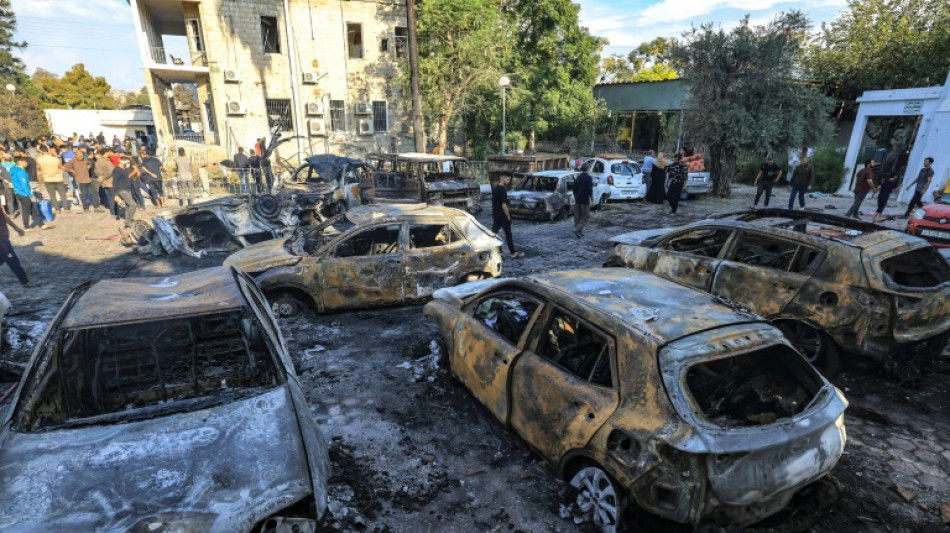
Alongside rows of charred vehicles, volunteers recovered corpses and human limbs that were placed in body bags, while the remains of others were covered in white shrouds and blankets.
"This is a massacre," Ahmed Tafesh, who assisted in the recovery effort, told AFP, saying he had collected the eyes, arms, legs and heads of the deceased. "I have never seen anything like this in my life."
Health authorities in Hamas-ruled Gaza said the explosion killed between 200 and 300 people at the the Ahli Arab Hospital and was caused by an Israeli air strike in retaliation for the Islamist group's October 7 attack on communities near the enclave.
At the nearby Shifa hospital in Gaza City, residents gathered to identify the dead at the hospital's mortuary and take other bodies for burial.
Yahya Karim, 70, was among those searching for clues about the fate of their relatives.
"I don't know how many of them died and how many are still alive," said Karim, admitting that he had planned to shelter in the hospital before the strike.
Outside the Ahli hospital, others who survived the attack who spoke to AFP recounted the terrifying moment when the strike occurred.
"We felt there was fire and things were falling on us. We started looking for each other. The electricity cut suddenly, and we couldn't see," said Fatima Saed through tears.
"I don't know how we came out of it."
Gaza resident Adnan al-Naqa told AFP that around 2,000 people were taking refuge at the hospital on Tuesday night at the time of the strike.
"As I entered the hospital, I heard the explosion, I saw a massive fire," said Naqa.
"The entire square was on fire, there were bodies everywhere, children, women and elderly people."
- War of words -
With water and food supplies running low, the United Nations estimates that around one million of Gaza's 2.4 million residents are currently displaced, with thousands sheltering in hospitals dotted throughout the densely populated enclave.
As residents surveyed the damage, Israel and Palestinian militants traded blame for the strike.
On Wednesday morning, the Israeli military offered "evidence" that Islamist militants were responsible for the blast, saying a review of the strike proved others were at fault.
"The evidence — which we are sharing with you all — confirms that the explosion at the hospital in Gaza was caused by an Islamic Jihad rocket that misfired," military spokesman Daniel Hagari told a press conference in Tel Aviv.
"There was no IDF (Israeli army) fire by land, sea or air that hit the hospital," Hagari said.
US President Joe Biden threw his support behind Israel's account of the strike, telling Prime Minister Benjamin Netanyahu "it appears as though it was done by the other team" after landing in Israel for a high-stakes solidarity visit.
Hamas fired back at the comments from the Israeli military, saying "its outrageous lies do not deceive anyone".
Israel's Arab allies blamed it for the hospital deaths, despite the military's denials.
The United Arab Emirates and Bahrain, which both established ties with Israel in the Abraham Accords of 2020, condemned the "Israeli" attack.
Morocco, another country that recognised Israel in 2020, also blamed it for the strike, as did Egypt, which became the first Arab country to normalise relations in 1979.
As the two sides pinned blame on each other, Israeli air strikes continued to batter the war-torn enclave, sending residents running for cover early Wednesday.
Around 3,000 people have been killed in Gaza as a result of Israeli air strikes, according to health officials.
A.Peeters--LCdB