New missiles won't help Ukraine, says Putin / Photo: Sergei GUNEYEV - POOL/AFP
Russian President Vladimir Putin said Wednesday the long-range missiles Washington had supplied Kyiv would only prolong the country's agony, hours after Ukraine's leader Volodymyr Zelensky said they had already proved their worth.
Ukraine also reported more deaths from the latest wave of Russian missile strikes and said they were bracing for an expected fresh assault on the frontline town of Avdiivka.
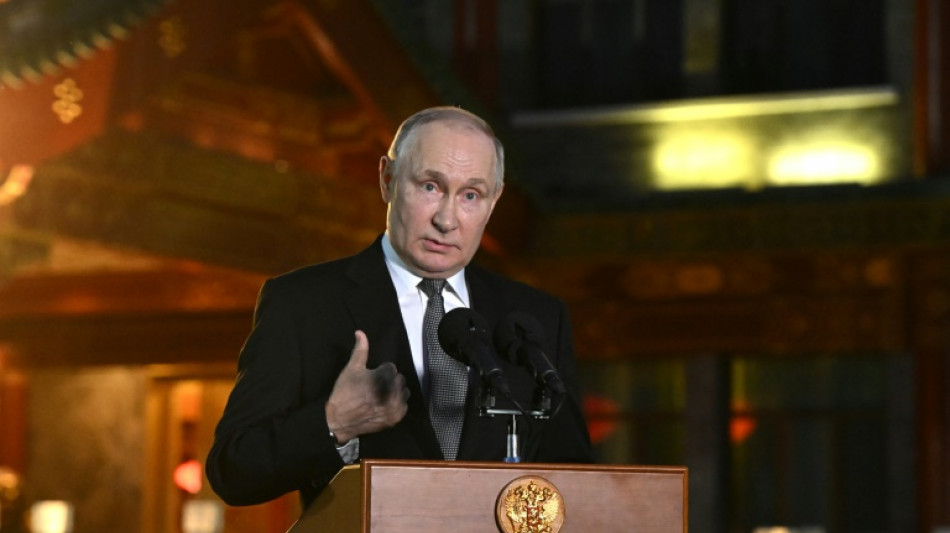
It had been a "mistake" for Washington to give Ukraine long-range ATACMS missiles, Putin told journalists at a news conference in Beijing.
"War is war, and, of course ... they pose a threat, that goes without saying," he said in response to questions about the weapons.
"But most importantly, this will not change the situation on the line of contact dramatically at all," he added.
The decision to supply the missiles had been "another mistake on the part of the United States," he said. "It just prolongs the agony."
White House confirmed on Tuesday that it had provided Ukraine with the longer-range weapons they had requested to strike deep inside Russian-held territory. According to US media outlets the ATACMS have a maximum range of around 160 kilometres (100 miles).
Russian officials had already accused Ukraine on Tuesday of using the US-supplied missiles to attack Berdyansk, a Russian-controlled port city in Ukraine's southeastern Zaporizhzhia region.
President Volodymyr Zelensky confirmed Ukraine had used the missiles after the attacks, but did not give details about how or when they were deployed.
"They have performed very accurately. ATACMS have proven themselves," he said in an evening address Tuesday.
On Wednesday, he posted on X, formerly Twitter, to say he had had talks with French President Emmanuel Macron "on the next steps to strengthen Ukraine’s air defence, long-range, and naval capabilities".
Russia later on Wednesday said it had shot down two Ukrainian missiles targeting Crimea, which was annexed by Russia in 2014 and is increasingly under fire from Ukrainian strikes.
Russia's defence ministry said the missile debris fell in a deserted area and there was no damage or casualties.
- Non-stop shelling -
Kyiv on Wednesday warned that Russian forces were likely to escalate their assault on the frontline town of Avdiivka, as Moscow continued shelling nearby Ukrainian positions.
Ukraine has in recent weeks reported intense Russian attacks on Avdiivka, which lies just north of the Moscow-controlled city of Donetsk, seized by pro-Russian separatist forces in 2014.
"I can say for sure that this is the largest offensive that has ever taken place in Avdiivka since the war began in 2014," the head of the town's administration Vitaliy Barabash said on television.
While attacks on the town itself had quietened down, Russia had continued to shell Ukrainian positions. "Most likely, in the next few days we expect this escalation to continue," he added.
The town has become a symbol of Ukrainian resistance against Moscow, with Kyiv clinging on there despite relentless Russian attacks during the Kremlin's almost 20-month long offensive.
Russian forces now control territory to the east, north and south of Avdiivka, gradually tightening the noose in a bid to push Ukrainian forces further from Donetsk.
Avdiivka itself has been devastated by the conflict and most of its pre-war population of around 30,000 has fled.
- Overnight attacks -
Russia continued to attack other parts of Ukraine overnight, as officials said air strikes on Ukraine's Zaporizhzhia and Dnipropetrovsk regions had killed at least six people.
Five died in a missile strike that hit a residential building in the southeastern city of Zaporizhzhia, local officials said.
A 31-year-old woman was killed in a strike on a town just outside the city of Dnipro, Ukraine's internal affairs minister Igor Klymenko said.
Zaporizhzhia governor Yuriy Malashko said Russia had "launched six missile attacks on Zaporizhzhia" in the early hours of Tuesday.
Emergency services said the Zaporizhzhia strike had destroyed an apartment building's third to fifth floors. Photos showed a crater in the upper floors and a collapsed facade.
In an interview with a Ukrainian TV station, Malashko blamed the strike on an "S-300 missile".
Also hit was Zaporizhzhia's Holy Intercession Cathedral, an Orthodox church destroyed during the Soviet repression of the 1930s, then rebuilt in the 1990s.
"The blast wave smashed all the windows in the church and broke the window frames," the Ukrainian Orthodox Church said, citing cathedral rector Oleh Semenchuk.
K.Cox--LCdB