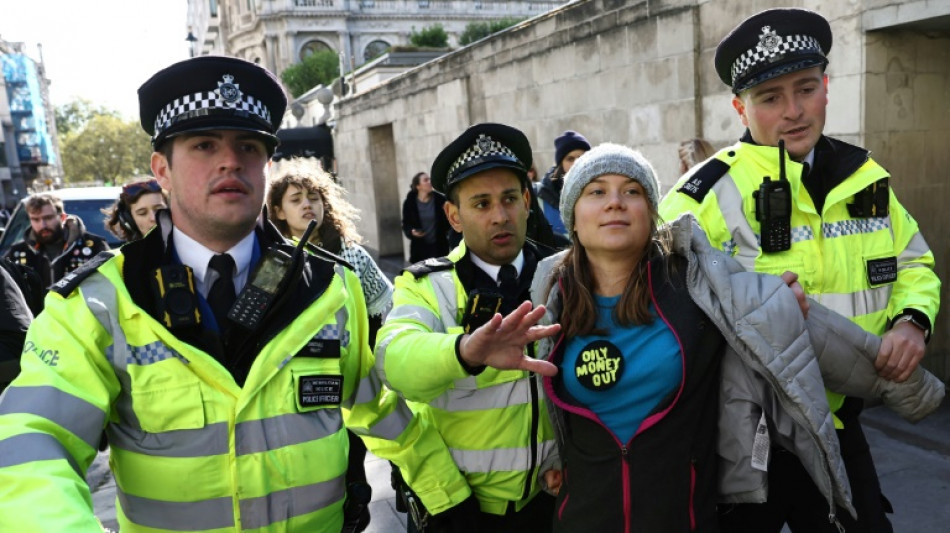
UK police charge Greta Thunberg after climate protest arrest / Photo: HENRY NICHOLLS - AFP
UK police on Wednesday charged Swedish climate campaigner Greta Thunberg with a public order offence, following her detention at a protest outside an annual gathering of energy industry figures in London.
The 20-year-old activist -- a key face of the movement to fight climate change -- was among 26 people charged by the capital's Metropolitan Police, after she was held at Tuesday's demonstration.
Thunberg was charged with "failing to comply with a condition" imposed under Britain's Public Order Act dealing with public assemblies. She was released on bail and is due back in court on November 15.
Thunberg was on Tuesday taken away by two police officers and put into the back of a police van outside the Energy Intelligence Forum, after she had joined a mass protest there.
Several hundred protesters had gathered outside the InterContinental London Park Lane hotel during the "Oily Money Out" demonstration, organised by pressure groups Fossil Free London and Greenpeace, blocking all entrances to the venue.
Prior to her arrest, Thunberg had criticised "closed door" agreements struck between politicians and representatives of the oil and gas industry.
London police said they imposed "conditions to prevent disruption to the public" after officers arrived at the protest, which were then breached and prompted the arrests.
"The protesters were asked to move from the road onto the pavement, which would enable them to continue with their demonstration without breaching the conditions," a police statement said.
Thunberg, who started the so-called "School Strike for Climate" movement as a teenager, was fined by a court in Sweden earlier this month.
It followed the court convicting her for having resisted arrest during a July protest that blocked traffic.
- 'Unacceptable' -
Climate protesters, meanwhile, on Wednesday staged a demonstration outside the offices of Total Energies UK in London.
Josie, an organiser with Fossil Free London, told AFP the company was "funding the East African Crude Oil Pipeline" (EACOP) and that their CEO had been at the meeting of energy industry figures where Thunberg was detained.
She said he had been "meeting with bankers, politicians and other oil execs to decide how they can build new fossil fuel infrastructure.
"We think this is unacceptable in a time of climate emergency and we're determined to stop EACOP," said the activist who did not give her full name.
Another activist, Lauren MacDonald, from the Stop Rosebank group which campaigns against oil and gas production in Britain's largest undeveloped field, joined around 100 protesters outside the forum.
There could not be "any new oil and gas projects if we're going to have a safe livable future", she said.
Britain last month authorised oil and gas production in the Rosebank field in the North Sea off the coast of Scotland.
Commenting on the decision, Equinor CEO Anders Opedal said it had been a "difficult decision".
"I spent a lot of time thinking about it. But in the end, I think this is the right decision for the UK and for Equinor," he told the forum.
I.Mertens--LCdB