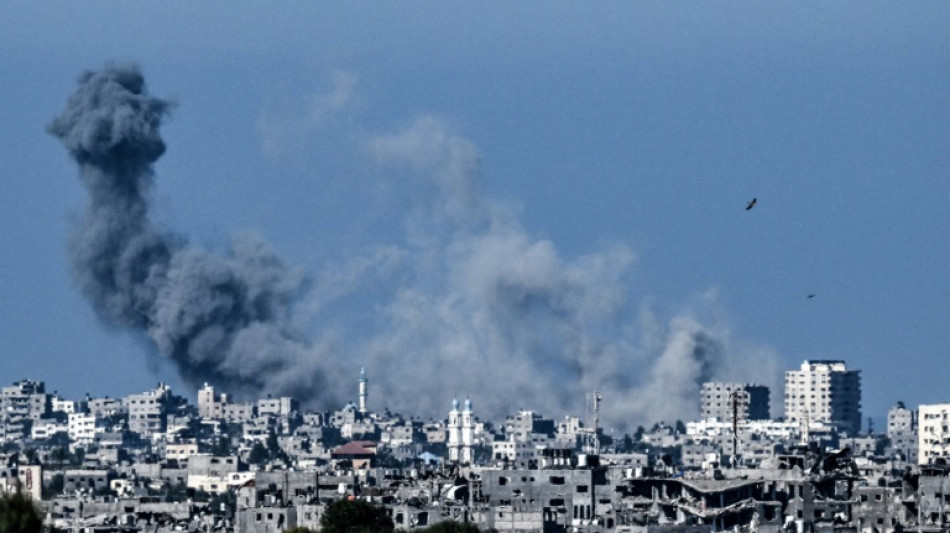
First aid rolls into Gaza devastated by 'nightmare' war / Photo: Aris MESSINIS - AFP
The first aid trucks arrived in the war-torn Gaza Strip from Egypt on Saturday, bringing humanitarian relief to the Hamas-controlled Palestinian enclave suffering what the UN chief labelled a "godawful nightmare".
Israel has vowed to destroy Hamas after the Islamist militant group carried out the deadliest attack in the country's history on October 7.
Hamas militants killed at least 1,400 people, mostly civilians who were shot, mutilated or burnt to death on the first day of the raid, and took more than 200 hostages, according to Israeli officials.
Israel says around 1,500 Hamas fighters were killed in clashes before its army regained control of the area under attack.
AFP journalists on Saturday saw 20 trucks from the Egyptian Red Crescent, which is responsible for delivering aid from various UN agencies, pass through the Rafah border crossing from Egypt into Gaza.
The crossing -- the only one into Gaza not controlled by Israel -- closed again after the trucks passed.
The lorries had been waiting for days on the Egyptian side after Israel agreed to allow aid to enter following a request from its top ally the United States.
UN humanitarian chief Martin Griffiths said the convoy "must not be the last" and that the delivery would start "a sustainable effort to provide essential supplies" to Gaza.
UN chief Antonio Guterres warned Friday that the aid was "the difference between life and death" for many Gazans, more than one million of whom have been displaced.
"Much more" aid needs to be sent, he told a peace summit in Egypt on Saturday.
- 'Reeling in pain' -
Israel's military campaign against Hamas has levelled entire city blocks in Gaza, killing more than 4,300 Palestinians, mostly civilians, according to the Hamas-run health ministry.
Israeli troops are massed on the Gaza border ahead of an expected ground invasion that officials have pledged will begin "soon".
As international tensions soar, Egyptian President Abdel Fattah al-Sisi was hosting a peace summit in Cairo on Saturday attended by regional and some Western leaders.
"The time has come for action to end this godawful nightmare," Guterres told the summit, calling for a "humanitarian ceasefire".
The region "is reeling in pain and one step from the precipice", he added.
Egypt, historically a key mediator between Hamas and Israel, has urged "restraint" and called to restart long-frozen peace talks.
But diplomatic efforts to end the violence have made little headway, with Israel and its enemy Iran, a supporter of Hamas and other armed groups, among those absent from the Cairo talks.
- 'Sliver of hope' -
A full-blown Israeli land offensive carries many risks, including to the more than 200 hostages Hamas took during their raid and whose fate is shrouded in uncertainty.
So the release of the first two hostages -- US mother and daughter Judith and Natalie Raanan -- offered a rare "sliver of hope", said Mirjana Spoljaric, president of the International Committee of the Red Cross.
US President Joe Biden said he was "overjoyed" and thanked Qatar, which hosts Hamas' political bureau, for its mediation in securing the release.
He said he was working "around the clock" to win the return of other Americans being held.
Natalie Raanan's half-brother Ben told the BBC he felt an "overwhelming sense of joy" at the release after "the most horrible of ordeals".
Traumatised families with loved ones missing in Gaza demanded more action.
"Absolutely nothing has been done," Assaf Shem Tov, whose nephew was abducted from a music festival where hundreds were killed by Hamas, said Friday.
"We ask humanity to interfere and bring back all those young boys, young girls, mothers, babies."
- Crucial aid -
In Gaza, Israeli jets continued the relentless bombing campaign, with the military saying it hit more than 100 Hamas targets overnight.
Almost half of Gaza's residents have been displaced, according to the United Nations.
The UN agency for Palestinian refugees said Saturday that 17 staff have been confirmed killed in the war, warning the actual numbers "are likely to be higher".
At least 30 percent of all housing in Gaza has been destroyed or damaged, the UN says, citing local authorities, and thousands have taken refuge in a tent city set up in southern Gaza's Khan Yunis.
Fadwa al-Najjar said she and her seven children walked for 10 hours to reach the camp, at some points breaking into a run as air strikes descended around them.
"We saw bodies and limbs torn off and we just started praying, thinking we were going to die," she told AFP.
"I would have preferred not to leave, to have stayed at home and died there," her daughter Malak added.
Israel's operation will take not "a day, nor a week, nor a month," the country's defence minister Yoav Gallant warned Friday, and will result in "the end of Israel's responsibilities in the Gaza Strip".
An Israeli foreign ministry source, speaking to AFP on condition of anonymity, said Israel envisaged "handing over the keys" to neighbouring Egypt, which has strongly rejected attempts to place Gaza's residents under its responsibility.
- Regional tensions flare -
"I'm afraid that the current destruction is part of a clear plan for people to have no place left to live," said Omar Ashour, a retired general in Gaza.
"This will cause a second Nakba," he added, referring to the 760,000 Palestinians who were expelled from or fled their homes when Israel was created.
The United States has moved two aircraft carriers into the eastern Mediterranean to deter Iran or Lebanon's Hezbollah, both Hamas allies, amid fears of a wider conflagration.
Israel on Friday ordered the 25,000 residents of the northern town of Kiryat Shmona to evacuate.
Violence has also flared in the West Bank, where 84 Palestinians have been killed since October 7, according to the Palestinian health ministry.
Protests have erupted over the conflict across the region, and Israel on Saturday urged its citizens to immediately leave Egypt and Jordan.
burs-imm/fz
P.Verhoeven--LCdB