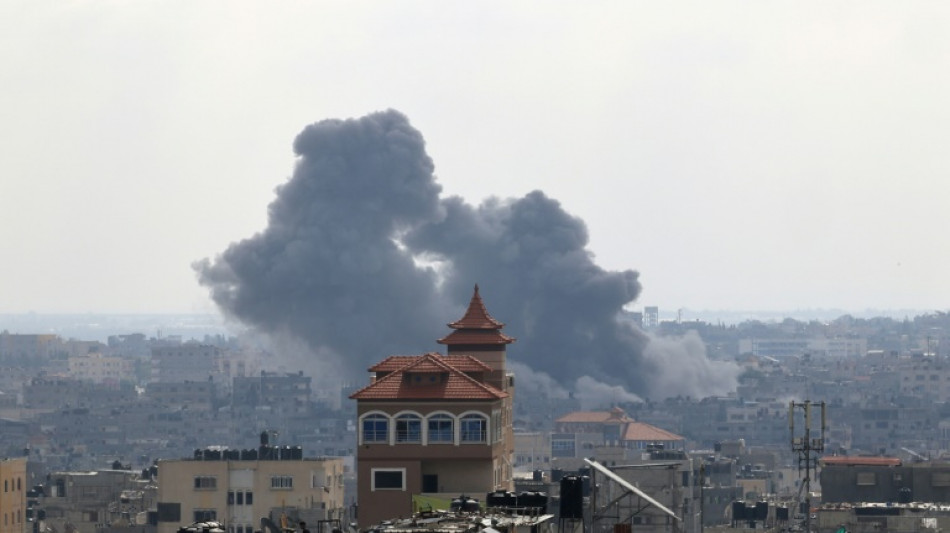
Israel steps up Gaza strikes ahead of ground invasion / Photo: SAID KHATIB - AFP
Israel heavily bombarded Gaza overnight after warning it would intensify strikes ahead of a ground invasion, as the war sparked by Hamas's bloody attack entered its third week on Sunday.
As fears mount of a wider conflagration, the Pentagon said it was bolstering its forces in the Middle East to "assist in the defence" of US ally Israel amid "escalations by Iran and its proxy forces" across the region.
A first trickle of aid entered the besieged Gaza Strip on Saturday, but the 20 trucks permitted to cross were described as a "drop in the ocean" given the "catastrophic" humanitarian situation for 2.4 million people.
Hamas militants stormed into Israel from the Gaza Strip on October 7 and killed at least 1,400 people, mostly civilians who were shot, mutilated or burnt to death on the first day of the raid, according to Israeli officials.
It was the worst attack on civilians in Israel's history and coincided with the end of the religious holiday of Sukkot.
The retaliatory bombing campaign has killed more than 4,300 Palestinians, mainly civilians, according to the Hamas-run health ministry, and reduced swathes of densely populated Gaza to smouldering ruins.
More than 40 percent of all Gaza's housing has been damaged or destroyed, according to the UN citing local authorities, and Israel has halted the delivery of food, water, fuel and electricity.
Israel has massed tens of thousands of troops around the enclave for a widely predicted ground invasion. It says its daily raids have already killed many Hamas leaders and military commanders.
Israel will now intensify its bombardment to minimise the risks to its troops when they begin a ground invasion, military spokesman Admiral Daniel Hagari said on Saturday.
Israel has warned more than one million residents of northern Gaza to move south for their safety, and the UN says more than half the enclave's population is now internally displaced.
Hundreds of thousands of civilians are believed to remain in and around Gaza City in the north, unwilling or unable to leave.
- 'We are preparing' -
Hamas said overnight raids on the Gaza Strip killed at least 80 people and destroyed more than 30 homes.
In Rafah, an AFP journalist saw a man carry the shrouded body of his baby as people wept by a row of corpses.
US Defense Secretary Lloyd Austin said on Saturday that he had ordered the deployment of a second carrier strike group in the eastern Mediterranean and additional Patriot battalions.
The Pentagon also said it was notifying additional troops to "prepare to deploy orders" without specifying how many or when they could be dispatched.
Israeli commanders visited front-line units on Saturday to rally troops ahead of the expected ground invasion.
"Gaza is densely populated, the enemy is preparing a lot of things there -- but we are also preparing for them," chief of staff Lieutenant General Herzi Halevi told one infantry brigade on a visit.
A ground invasion poses myriad challenges for Israeli troops, who are likely to face Hamas booby traps and tunnels, and must also weigh the safety of more than 200 hostages abducted by the militants.
Two US hostages were released on Friday evening after mediation from Qatar, which said more could be freed "very soon".
- 'Desperate situation' -
After negotiations and US pressure, food, water and medicine, but no fuel, crossed from Egypt into Gaza on Saturday.
The crossing closed afterwards, and UN officials warned much more was needed.
"It is now catastrophic."
At a peace summit in Egypt, UN chief Antonio Guterres urged a humanitarian ceasefire "to end this godawful nightmare".
The summit ended without a joint statement however, as Western officials demanded a clear condemnation of Hamas, and Arab attendees issued their own statement criticising world leaders.
- Shellshocked residents -
Inside Gaza, shellshocked residents said they were unsure where to go or how to protect their families.
"Even in my worst nightmares, I never thought this could be possible," said Rami Abu Wazna, staring at the destruction in central Gaza's Al-Zahra.
The scale of the bombing has left basic systems unable to function, with the UN reporting dozens of unidentified bodies were buried in a mass grave in Gaza City because cold storage had run out.
Across the border in Israel's Kibbutz Beeri, where Hamas militants killed 10 percent of the population, funerals will be held Sunday.
Romy Gold, 70, said residents were still struggling to comprehend the attack.
"Around us whole families were shot or butchered or burned alive," he told AFP.
The ground invasion of Gaza "cannot come fast enough," he added.
"Something needs to be done."
- 'Better to leave now' -
The conflict has sparked fresh violence in the West Bank, where Israeli raids and settler attacks have killed dozens of Palestinians.
Israel's military said Sunday it killed "terror operatives" in an air strike on a mosque in Jenin.
The Palestinian health ministry said two men were killed in the strike.
Fresh fire was also exchanged across Israel's border with Lebanon, as Israel's military warned militant group and Hamas ally Hezbollah was "dragging Lebanon into a war".
"Hezbollah is playing a very, very dangerous game. They're escalating the situation. We see more and more attacks every day," army spokesman Jonathan Conricus said.
Western leaders have warned Hezbollah against intervening in the conflict, but the group's number two said it was ready to step up involvement.
"If something comes up that calls for greater intervention by us, we will do so," Naim Qassem said.
"All my children are young. If the apocalypse comes, how will I get them all out in one go?" said Mustafa al-Sayyid, in a classroom stripped of desks and dotted with thin mattresses.
"So I thought, better to leave now."
burs-imm/dv
W.Smets--LCdB