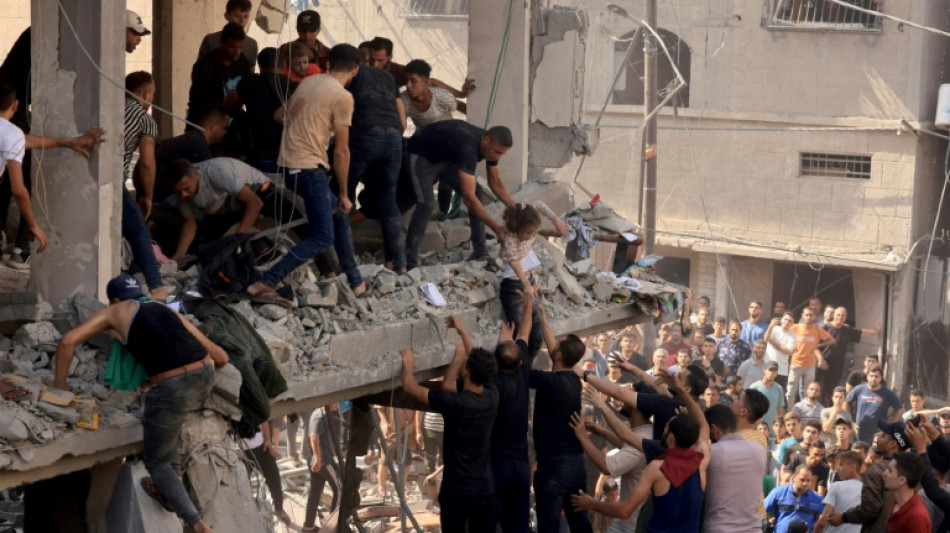
Israel facing growing pressure over Gaza ground operation plans / Photo: MAHMUD HAMS - AFP
Israel faced growing international pressure Wednesday to rethink plans for a massive ground operation in Gaza where it has pressed a relentless bombing campaign that the Hamas-run health ministry says killed 700 people in 24 hours.
Alarm is growing over the spiralling death toll in Gaza which Israel has been bombarding since October 7 when Hamas gunmen poured across the border killing 1,400 people, mostly civilians, and kidnapping 222 others, officials say, in the worst attack in Israel's history.
So far, more than 6,500 Palestinians have been killed, mostly civilians, and there are fears the toll could further soar if Israel pushes ahead with a widely-expected ground invasion in a bid to destroy Hamas and rescue the hostages.
"A massive intervention that would put civilian lives at risk would be an error," French President Emmanuel Macron said in Cairo after meeting Egypt's Abdel Fattah al-Sisi, who also warned a ground operation would cause "many, many civilian casualties".
It would also "be unlikely to offer Israel long-term protection" and would be incompatible with respecting "international humanitarian law and the rules of war," Macron said.
His remarks came as alarm grew over the humanitarian crisis in Gaza where hospitals are facing "complete collapse", a top Palestinian medic warned.
The United Nations said 12 of the territory's 35 hospitals have closed due to damage or insufficient fuel.
"The hospitals are in a state of complete collapse," said Mohammed Abu Selmeya, head of Shifa, the biggest hospital in the Gaza Strip.
He told AFP "more than 90 percent of medicines" had run out and "we urgently need fuel to run the generators and to operate hospital departments and operating theatres."
Israel has cut off Gaza's usual water, food and other supplies, and fewer than 70 relief trucks have entered the impoverished territory since the war began.
But none have contained fuel, which Israel fears Hamas will use for weapons and explosives.
Violence has also risen sharply in the occupied West Bank, where health officials said more than 100 Palestinians had been killed, mostly in raids by Israeli troops or in clashes with Israeli settlers.
- 'Severe pain but no anaesthetic' -
Fuel is used to power vital services such as hospitals in Gaza which rely on generators, and aid agencies have warned that more people will die if medical equipment, water desalination plants and ambulances stop running.
Once the generators stop running, hospitals will "turn into morgues", the Red Cross has warned.
Hospitals are also struggling with a dramatic shortage of medicines and equipment.
"There's not enough anaesthetic," said Ahmad Abdul Hadi, an orthopaedic surgeon working at Nasser hospital in Khan Yunis.
"The wounded are in severe pain but we can't wait for the procedure so we're forced to do the operation. We performed a number of surgeries without anaesthetic. It's tough and painful, but with the lack of resources, what can we do?"
UNRWA has also said its operations were at breaking point from the shortage of fuel.
"If we do not get fuel urgently, we will be forced to halt our operations in the Gaza Strip as of (Wednesday) night," it said on Tuesday.
Petrol stations in the southern town of Rafah had also run dry.
"We ask God for the fuel to arrive so cars, tractors, ambulances and UNRWA operations can function to help the people," taxi driver Ibrahim Namla told AFP.
- UN vote -
The Gaza war has sparked fears of a regional conflagration if it draws in more of Israel's enemies, with Iran's top diplomat on Wednesday accusing Israel of carrying out "genocide" in Gaza.
"The attacks of the Zionist (Israeli) regime have reached an intensity that shows the goal is the mass killing of the Palestinian people in Gaza," Hossein Amir-Abdollahian charged in a letter addressed to UN human rights chief Volker Turk.
"This is a campaign for the genocide of the Palestinian people," he wrote, with the letter shared on social media by his ministry.
Jordan's King Abdullah became the latest leader to warn that ongoing violence could "lead to an explosion" in the region while his wife Queen Rania accused Western leaders of a "glaring double standard" for not condemning Israel's killing of Palestinian civilians in its bombardment of Gaza.
Meanwhile, a divided UN Security Council was to vote on competing draft resolutions on the Gaza war drawn up by Russia and the United States at a meeting due to start at 1900 GMT, diplomats said.
The Russian document, seen by AFP, calls for "an immediate, durable and fully respected humanitarian ceasefire" and "condemns all violence and hostilities against civilians" and also says it "rejects and condemns the heinous attacks by Hamas" of October 7.
Also Wednesday, the Palestinian Authority's foreign minister Riyad al-Maliki met with senior officials from the International Criminal Court in The Hague, the court said, without giving further details.
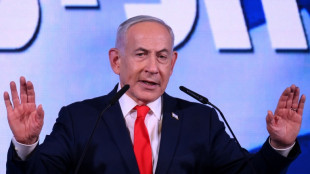
And Israel's Benjamin Netanyahu on Wednesday acknowledged for the first time that he would have to give "answers" for security lapses exposed in the deadly Hamas attacks.
"The fault will be examined and everyone will have to give answers, including me. But all this will happen later," he said in a televised address.
burs-hmw/ami
S.Leysen--LCdB