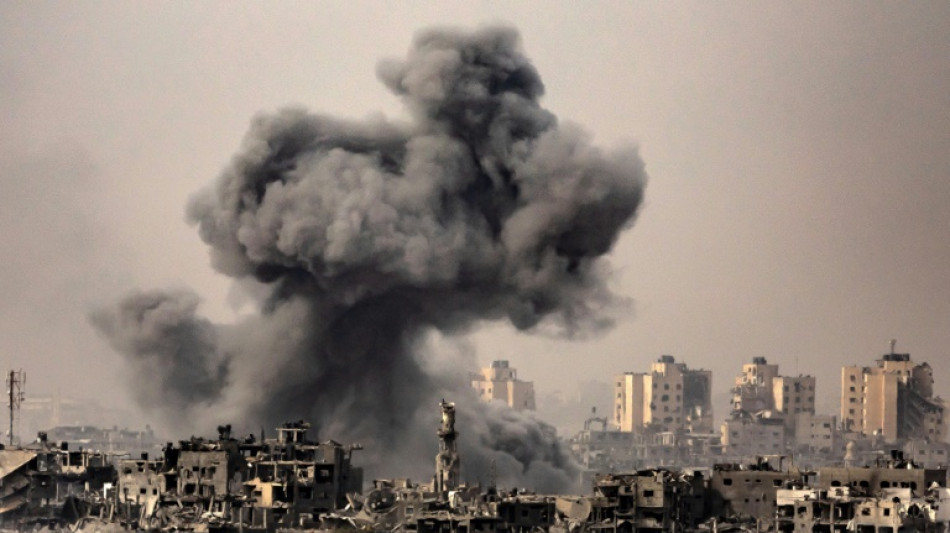
UN warns order 'starting to break down' as Israel pounds Gaza / Photo: FADEL SENNA - AFP
Desperate Palestinians in Gaza burst into aid centres after more than three weeks of siege and bombardment, the UN said on Sunday, as Israel escalated ground operations in the Hamas-run territory.
Israel's allies France and Britain underlined the urgency of delivering aid to Gaza, a day after Israeli Prime Minister Benjamin Netanyahu steeled his nation for a "long and difficult war".
Despite calls for a humanitarian ceasefire, international outrage and the potential risk to hostages held in Gaza, Israel has intensified the war triggered by Hamas's unprecedented attack.
Hamas militants stormed across the Gaza border on October 7 in the deadliest attack in Israel's history, killing 1,400 people, mostly civilians, and kidnapping 230 others, according to Israeli officials.
The Hamas-run health ministry in Gaza says the retaliatory Israeli bombardment has killed more than 8,000 people, mainly civilians and half of them children.
Panic and fear have surged inside the Palestinian territory, where the UN says more than half of its 2.4 million residents are displaced and thousands of buildings destroyed.
UN chief Antonio Guterres said the situation was "growing more desperate by the hour" as casualties increase and essential supplies of food, water, medicine and shelter dwindle.
British Prime Minister Rishi Sunak and French President Emmanuel Macron "stressed the importance of getting urgent humanitarian support into Gaza" during a conversation on Sunday, the UK government said.
The UN agency for Palestinian refugees, UNRWA, said "thousands of people" broke into several of its warehouses and distribution centres in Gaza, grabbing basic survival items like wheat flour and hygiene supplies.
"This is a worrying sign that civil order is starting to break down," it said.
- 'Catastrophic failing' -
Outside a bakery in southern Gaza's Rafah, Etidal al-Masri was queueing but did not know if she would get bread.
Having been displaced from the northern Strip, Masri lamented that Gazans "must now queue for bread, toilets and even for sleep".
Communications were down for days after Israel cut internet lines, although connectivity was gradually returning on Sunday.
Mirjana Spoljaric, president of the International Committee of the Red Cross, voiced shock at the suffering in Gaza and urged all sides to de-escalate.
"This is a catastrophic failing that the world must not tolerate," she said.
A US government official, speaking on condition of anonymity, said 40 more aid trucks may enter Gaza on Sunday and that Israel was committed to allowing 100 to arrive daily.
Israel's army said a new "stage" of the war started with ground incursions since late Friday, an escalation from the brief operations earlier in the week.
On Sunday the military said it had struck hundreds of Hamas targets and increased its ground forces in Gaza.
In a late-night televised address on Saturday, Netanyahu announced a "second stage of the war whose goals are clear: destroying the military and leadership capabilities of Hamas, and bringing the hostages back home".
He vowed to "eradicate" Hamas, the Palestinian Islamist movement that has governed Gaza since 2007, "for the sake of our existence".
- 'All areas are dangerous' -
A Gaza health ministry spokesman said "hundreds" were killed and wounded on Sunday in "unprecedented" Israeli military action.
The "burden" lies with Israel to distinguish between Hamas militants and innocent civilians in Gaza, US National Security Advisor Jake Sullivan told CNN television.
President Joe Biden will call Netanyahu on Sunday to reiterate the US position, Sullivan added.
Israeli military spokesman Daniel Hagari again urged Palestinian civilians to go south "to a safer area where they can receive water, food and medicine".
Israeli fighter jets again dropped leaflets over Gaza City on Saturday, warning residents that the northern area was now a "battlefield" and they should "evacuate immediately".
After dozens of aid trucks entered the territory in recent days -- far below the estimated needs -- Hagari vowed humanitarian efforts would expand.
But Ibrahim Shandoughli, a 53-year-old from Jabaliya in northern Gaza, told AFP he and his family went nowhere.
"Where do you want us to evacuate to? All the areas are dangerous."
- 'Bring them home' -
While Israel has mourned its dead, sympathy has swelled for the families whose loved ones were abducted by Hamas and are at heightened risk as the war intensifies in Gaza.
"We demanded that no action be taken that endangers the fate of our family members," said Meirav Leshem Gonen, the mother of hostage Romi Gonen.
Dozens of Israelis rallied outside President Isaac Herzog's residence in Jerusalem on Sunday before a meeting with families of hostages.
Hamas's armed wing, the Ezzedine al-Qassam Brigades, said it was prepared to release the hostages if Israel freed the Palestinian prisoners it was holding.
Hamas's leader in Gaza, Yahya Sinwar, said the group was ready for an "immediate" exchange.
Ifat Kalderon, whose cousin Ofer Kalderon is believed held in Gaza along with other relatives, told AFP she supported the idea of a prisoner release in exchange for the hostages.
"Take them, we don't need them here," she said, referring to Palestinian detainees.
"I want my family and all the hostages to come back home."
- 'Red lines crossed' -
The ground operations have heightened fears that Israel's other enemies -- the Iran-allied "axis of resistance" forces in Lebanon, Syria, Iraq and Yemen -- enter the conflict.
Top ally the United States has warned Israel's enemies to stay out and strengthened its military presence in the region.
Skirmishes have intensified on the Israeli-Lebanese border with Iran-backed Hamas ally Hezbollah, raising fears of a new front.
Iran's President Ebrahim Raisi warned on X, formerly Twitter, that Israel's "crimes have crossed the red lines, which may force everyone to take action".
burs-imm/ami
M.Franck--LCdB