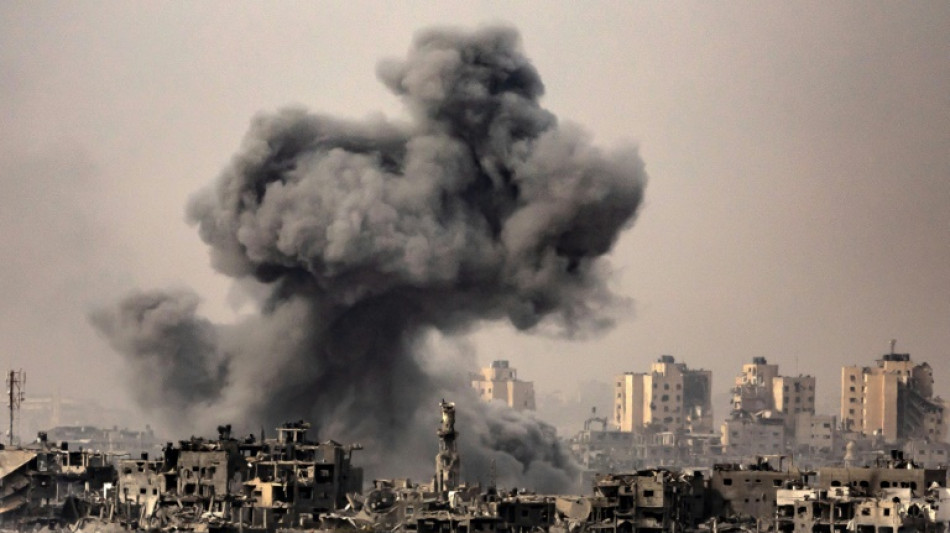
Hamas says 'heavy fighting' in Gaza as Israel steps up ground war / Photo: FADEL SENNA - AFP
Hamas said it was engaged in "heavy fighting" with Israeli troops inside northern Gaza Sunday, as besieged residents were again warned to flee southward.
After weeks of ferocious airstrikes, Israel has declared a new "stage" in a war that Prime Minister Benjamin Netanyahu warned would be "long and difficult".
Late Sunday Israel's military released footage that purported to show a significant number of tanks, infantry and artillery operating in Palestinian territory.
The military claimed to have struck more than "450 terror targets, including operational command centres, observation posts, and anti-tank missile launch posts".
Hamas said its Ezzedine al-Qassam Brigades were already "engaged in heavy fighting... with the invading occupation forces".
With a fierce door-to-door urban war expected, Israeli army spokesman Daniel Hagari told Palestinian civilians to go south "to a safer area".
It is now 23 days since Hamas gunmen launched a wave of bloody cross-border raids against homes, communities, farms and security posts inside Israel.
An estimated 1,400 people, mostly civilians, were killed and 239 people were taken hostage, according to the latest Israeli tallies.
Israel has vowed to free the hostages, track down those responsible and "eradicate" Hamas, a Palestinian Islamist movement that has governed Gaza since 2007.
But there is deep and growing international concern about the toll of Israel's campaign on Gaza's two-plus million residents.
The territory is under siege, with people unable to leave and only a limited amount of humanitarian aid allowed in.
Meanwhile, Israel has carried out one of the most intense bombing campaigns in recent memory.
The Hamas-run health ministry in Gaza says more than 8,000 people, mainly civilians and half of them children have already been killed.
- Food, water, medicine -
Inside Gaza's maze of streets, rubble and hulled-out buildings, there is a growing sense of panic, fear and desperation.
Ibrahim Shandoughli, a 53-year-old from Jabaliya in northern Gaza, asked why he would head south when that area is also being bombed.
"Where do you want us to evacuate to? All the areas are dangerous," he said.
Etidal al-Masri was among those who fled after Israel told residents in the north to leave.
But she still struggles to find even the basics amid shortages of food, water and medicine.
Gazans "must now queue for bread, toilets and even for sleep", she said.
On Sunday, the desperation appeared to boil over.
The United Nations reported that "thousands of people" had ransacked several of its warehouses looking for tinned food, flour, oil and hygiene supplies.
Only a trickle of aid has been allowed to cross the border from Egypt.
The UN said 33 trucks carrying water, food, and medical supplies had entered Gaza on October 29.
It is one of the largest deliveries to date, but still far short of the 100-a-day aid groups say is needed.
International Criminal Court lead prosecutor Karim Khan told Israel on Sunday that preventing access to humanitarian aid could be a "crime".
"Impeding relief supplies as provided by the Geneva conventions may constitute a crime within the court jurisdiction," Khan told reporters in Cairo.
He said he wanted "to underline clearly to Israel that there must be discernible efforts without further delay to make sure civilians" in the Hamas-run Palestinian territory "receive basic food, medicines".
- 'Axis of resistance' -
In a phone call with Netanyahu on Sunday, US President Joe Biden also underscored the need to "immediately and significantly" increase the flow of aid.
And while the White House has welcomed the gradual return of cell phone and internet services that had been cut for days, it had a sharp warning for Israel's leaders.
The "burden" lies with Israel to distinguish between militants and innocent civilians in Gaza, US National Security Advisor Jake Sullivan told CNN.
This as the United Nations said all hospitals in the north of Gaza had received evacuation orders, despite sheltering thousands of patients and more than 117,000 people who had become internally displaced because of the bombardment.
The Palestinian Red Crescent Society reported repeated strikes around Al-Quds hospital in central Gaza.
Mohamed al-Talmas, who has taken shelter in Gaza's biggest hospital Al-Shifa, said "the ground shook" with intense Israeli raids.
Iran's President Ebrahim Raisi has warned Israel's "crimes have crossed the red lines, which may force everyone to take action".
Since Hamas's attack on October 7, Iran-backed groups have launched attacks from Lebanon, Yemen, Iraq and Syria.
Skirmishes have intensified on the Israeli-Lebanese border with Iran-backed Hamas ally Hezbollah.
On Sunday militants in south Lebanon fired rockets towards Israel, which has responded with strikes.
The Israel Defense Forces also said they had "struck military infrastructure in Syrian territory" in response to launches "toward Israeli territory."
- 'Psychological games' -
Inside Israel, where shocked residents still face daily rocket attacks, much of the focus is on the hostages abducted by Hamas.
Hamas has released four prisoners and offered to release more as part of a swap for Palestinians detained in Israel.
It has also claimed "almost 50" hostages were killed by Israeli strikes -- a claim that was impossible to verify but has caused anguish to those praying for their loved ones to return.
"We demanded that no action be taken that endangers the fate of our family members," said Meirav Leshem Gonen, the mother of hostage Romi Gonen.
Israel's Defence Minister Yoav Gallant accused Hamas of playing "psychological games".
"Hamas is cynically using those who are dear to us -- they understand the pain and the pressure," he said.
burs-arb/ser
D.Moerman--LCdB