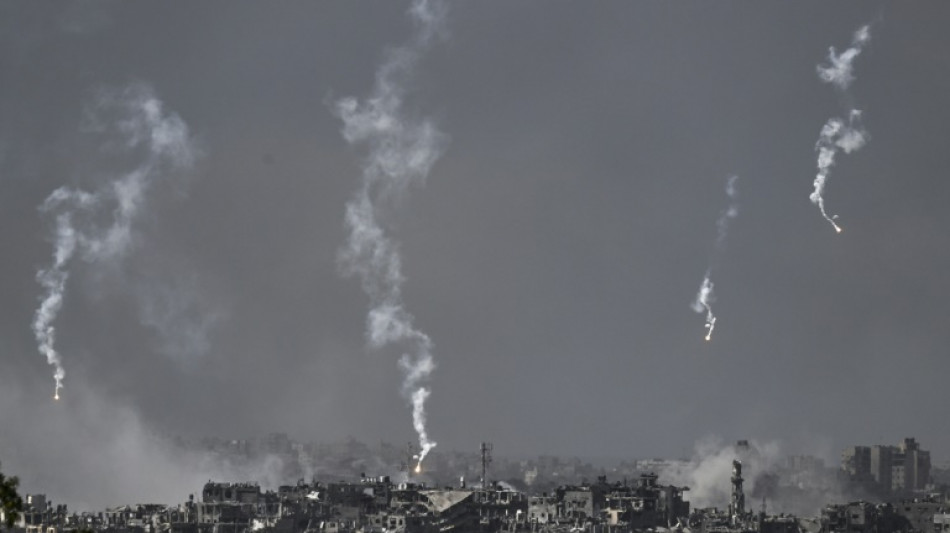
Ground battles rage in Gaza as concern grows for hospitals / Photo: Aris MESSINIS - AFP
Israeli ground forces fought deadly battles with Hamas militants inside Gaza on Monday and sent tanks to the outskirts of the biggest city while air strikes kept raining down on the besieged Palestinian territory.
The intensifying military campaign since the October 7 Hamas attacks has sharply heightened fears for the 2.4 million civilians trapped inside Gaza, where the Hamas-controlled health ministry says more than 8,300 have died.
Concern has surged about the widening humanitarian crisis and the fate of hospitals in the war zone where, the World Health Organisation warns, many patients cannot be safely moved despite Israel's evacuation order.
Israel's Prime Minister Benjamin Netanyahu has vowed to eradicate Hamas after its gunmen killed 1,400 people and took more than 230 hostages, according to the latest Israeli figures, in the worst attack in the country's history.
The attack set off the bloodiest-ever Gaza war, marked by weeks of withering aerial bombardment and three continuous nights of ground operations centred on northern Gaza, which Israel has told civilians to evacuate.
In heavy clashes overnight, the Israeli army said it had killed dozens of militants hiding "inside buildings and tunnels", and a fighter jet struck a building "with over 20 Hamas terrorist operatives inside".
Columns of Israeli tanks and armoured bulldozers were seen churning through the sand, and Israeli snipers took positions inside emptied residential buildings, in footage released by the army.
Dozens of Israeli tanks advanced for more than an hour into the southern fringes of Gaza City and blocked the main north-south highway, "firing at any vehicle that tries to go along it", an eyewitness told AFP by phone.
Air strikes also cratered the road and brought down buildings, residents said, before the tanks pulled back from the area.
- 'Cruel psychological propaganda' -
The Israeli land forces were supported by heavy fire from fighter jets, drones and artillery that the army said had struck more than 600 targets within 24 hours, up sharply from 450 a day earlier.
Hamas said it had fired anti-tank missiles at two Israeli armoured vehicles.
It also charged Israel was trying to present a "false image that its soldiers are present in the Gaza Strip interior, even though blows delivered by the resistance have prevented them".
Hamas also released a video of what it said were three women hostages, seated against a tile wall, although the time and place of the recording could not be verified.
One woman was heard calling in an agitated tone for Netanyahu to agree to Hamas' proposed exchange of the hostages for Palestinian prisoners.
Netanyahu decried the clip as "cruel psychological propaganda", in a statement issued shortly afterwards. He named them as Yelena Trupanob, Daniel Aloni and Rimon Kirsht, and vowed "to bring all the abducted and missing people home".
The more than 230 hostages -- aged between a few months and above 80 -- are believed to be held in a giant network of underground tunnels where Hamas has hid its military infrastructure from Israeli surveillance and air attacks.
"Our hearts are broken," it wrote on X, formerly Twitter. "Shani who was kidnapped from a music festival and tortured and paraded around Gaza by Hamas terrorists, experienced unfathomable horrors. May her memory be a blessing."
- Spiralling crisis -
Fear and desperation have spiralled in Gaza, under weeks of siege that have cut off water, food, fuel and other essentials to the long-blockaded territory.
The United Nations reported Sunday that civil order was starting to break down after "thousands of people" ransacked its warehouses looking for tinned food, flour, oil and hygiene supplies.
Donkey carts were lining up to load water, as safe drinking water has become scarce, in Khan Yunis in the southern Gaza Strip.
According to the UN, all 10 hospitals in northern Gaza have received evacuation orders -- despite sheltering thousands of patients and about 117,000 of the displaced.
Among those being treated are intensive care patients, infants and elderly people on life support systems.
The head of the World Health Organization said calls to evacuate Al-Quds hospital in Gaza City were "deeply concerning".
"We reiterate -- it's impossible to evacuate hospitals full of patients without endangering their lives," Tedros Adhanom Ghebreyesus wrote on X.
Mohamed al-Talmas, who has taken shelter in Gaza's biggest hospital Al-Shifa, said "the ground shook" there with intense Israeli raids.
Israel describes Al-Shifa hospital as a de facto Hamas "command centre" and headquarters.
- 'Collective punishment' -
UN chief Antonio Guterres has warned the situation in Gaza is getting "more desperate by the hour" and warned against the "collective punishment" of Palestinians.
US President Joe Biden stressed to Netanyahu that, while Israel has the right to defend itself, it must do so "in a manner consistent with international humanitarian law that prioritises the protection of civilians".
Britain's Prime Minister Rishi Sunak and French President Emmanuel Macron earlier "stressed the importance of getting urgent humanitarian support" into Gaza.
Limited aid has entered Gaza from Egypt under a US-brokered deal, but its volume, 117 trucks so far, has fallen far short of the hundreds of trucks a day aid agencies say are needed.
Anti-Israel anger has flared across the region and beyond.
In Russia's Muslim-majority Dagestan, police said they had arrested 60 people after on Sunday a crowd stormed an airport to attack Jewish passengers coming from Tel Aviv.
Washington has warned Israel's enemies -- in particular Iran-allied "axis of resistance" groups -- not to become more fully involved after a series of attacks across the Middle East.
The Israeli army has traded cross-border fire with Hezbollah in Lebanon and struck targets in Syria, including on Monday when it said it was responding to launches "toward Israeli territory".
Lebanon's caretaker prime minister, Najib Mikati, told AFP that "I am doing my duty to prevent Lebanon from entering the war".
Violence has also surged in the occupied West Bank where health officials say about 120 Palestinians have been killed since the Gaza war started.
Germany on Monday called on Israel to protect Palestinians in the West Bank from attacks by "extremist" Israeli settlers.
In annexed east Jerusalem on Monday, police said a knife-wielding Palestinian stabbed and seriously wounded an Israeli police officer before the attacker was shot dead.
burs-jmm-jd/fz/dv
G.Wouters--LCdB