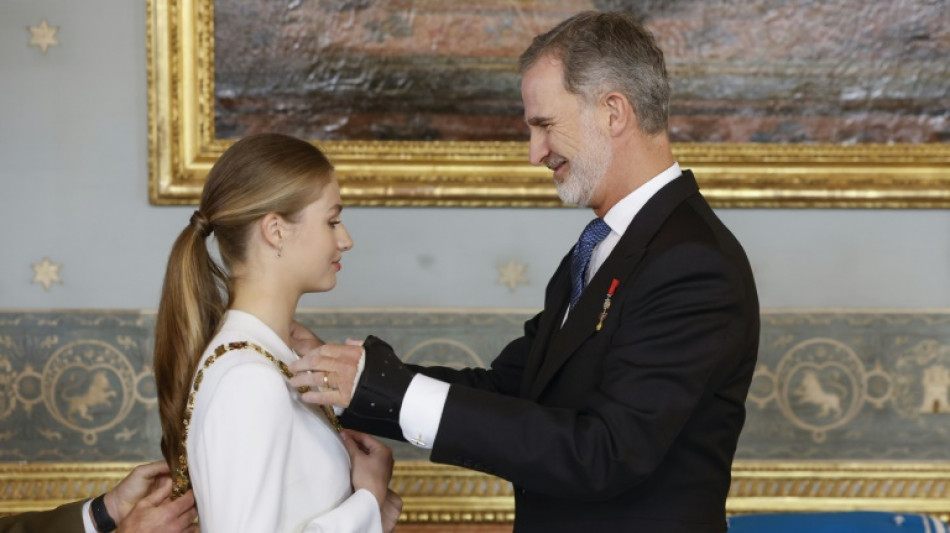
Spain cheers as crown princess comes of age in boost for monarchy / Photo: Juanjo MARTIN - POOL/AFP
Princess Leonor, heir to the Spanish crown, swore loyalty to the constitution on Tuesday, her 18th birthday, a legal milestone that royal watchers hope will turn the page for the monarchy after several years marred by scandal.
Her parents, King Felipe VI and Queen Letizia, and younger sister Sofia watched on as Leonor took the oath before a joint session of both houses of parliament.
Outside, flag-waving, cheering crowds watched the brief ceremony live on giant screens set up around Madrid.
"So proud to live such a day in Spain, it should have been a national holiday," said Blanca Palomares, a 23-year-old student who watched the ceremony in the Puerta del Sol square.
Wearing a white suit, Leonor pledged loyalty on the same copy of the constitution as her father 37 years ago.
"I swear to faithfully fulfil my duties, to protect and have protected the Constitution and its laws, to respect the rights of citizens and autonomous communities and to be faithful to the king," she said.
Loud applause erupted in the chamber after, as the king embraced his oldest daughter.
Church bells rang around Madrid and the country and crowds watching on screens also broke into applause and cheers.
With the oath taken, Leonor can legally succeed Felipe and automatically becomes head of state in the event of the monarch's absence.
Afterwards, the crown princess drove to the royal palace through the streets of Madrid, many of them decorated with photos of her.
"Happy birthday!" "Long live Spain!" shouted onlookers.
Leonor has managed to win popular affection, with the latest edition of celebrity magazine Lecturas dedicating its front page to the rise of "Leonormania" this week.
"I'm not a royalist, but the fact that it's a woman makes me a bit more sympathetic," said Andrea, 23, who came to central Madrid out of curiosity to witness the ceremony.
- New chapter -
Leonor speaks French, English and Catalan in addition to Spanish, and is learning a bit of Galician and Basque -- two regional languages spoken in Spain.
After finishing her International Baccalaureate at Atlantic College in Wales, the future commander-in-chief of Spain's armed forces in August began three years of military training at a military academy in the northeastern city of Zaragoza.
Like her father Felipe, she is expected to spend a year in each section of the armed forces, beginning with the army, before completing her university studies.
Royal supporters hope that the young, photogenic Leonor can breathe new life into the royal family, which had been battered over the last few years by scandals surrounding her grandfather, Juan Carlos.
Juan Carlos came to the throne in 1975 after the death of dictator Francisco Franco.
He was widely respected for his role in helping guide Spain from dictatorship to democracy, but a steady flow of embarrassing stories about his love life and personal wealth eroded his standing.
Juan Carlos did not attend the ceremony in parliament, but media reported he would attend a private party at the El Pardo palace near Madrid later in the day -- the first formal royal family gathering at which he'll be present since going into exile.
When she ascends to the throne, Leonor will become Spain's third full-fledged queen (instead of a queen consort), following Joanna of Castile in the 16th century and Isabella II in the 19th century.
V.Nijs--LCdB