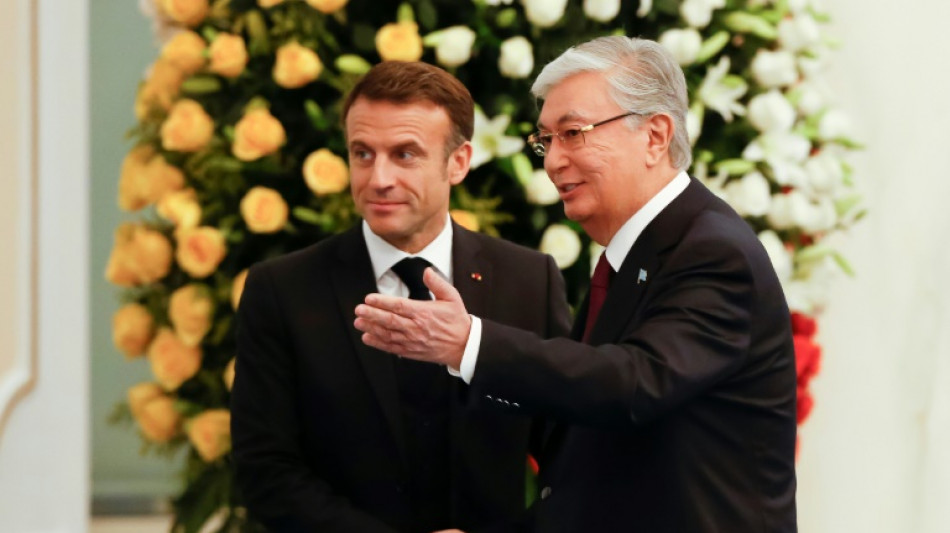
Macron calls to strengthen partnerships in Central Asia visit / Photo: Stanislav FILIPPOV - POOL/AFP
French President Emmanuel Macron said he wanted to "accelerate cooperation" with Kazakhstan on Wednesday, as part of a visit to boost France's footprint in Central Asia.
Macron is on a two-day visit to the resource-rich region, where Russia, China, Turkey and Europe are all jostling for influence.
"The strength (of our partnership) demonstrates the good strategic direction that has been taken, and the need to complement and accelerate it, which is the whole meaning of this visit," Macron said in a press conference in the Kazakh capital Astana.
Kazakhstan's president Kassym-Jomart Tokayev said France was his country's "key and reliable partner in the EU" and that he wanted to give their partnership "extra impetus".
The two leaders signed a series of contracts in sectors ranging from minerals and energy to pharmaceuticals and aerospace.
French energy giant EDF is in the running to build Kazakhstan's first nuclear power station -- a project that is due to be decided on in a referendum this year.
Critical minerals vital for clean energy technologies, which the region has plenty of, are an important part of the talks.
The head of French uranium company Orano, which already has a mine in Kazakhstan, is in Macron's delegation.
France is the fifth-biggest foreign investor in Kazakhstan, ahead of China, mainly because of the involvement of energy giant TotalEnergies in the massive Kashagan offshore oil field project
Trade turnover between France and Kazakhstan reached 5.3 billion euros ($5.6 billion) in 2022 and Kazakhstan supplies around 40 percent of France's uranium needs.
Central Asia, which has long been under Russian influence and was part of the Soviet Union, is receiving increasing attention from other powers as Moscow is taken up with its war in Ukraine.
The French leader will later travel to neighbouring Uzbekistan, ramping up efforts to put his country's political and economic mark on the energy-rich region.
China is particularly active in Central Asia with its "New Silk Road" project, but Europe and Turkey have also shown growing interest.
Hungarian Prime Minister Viktor Orban and Turkish President Recep Tayyip Erdogan are due to visit Astana on Thursday and Friday, shortly after Macron.
- 'Reform dynamic' -
Both Kazakhstan and Uzbekistan are aiming for greater economic openness and a balanced diplomacy, even though Russia remains their primary partner.
Macron's visit aims to support "interest in a diversification of partnerships expressed by both countries", a French presidency source said.
Several French presidents have visited Kazakhstan since the fall of the Soviet Union, but Macron will be the first to go to Uzbekistan since 1994.
Uzbek President Shavkat Mirziyoyev has put an end to two decades of isolation imposed by his predecessor and former mentor Islam Karimov, but there is still no real political opposition.
Macron prefers to emphasise the "reform dynamic" going on in the country and has said that the rule of law issue will be brought up during his visit.
V.Renard--LCdB