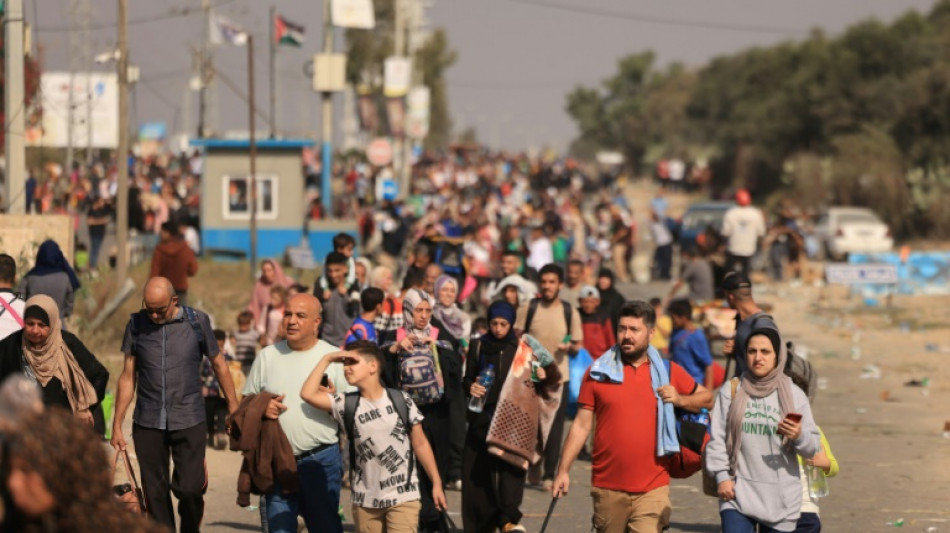
Thousands flee Gaza combat as talks seek pause / Photo: MAHMUD HAMS - AFP
Thousands of Palestinians fled heavy combat Thursday between Hamas and Israel in Gaza City as Israeli and US spy chiefs met in Qatar for talks on a possible humanitarian pause in the fighting.
Washington announced Israel had agreed to a daily four-hour military halt in northern Gaza to allow civilians out after for more than a month of war sparked by the October 7 Hamas attacks on Israel.
The limited pauses build on north-south "evacuation corridors" the Israeli army had promised would remain safe and which were used by tens of thousands to flee in recent days.
CIA director Bill Burns and David Barnea, head of Israel's Mossad spy agency, were in Doha for talks on a potential "humanitarian pause" that would include hostage releases and more aid for Gaza, an official told AFP.
"Talks have been progressing well towards a deal in the past few days," said the official who spoke on condition of anonymity.
While fighting raged Thursday, crowds walked south clutching children and small bags on the road leading away from the main focus of the war in Gaza City and its surroundings.
On October 7, gunmen from the Islamist group poured over the Gaza border with Israel and, according to Israeli officials, killed 1,400 people and seized about 240 hostages in the worst attack in the country's history.
Vowing to destroy Hamas, Israel retaliated with an aerial bombing and ground offensive that the health ministry in the Hamas-run Gaza Strip says has killed more than 10,800 people, many of them children.
- Humanitarian pauses -
Some 50,000 people fled south on Wednesday, UN and Israeli officials said, and thousands more followed on Thursday as Israel allowed several-hour windows for civilians to move away from the heaviest clashes.
US National Security Council spokesman John Kirby told reporters that Israel would implement four-hour pauses in areas of northern Gaza each day.
"We've been told by the Israelis that there will be no military operations in these areas over the duration of the pause (and) that this process is starting today," Kirby said.
Oda Bikhet, a witness to the consequences of the latest bombardment in Deir al-Balah in central Gaza, recounted the human toll.
"All of a sudden, an air strike hit the area, and we went out to check only to find children injured," he said. "One child lost his arm, another lost an eye. Another old person was injured."
Movement of civilians within Gaza has increased sharply from earlier this week, after the UN had estimated some 1.5 million people were already seeking safety in the south.
But hundreds of thousands of civilians remained in battle zones in the north, according to the UN Office for the Coordination of Humanitarian Affairs (OCHA).
Hamas on Thursday released images of its fighters, armed with rocket-propelled grenade launchers and assault rifles, clashing with Israeli soldiers backed by armoured vehicles in the ruins of the besieged territory's north.
The Israeli military said its operations in the heart of Gaza City, near Al-Shifa hospital, had targeted Hamas's "central intelligence headquarters" and weapons making facilities.
The battle raged above and below ground, the army said, exposing some of Hamas's extensive network of tunnel and subterranean bases that form a significant element of the militants' capacity to fight.
Israel said dozens of militants were killed, while adding the overall death toll for Israel's troops in the ground offensive had risen to 35.
The intense combat and the densely populated coastal territory being effectively sealed off have led to increasingly dire conditions for civilians.
French President Emmanuel Macron urged nations to "work towards a ceasefire" between Israel and Hamas, as he opened a conference in Paris on Gaza aid.
France's foreign ministry said the Paris talks would include work on donations of goods such as food, fuel and medical supplies, financial support and humanitarian access.
- 'Just a few trucks' -
Any promises of aid risk ringing hollow while supplies are being held up at the Gazan border.
"We're going to ask that aid enter Gaza because for now it's just a few trucks each day," Philippe Lazzarini, head of the United Nations' agency for Palestinian refugees UNRWA, told broadcaster France Inter early on Thursday.
Gaza's southern Rafah crossing with Egypt reopened Thursday to allow a limited number of wounded people and foreigners to flee the war, a Palestinian official told AFP.
Crossings were suspended for the second time on Wednesday due to Israel refusing to approve the list of wounded people due to be evacuated, which had been sent by the Hamas government to Egypt.
"Inside the operation room of Al-Awda hospital work is ongoing, but using primitive means, as the doctors are using head lamps and trying to perform surgical interventions with local anaesthesia," Mhanna said.
- Football fields become graveyards -
An Israeli military official insisted Gaza was not in a humanitarian crisis, even as he acknowledged the Palestinian territory faces several challenges amid the ongoing war.
"We know the civil situation in the Gaza Strip is not an easy one," said Colonel Moshe Tetro, head of Gaza coordination and liaison at COGAT, the Israeli defence ministry body handling civil affairs in the Palestinian territories.
Yet as he spoke, the climbing death toll in the territory meant that Palestinians were having to inter their dead in makeshift cemeteries.
"We bury the dead in football fields and other vacant lots because the proper burial grounds are full," said Shihteh Nasser, 48, who had helped in the burials.
Bodies have piled up outside hospitals, on roads and in parks, in refrigerated trucks and even in a repurposed ice-cream van.
Israeli Prime Minister Benjamin Netanyahu has repeatedly rejected a ceasefire unless the 239 believed to be held in Gaza are released.
As the war intensifies, discussions on the possible future of Gaza once the conflict ends have also grown, after Netanyahu this week said Israel would assume "overall security responsibility" of the territory.
Israel seized Gaza in the 1967 Six-Day War and withdrew in 2005. Two years later, Hamas took control and Israel imposed a crippling blockade.
burs-jm/ami
D.Jacobs--LCdB