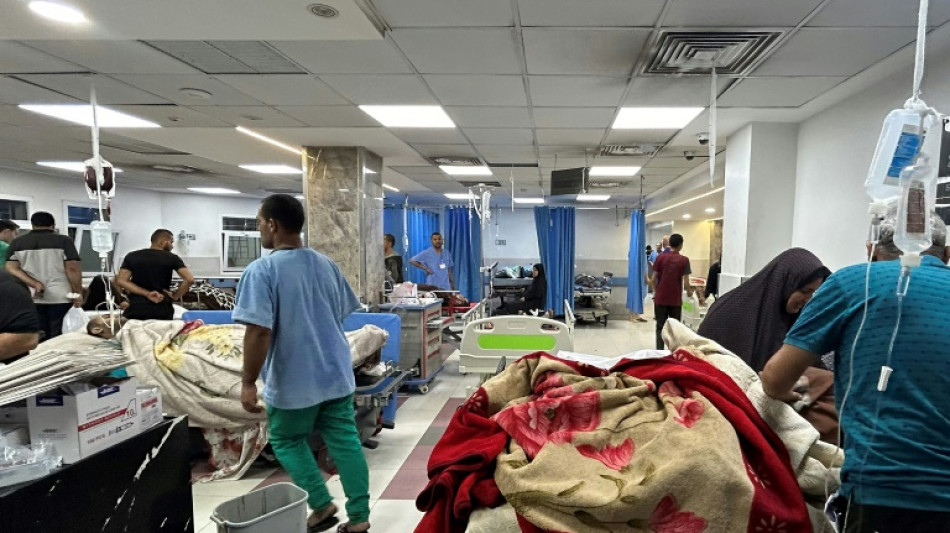
Israel-Hamas battles heighten fears for people trapped in Gaza hospital / Photo: Khader Al Zanoun - AFP
Intense fighting raged around Gaza's biggest hospital Sunday where doctors said thousands of Palestinians were trapped in dire conditions, as Israel pledged to help evacuate babies from the crippled facility.
Gaza City's Al-Shifa hospital has been caught in Israel's ground offensive aimed at destroying Hamas, and the compound has been repeatedly hit by gunfire and strikes, one of which Hamas health officials said destroyed the cardiac ward on Sunday.
The Israeli military has denied deliberately targeting the hospital and has repeatedly accused the Islamist militant group ruling Gaza of using medical facilities or tunnels beneath them as command centres and hideouts -- a charge Hamas denies.
The bloodiest ever Gaza war broke out after Hamas fighters smashed through the militarised border with Israel on October 7, killing around 1,200 people, mostly civilians, and taking about 240 people hostage, according to the most recent Israeli figures.
Israel's relentless campaign in response has killed more than 11,000 people, also mostly civilians and including thousands of children, according to the latest figures from the health ministry in Hamas-run Gaza.
The ministry has not updated tolls for two days citing the collapse of hospital services.
Witnesses inside the Al-Shifa hospital told AFP by phone on Sunday that "violent fighting" had raged around the hospital the whole night.
- Dire conditions in Gaza hospitals -
Inside Al-Shifa hospital, Doctors Without Borders surgeon Mohammed Obeid said there was no water, power, food or internet access for about 600 post-operative patients, 37-40 babies and 17 people in intensive care.
Countless other people are seeking refuge in the hospital grounds.
The surgeon said in an audio message posted Saturday on social media that two babies died in the Al-Shifa neonatal unit after power to their incubators was cut off and a man also died when his ventilator shut down.
The Israeli military pledged Saturday to aid the evacuation of babies from the hospital, noting that "staff of the Al-Shifa hospital has requested that tomorrow".
Military spokesman Daniel Hagari pledged that "we will help the babies in the paediatric department to get to a safer hospital. We will provide the assistance needed."
Twenty of Gaza's 36 hospitals are "no longer functioning", according to the UN's humanitarian agency.
Very little aid has made it into Gaza in the five weeks of war, with the densely populated coastal territory effectively sealed off by a total blockade that Israel has vowed to maintain until the hostages are freed.
The Israeli military confirmed that a Jordanian plane dropped medical equipment and food to the Jordanian Hospital in the Gaza Strip.
The army declined to elaborate further, and Israel's Foreign Ministry also made no comment.
As the fighting raged, Israeli Prime Minister Benjamin Netanyahu on Saturday ruled out a role for the current Palestinian Authority government in Gaza once the war is over.
"There will have to be something else there," he said, when asked whether the Palestinian Authority (PA), which has partial administrative control in the occupied West Bank, may govern Gaza after the war.
Palestinian president Mahmud Abbas, in a meeting with US Secretary of State Antony Blinken earlier this month, said the PA could only assume power in Gaza if a "comprehensive political solution" is found for the decades-old Israel-Palestinian conflict encompassing the West Bank, east Jerusalem and the Gaza Strip.
Netanyahu, in an interview earlier this week, said that Israel would assume "overall security" over Gaza "for an indefinite period" after the war.
- Many thousands flee south -
The intense fighting in northern Gaza has accelerated an exodus of people toward Gaza's south.
In all, the Israeli army said Saturday that in the past three days around 200,000 Palestinians had left southwards from the area of the northern Gaza Strip where fighting is heaviest.
In Gaza's south, arriving people were no longer able to find tents or improvised shelter, with some sleeping in the streets, according to AFP journalists.
Strikes were also hitting buildings at the southern end of Gaza in Rafah, the area to which civilians have been urged to evacuate.
A strike in southern Bani Souheila destroyed a dozen houses on Sunday, killing at least four people and wounded at least 30, said an AFP reporter at the scene.
Almost 1.6 million people have been internally displaced since October 7, according to the UN agency for Palestinian refugees UNRWA. This equals about two-thirds of Gaza's population.
- Regional tensions -
Around the world, the war has sparked Israeli commemorations for those killed and kidnapped on October 7, and pro-Palestinian rallies decrying the plight of people in Gaza and demanding a ceasefire.
Police estimated 300,000 marched in London on Sunday to support Palestinians. Many carried placards proclaiming "Stop Bombing Gaza", "Ceasefire Now" or "Free Palestine".
The families of Israeli hostages spoke of their agony at a rally in Tel Aviv Saturday.
"I came here to shout for my kidnapped parents," said Yair Mozes, whose parents were both abducted from Nir Oz, a kibbutz in southern Israel.
"We don't know their situation and we need them to be released immediately."
The conflict is stoking regional tensions and fears of the war expanding into neighbouring countries.
Israel fighter jets carried out strikes against "terror infrastructure" targets inside Syria in response to cross-border fire directed at the Golan Heights, the military said on Sunday.
Exchanges of cross-border fire have also taken place regularly along the frontier with Lebanon.
Israeli Defence Minister Yoav Gallant on Saturday warned Iran-backed Hezbollah that launching a war would result in widespread destruction in Lebanon similar to that in Gaza.
burs-jm/fz
K.Smeets--LCdB