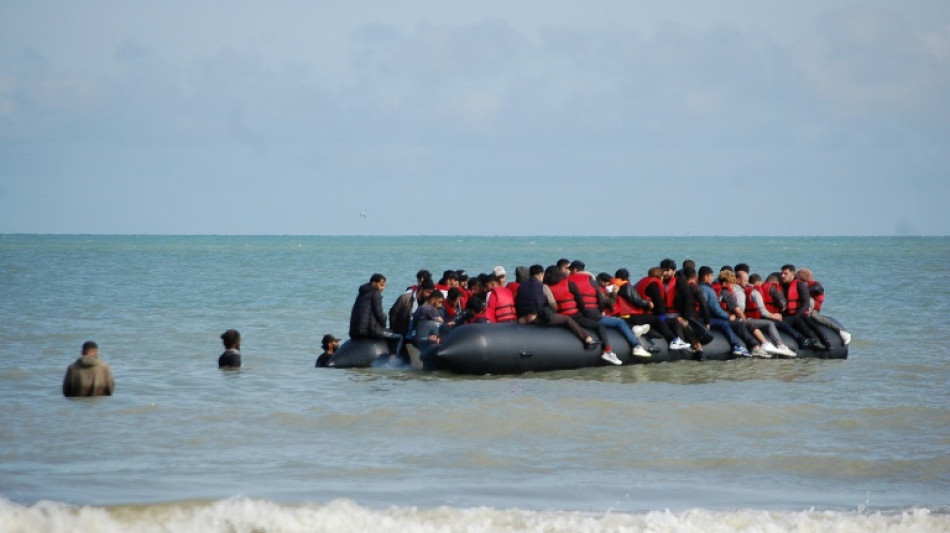
UK govt doubles down on Rwanda migrant policy despite court defeat / Photo: BERNARD BARRON - AFP
The UK government vowed Wednesday to persevere with a controversial plan to send migrants to Rwanda, despite the Supreme Court upholding a lower court ruling that it was unlawful and should not go ahead.
In a major setback for Prime Minister Rishi Sunak, a five-judge panel at the UK's highest court unanimously sided with an earlier Court of Appeal decision that the policy was incompatible with Britain's international obligations.
In a 56-page ruling, the judges agreed there were "substantial grounds" to believe Rwanda could forcibly return asylum seekers and refugees to a country where they could face persecution.
But within hours of the long-awaited judgment, Sunak and his ministers said the government would press ahead with finalising a "new treaty" with Rwanda to address those concerns.
"We anticipated this judgment... and for the last few months have been working on a plan to provide the certainty that the courts demand," newly appointed interior minister James Cleverly told MPs.
The new treaty will "make it absolutely clear" to British and European courts that the Rwanda policy "will be consistent with international law", he added.
In a call shortly after the ruling, Sunak and Rwandan President Paul Kagame "reiterated their firm commitment to making our migration partnership work", Downing Street said.
"Both leaders... agreed to take the necessary steps to ensure this is a robust and lawful policy and to stop the boats as soon as possible," Sunak's office added.
- 'Appetite' -
The Migration and Economic Development Partnership agreed in April last year envisages sending to Rwanda anyone who has made what London calls "dangerous or illegal journeys" to Britain on boats and hidden in lorries.
The first deportees were aboard a plane to fly to the African country in June 2022 when a last-minute European Court of Human Rights (ECHR) injunction prevented any deportations, prompting the legal challenges.
The government insists the scheme is crucial to deter "illegal" immigration across the Channel from France on inflatable vessels -- an emotive issue set to feature prominently in the next general election.
More than 27,000 have made the perilous journey this year -- down on the nearly 46,000 who crossed in 2022, but still far short of meeting Sunak's vow to "stop the boats".
His administration says both regular and irregular immigration must be slashed to ease pressure on government-funded services, such as health and housing asylum seekers.
Britain's asylum backlog stands at 122,585, after falling 12 percent from a record high in February.
Sunak's government passed legislation in July barring any "illegal" arrivals from claiming asylum, but it relies on finding third countries to send them to.
Opponents criticise the choice of Rwanda, while arguing the policy is overly cruel, costly and difficult to implement.
The government in Kigali said Wednesday it "take(s) issue" with the ruling that it is not a safe third country.
Despite the pledge to push ahead with its Rwanda plan, there is growing speculation London will now try to strike deals with other countries.
Cleverly claimed there was "an appetite for this concept", and said several other European countries were exploring similar agreements.
- 'Ignore the laws' -
The Supreme Court decision could widen rifts in the ruling Conservative party and prompt renewed demands from right-wingers that Britain withdraw from the ECHR.
Former interior minister Suella Braverman launched a scathing attack on Sunak on Tuesday, a day after he sacked her, accusing him of "betrayal" over immigration and saying he had "no appetite for doing what is necessary".
In parliament on Wednesday, Sunak told MPs he was "prepared to change our laws and revisit those international relationships" if "domestic legal frameworks or international conventions" frustrated the plans.
Outspoken Tory party deputy chairman Lee Anderson said ministers should "ignore the laws" and deport migrants the day they arrive.
He branded the court judgment a "dark day for the British people" and said the government should "just put the planes in the air now and send them to Rwanda".
The main Labour opposition, riding high in the polls, accused Sunak of failing to "have any serious plan to tackle dangerous boat crossings".
"Labour argued from the start this plan is unworkable and extortionately expensive," said home affairs spokeswoman Yvette Cooper.
Amnesty International's UK chief executive Sacha Deshmukh urged ministers to "now draw a line under a disgraceful chapter in the UK's political history".
H.Vermeulen--LCdB