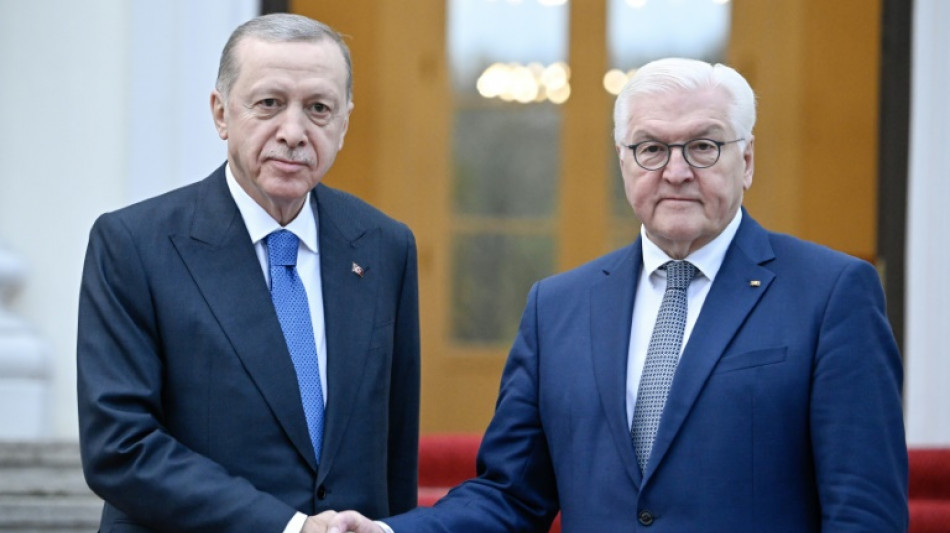
Germany, Turkey leaders trade barbs over Israel-Hamas war / Photo: Tobias SCHWARZ - AFP
Germany and Turkey's leaders traded barbs Friday over Israel's war on Hamas, with Frank-Walter Steinmeier stressing the country's right to exist while Recep Tayyip Erdogan demanded an end to Israel's military operation.
Erdogan is on a highly controversial visit to staunch Israel defender Germany, made more tricky by his accusations directed at Israel.
The Turkish leader has repeatedly branded Israel a "terror state" and defended Gaza's rulers Hamas as "liberators" fighting for their land.
In response to the statements, Steinmeier made clear Germany's position that the unprecedented October 7 onslaught by Hamas on Israel was a "terror attack", and Berlin viewed the group as a "terror organisation".
A separate statement issued by the Turkish presidency on the talks said "Erdogan stated that Israel's attacks on Palestinian lands must end and that the reaction from the whole world against human rights violations is important".
Erdogan has been increasingly critical of Israel's war against Hamas, triggered by the group's attack that Israel said killed around 1,200 people, mostly civilians, with around 240 hostages taken.
While Chancellor Olaf Scholz travelled to Israel to offer Germany's unconditional and unwavering support, the Turkish leader has accused Israel of committing war crimes with its bombardment and ground incursion in Gaza.
The death toll there has hit 11,500, mostly civilians and including thousands of children, according to Gaza's Hamas-run health ministry.
Erdogan's stance has sparked questions in Germany about the wisdom of hosting him at this time, with the opposition conservatives and even the liberal FDP, a member of Scholz's coalition, urging the chancellor to scrap the invitation.
The tensions were palpable as Erdogan arrived at Steinmeier's official residence earlier Friday.
The unsmiling leaders exchanged a terse handshake before the Turkish president was led indoors to sign a guestbook, while his German counterpart stood stony-faced by his side.
Later Friday, Erdogan is due to dine with Scholz.
- 'Uncomfortable partner' -
Characterised as an "uncomfortable partner" by Scholz's spokesman, Erdogan was on his first visit to Germany since 2020.
Scholz gave a hint of the tone at the upcoming talks as he slapped down a recent "fascism" accusation against Israel by Erdogan as "absurd".
Yet the Turkish leader ramped up his verbal attacks against Israel this week, calling it a "terror state" and alleging the West was "trying to exonerate the murderers".
The daily Frankfurter Allgemeine Zeitung said Germany offered the "ideal stage" for Erdogan to position himself as a voice for the "global south".
"As the loudest critic of Israel, he is underlining his demand for leadership of the Islamic world," said the daily.
Another issue that Erdogan may raise is Turkey's hopes to buy 40 Eurofighter Typhoon jets, which, according to Turkey's defence ministry, co-manufacturer Germany opposes.
Because of the differences, Scholz's centre-left-led government said it was all the more important to keep talking.
"We have always had difficult partners whom we have to deal with," said Scholz's spokesman Steffen Hebestreit, acknowledging that it is a visit "that will be challenging given the current circumstances".
"But it's not just about telling each other what we think, it's about moving forward on numerous issues... and for that, we need these talks."
Ties between the two countries have always been uneasy, with Berlin critical of Erdogan's clampdown on domestic dissent while recognising that getting regional power Turkey onside was necessary to tackle thorny issues.
From mediating to get grain shipments out of Ukraine amid Russia's war to negotiating a key deal on alleviating the 2015-2016 migrant influx in Europe, NATO member Turkey remains a crucial player.
Germany is also home to the biggest Turkish diaspora abroad, and a majority of the Turkish community in the country are supporters of Erdogan, including former German international footballer Mesut Ozil.
Erdogan's strident criticism of Israel sets him awkwardly against Germany, which has made the existence of Israel unconditional given its responsibilities over the Holocaust.
Josef Schuster, president of the Central Council of Jews in Germany, said Erdogan did not deserve to be trusted.
"Anyone who not only denies Israel's right to exist but also actively fights against it should not a be a partner for German politicians," he told newspaper group RND.
Yet Roth, who like Scholz is a Social Democrat, said the talks were important and should deliver "a lot of plain language".
N.Lambert--LCdB