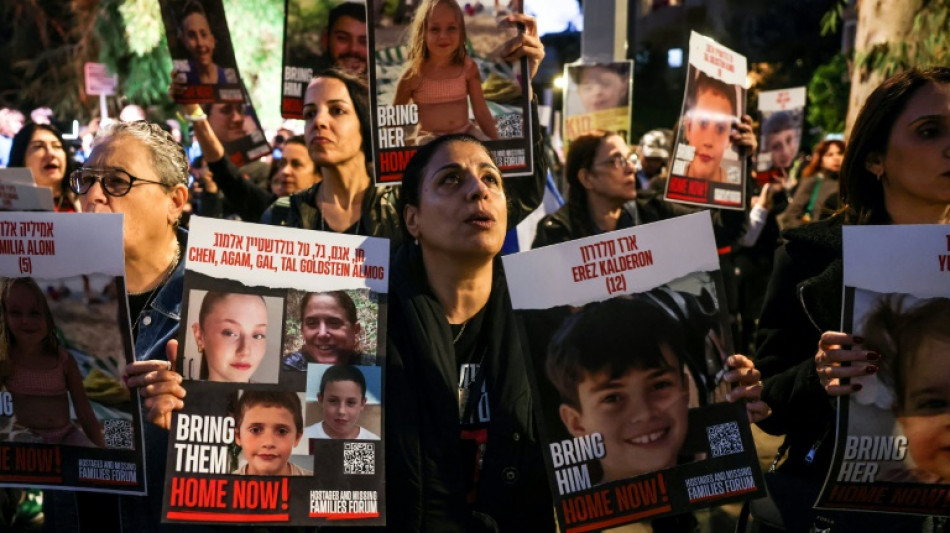
Hopes for hostages as Israel, Hamas, Qatar say progress in talks / Photo: AHMAD GHARABLI - AFP
Hopes mounted Tuesday that Hamas could release dozens of hostages from war-torn Gaza after the militant group's leader and key mediator Qatar said a truce deal was in sight and the Israeli premier pointed to "progress".
"We are close to reaching a deal on a truce," Hamas leader Ismail Haniyeh said, according to a statement sent by his office to AFP, after US President Joe Biden indicated an accord was on the cards.
In Qatar, foreign ministry spokesman Majed Al-Ansari said "we're very optimistic, very hopeful" and told reporters: "We are at the closest point we ever had been in reaching an agreement."
Israeli Prime Minister Benjamin Netanyahu, who has vowed to destroy Hamas, told soldiers at a military base that "we are making progress" on the return of hostages.
"I hope there will be good news soon," he added before his office announced that the war and security cabinets and government would meet Tuesday evening.
CNN quoted an unnamed senior US official as saying a deal was "very close" and could be announced by Qatar later on Tuesday, citing sources familiar with the talks.
Hopes of a breakthrough have been mounting since Qatar on Sunday said only "minor" practical issues remained to secure a deal.
Speculation grew further when the International Committee of the Red Cross, which is often involved in prisoner exchanges and hostage releases, said on Monday that its president had met Haniyeh in Qatar.
In retaliation, Israel launched a relentless bombing campaign and ground offensive in the Gaza Strip. According to the Hamas government, the war has killed more than 13,300 people, thousands of them children.
Sources from Hamas and Islamic Jihad, which also participated in the attacks, told AFP on condition of anonymity that their groups had agreed to the terms of a truce deal.
The tentative agreement would include a five-day truce, comprised of a complete ceasefire on the ground and an end to Israeli air operations over Gaza, except in the north, where they would only halt for six hours daily.
Under the deal, which the sources said could yet change, between 50 and 100 Israeli civilian and foreign hostages would be released, but no military personnel.
In exchange, some 300 Palestinians would be freed from Israeli jails, among them women and minors.
China's President Xi Jinping called for an "international peace conference" to resolve the conflict.
Pope Francis was due to hold private meetings Wednesday with relatives of Israeli hostages and of Palestinians trapped in Gaza, the Vatican said.
- 'Waiting for answers' -
A truce agreement could bring some respite for Gazans who have endured more than six weeks under Israel bombardment and an expanding ground offensive.
Large parts of Gaza have been flattened by thousands of air strikes, and the territory is under siege, with minimal food, water and fuel allowed to enter.
According to the Hamas and Islamic Jihad sources, the proposed deal would also allow for up to 300 trucks of food and medical aid to enter Gaza.
Israel has vowed to press on with its offensive, pledging to crush Hamas and ensure the hostages are released.
"We will not stop fighting until we bring our hostages home," Netanyahu declared after a meeting Monday with relatives of those abducted.
The Israeli military meanwhile said air strikes had hit "around 250" Hamas targets in the past day, destroying three underground shafts in the Jabalia area, which it said it had fully surrounded.
Two Israeli soldiers were killed "in operational activity" in northern Gaza, it added.
In Lebanon, official media said two journalists from Al-Mayadeen television and two other civilians were killed in cross-border shelling in the south.
Israel said only it was "looking into the details" of the incident.
- Premature babies -
Medics and patients have been increasingly caught up in the fighting, as Israel expanded its operation across northern Gaza.
The Hamas-run health ministry said Israel had laid siege to and hit the Indonesian Hospital in Jabalia on Monday, killing dozens, but there was no independent confirmation of the toll.
Twenty-eight premature babies from Gaza's largest hospital, Al-Shifa, were taken to Egypt for treatment on Monday. Three others evacuated from Al-Shifa remain in southern Gaza, the World Health Organization said on Tuesday.
Two babies died before the evacuation, the UN agency said.
The Indonesian Hospital lies near Gaza's largest refugee camp Jabalia, which has been the scene of intense Israeli bombing in recent days.
The health ministry official said there were still about 400 patients inside the hospital, as well as 2,000 people seeking shelter.
Around 200 people were evacuated from the hospital on Monday and bussed to the relative safety of a hospital in Khan Yunis in southern Gaza.
At the packed Al-Nasser Hospital in Khan Yunis, an AFP reporter saw bloodied children being carried in and lying dazed on gurneys.
"We miraculously got out," said one man who said he escaped the Indonesian Hospital.
"We still have brothers there. I just can't..." he said, his voice trailing off.
- International criticism -
Israel says Hamas uses medical facilities to hide fighters and as bases for operations, making them legitimate military objectives, while insisting it does everything possible to limit harm to civilians.
But criticism of Israel's conduct of the war has grown, from international agencies and some governments, with protest marches held across the world.
On Tuesday, South Africa's President Cyril Ramaphosa accused Israel of war crimes and "genocide" in Gaza.
The World Health Organization said it was "appalled" by the strike on the Indonesian Hospital, calling it just one of 164 documented attacks on health facilities and workers since the war began.
The UN children's agency meanwhile warned that fuel shortages and worsening sanitation in Gaza were shaping up to be "a perfect storm for tragedy" through the spread of disease.
burs-phz/fz
W.Blondeel--LCdB