Israel, Hamas truce and hostage release delayed by at least a day / Photo: Mohammed ABED - AFP
Israel said a four-day Gaza truce and hostage release will not start until at least Friday, delaying a breakthrough deal to pause the brutal war with Hamas.
National security adviser Tzachi Hanegbi indicated the phased release of at least 50 hostages in return for 150 Palestinian prisoners would still go ahead but not on Thursday as expected.
"The contacts on the release of our hostages are advancing and continuing constantly," he said in a statement about the agreed deal to free mostly women and people aged 18 and under on both sides.
"The start of the release will take place according to the original agreement between the sides, and not before Friday."
A second Israeli official said that a temporary halt in fighting would also not begin on Thursday as bombardment and combat again raged in northern Gaza.
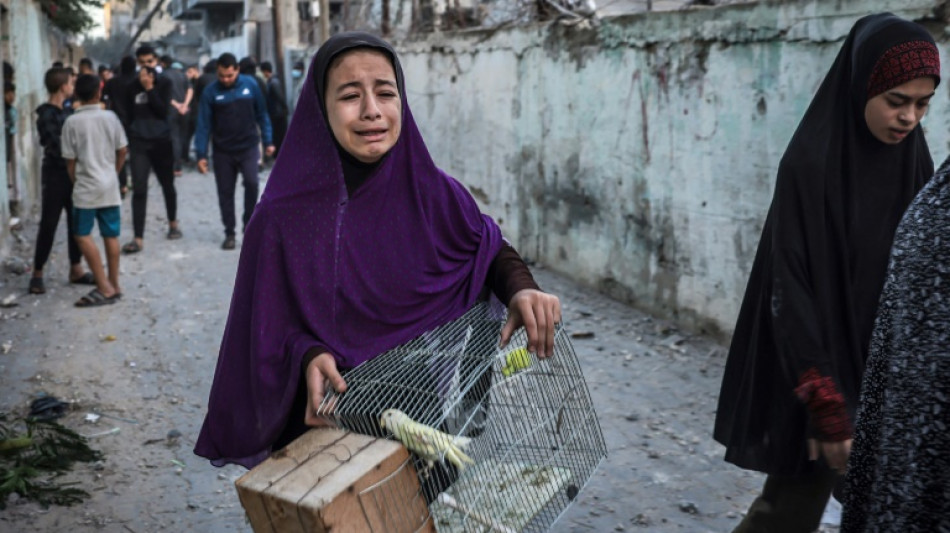
The delay is another blow to families desperate to see their loved ones return home, and to two million-plus Gazans praying for an end to 47 days of war and deprivation.
The complex and carefully choreographed deal saw Israel and Hamas agree a four-day truce, during which at least 50 hostages taken in the Palestinian militant group's attacks would be released in phases.
A Palestinian official with knowledge of the negotiation process who asked not to be named told AFP on Friday that the delay stemmed from "last minute" details over which hostages would be released and how.
Hamas and other Palestinian gunmen seized around 240 hostages during unprecedented raids into Israel on October 7 which killed 1,200 people, most of them civilians, according to Israeli authorities.
The attack prompted a relentless Israeli campaign of bombing and a ground offensive in Hamas-run Gaza, whose authorities say it has killed more than 14,000 people, thousands of them children.
An Israeli government document said that, in a second phase, for every 10 additional hostages released, there would be an extra day's "pause" in fighting.
Three Americans, including three-year-old Abigail Mor Idan, were among those earmarked for release.
In turn, Israel would free at least 150 Palestinian women and young detainees and allow more humanitarian aid into the besieged coastal territory.
The holdup came after weeks of talks involving Israel, Palestinian militant groups, Qatar, Egypt and the United States.
Qatari foreign ministry spokesman Majed Al-Ansari said Thursday that implementation of the accord "continues and is going positively."
- Homes shake -
In the meantime, Israel's aerial bombardment continued overnight on targets in Khan Yunis, southern Gaza, sending red and yellow fireballs and immense columns of black smoke into the air.
Homes shook several kilometres (miles) away in Rafah, AFP journalists said.
The agreement has been approved by Hamas leaders and by Israel -- despite fierce opposition from some within Prime Minister Benjamin Netanyahu's right-wing government.
Netanyahu has backed the agreement with Hamas, but vowed the truce will be temporary and will not end the campaign to destroy Hamas.
"We are winning and will continue to fight until absolute victory," he said on Wednesday, vowing to also secure Israel from threats coming from Lebanon, home to Iranian-backed Hezbollah militants.
Tensions rose on Israel's northern border early Thursday, after Hezbollah said five fighters, including the son of a senior lawmaker, had been killed.
Since the Israel-Hamas war began, the frontier between Lebanon and Israel has seen almost daily exchanges of fire, raising fears the Gaza war could fuel a region-wide conflagration.
Israel's army said Wednesday evening that it had struck a number of Hezbollah targets, including a militant "cell" and infrastructure.
The White House has pressed Israel not to escalate clashes with Hezbollah, for fear of sparking a wider war.
Biden also spoke to the leaders of Qatar and Egypt Wednesday, pushing for the truce to be "fully implemented" and to "ultimately secure the release of all hostages."
US Central Command said on Thursday said the destroyer USS Thomas Hudner in the Red Sea had "shot down multiple one-way attack drones launched from Huthi controlled areas in Yemen", referencing the Iran-backed rebel group.
- 'Pain in my heart' -
Families on both sides grappled with a lack of clarity over how the releases would unfold.
"We don't know who will get out because Hamas will release the names every evening of those who will get out the next day," said Gilad Korngold, whose son and daughter-in-law are being held in Gaza along with their two children and other relatives.
Israel's list of eligible Palestinian prisoners included 123 detainees aged under 18 and 33 women, among them Shrouq Dwayyat, convicted of attempted murder in a 2015 knife attack.
"I had hoped that she would come out in a deal," her mother, Sameera Dwayyat, said, but added that her relief was tempered by "great pain in my heart" over the dead children in Gaza.
Displaced Gazans remained sceptical about the Israel-Hamas deal.
Fatima Achour, a Palestinian lawyer in her forties, burst into tears when she reached Egypt through the Rafah border crossing, one of the few Gazans allowed to leave because she has a foreign passport.
"There's no city to go back to... There are no houses. Our lives have ended," she said. "This truce is not for us."
In northern Gaza witnesses reporting strikes on Kamal Adwan hospital and nearby homes.
Medical workers treated bloodied, dust-covered survivors as other residents fled through debris-strewn streets to safety.
At Gaza's biggest hospital, Al-Shifa, Israeli soldiers Wednesday escorted journalists into a tunnel shaft they said was part of a vast underground network Hamas has used for military purposes, a claim Hamas denies.
The army charged that Hamas "uses hospitals as a human shield" and led reporters into below-ground facilities with air-conditioning units, a kitchen and bathrooms, also showing piles of weapons outside it said it had recovered from battlefields.
Israeli forces arrested Al-Shifa's director Mohammad Abu Salmiya along with other medical personnel, another doctor and chief of department at the hospital, Khalid Abu Samra, told AFP.
burs-arb/it/fz
Y.Simons--LCdB