Gaza truce and hostage release to start Friday / Photo: SAID KHATIB - AFP
A pause in the Israel-Hamas war in Gaza will start on Friday morning and an exchange of hostages and prisoners will follow hours later, mediator Qatar said, after nearly seven weeks of fighting.
The breakthrough four-day truce facilitated by Qatar with help from Egypt and the United States had been due to take effect on Thursday but was delayed after a last-minute hitch.
Qatar said the pause would begin Friday at 7:00 am (0500 GMT) with the "first batch" of 13 civilian hostages -- all women and children from the same families -- being handed over around nine hours later.
Palestinian prisoners held in Israeli jails would also be released on Friday, Qatari foreign ministry spokesperson Majed Al Ansari said, adding a list of names had been approved, without saying how many.
The agreement entailed a "complete ceasefire with no attacks from the air or the ground" and the skies clear of drones to "allow for the hostage release to happen in a safe environment", Ansari said.
The armed wing of Hamas, the Ezzedine al-Qassam Brigades, confirmed the cessation of hostilities would start at 7:00 am under the deal that is also intended to provide aid to Gaza's 2.4 million residents struggling to survive with shortages of food, water and fuel.
It said a total of 50 hostages -- women and males aged 18 or under -- would be freed, with three Palestinian prisoners to be released for each of them.
The office of Israeli Prime Minister Benjamin Netanyahu said it was in contact with the families of the hostages after receiving "a first list of names" of those due to be released. It did not specify who was on it.
"We've already been on an emotional roller coaster for 47 days and today is no different," said Eyal Kalderon, a cousin of Ofer Kalderon, who is among those held captive in Gaza.
- 'Marathon negotiations' -
Palestinian prisoners will be released from three jails in Israel and the occupied West Bank and taken to the Ofer military camp on buses, an Israeli official told AFP on condition of anonymity, adding that they were expected to be freed in the evening.
Most were from the West Bank but five were from the Hamas-ruled Gaza Strip.
Hamas official Bassem Naim said "marathon negotiations" were behind the agreement, which "represents an important step towards alleviating the suffering of our people".
The release of Palestinian woman and children held in Israeli jails would start with those who have been detained the longest, Naim said.
The agreement follows weeks of war in Gaza after Hamas militants broke through the militarised border with Israel on October 7 in an unprecedented attack.
Israeli officials say about 1,200 people, mostly civilians, were killed and around 240 taken hostage.
The attack prompted a relentless Israeli campaign of bombing and a ground offensive in Gaza, where the Hamas government says more than 14,800 people, also mostly non-combatants, have been killed.
Governments around the world have welcomed the truce deal, with some expressing hope it will lead to a lasting end to the war.
"This cannot be just a pause before the massacre starts all over again," Riyad Mansour, Palestinian ambassador to the United Nations, told the Security Council.
Israeli officials, however, say the truce will be only temporary.
"We are not ending the war. We will continue until we are victorious," Israel's chief of staff, Lieutenant General Herzi Halevi, told troops he visited in Gaza, according to the army.
- Fighting rages -
Instead of the expected pause, fighting raged on Thursday. Explosions were heard on an AFPTV livecam and heavy grey clouds hovering over the territory's north, much of which has been reduced to rubble.
Israel's aerial bombardment continued on targets in the southern city of Khan Yunis, sending red and yellow fireballs and immense columns of black smoke into the air.
Homes shook several kilometres (miles) away in Rafah, AFP journalists said.
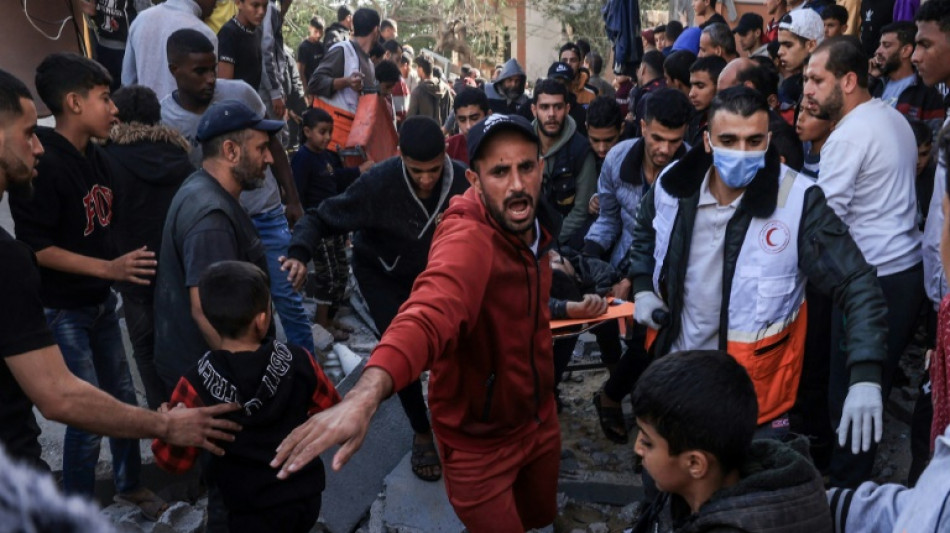
"I think there are still about 20 people under the rubble," said one Palestinian looking for survivors under a destroyed building east of Khan Yunis.
Thousands of children have been killed in Gaza, "the most dangerous place in the world to be a child", said Catherine Russell, executive director of the UN children's fund, UNICEF.
Youngsters are among the estimated 1.7 million Gazans who, according to the UN, have had to flee their homes during the fighting.
Under pressure to back up its claims that Hamas had a command centre under Gaza's Al-Shifa hospital, Israel's military on Wednesday escorted journalists to a tunnel shaft which soldiers said was part of a vast Hamas underground military network.
The army led reporters into underground facilities with air-conditioning, a toilet and what looked like a kitchenette.
Hamas and medical staff have denied a command centre is under Al-Shifa, Gaza's largest hospital.
Israeli forces arrested Al-Shifa's director Mohammad Abu Salmiya and other medical personnel, another doctor told AFP on Thursday.
- Fears of conflagration -
Since the Israel-Hamas war began, deadly exchanges of fire have gripped Israel's northern border, mainly between Israel and the Iran-backed Hezbollah movement.
These clashes have raised fears of a broader conflagration.
Hezbollah said Thursday that its chief, Hassan Nasrallah, met with Iran's Foreign Minister Hossein Amir-Abdollahian to discuss "the efforts made to end the Israeli aggression against the Gaza Strip".
Hezbollah said it fired 48 Katyusha rockets at a northern Israel military base.
The Israeli army said in response it used helicopters, fighter jets and the "Iron Sting" weapon system to strike Hezbollah infrastructure and attack sites.
Fatima Achour, a Palestinian lawyer in her 40s, burst into tears when she reached Egypt through the Rafah border crossing, becoming one of the few Gazans allowed to leave because she has a foreign passport.
"There's no city to go back to... There are no houses. Our lives have ended," she said. "This truce is not for us."
burs-dv/kir
T.Lambrecht--LCdB