Second hostage group returns to Israel after Hamas release / Photo: JACK GUEZ - AFP
Hamas on Saturday released a second group of Israeli and foreign civilians it had been holding hostage in the Gaza Strip in exchange for Palestinian prisoners, after an hours-long unexpected delay set nerves on edge.
Israeli authorities said 13 Israelis and four Thai citizens had returned to Israel.
The joint announcement by the Israeli military and the Shin Bet security service came after the prime minister's office said in a statement that the government "embraces the 17 hostages that are returning home, 13 of our citizens and 4 Thai citizens".
Hamas's armed wing said earlier that it had handed over 13 Israelis and seven foreigners to the Red Cross. The reason for the discrepancy in the reported number of foreigners released was not immediately clear.
The handover came hours later than expected after the militant group accused Israel of violating the exchange agreement, claims denied by Israeli officials.
The unexpected delay had caused heartache for relatives as Qatari and Egyptian mediators scrambled to address the Islamist group's concerns that Israel was interfering in the selection of prisoners for release and was not allowing aid to reach civilians in northern Gaza during the four-day truce.
Hamas said it had "responded positively" to Egyptian and Qatari mediators, after they relayed a promise by Israel to "uphold all the conditions of the accord".
Qatar had said that in the second exchange of the truce, 13 Israeli hostages -- eight children and five women -- would be released in return for 39 Palestinian prisoners -- 33 children and six women.
Seven foreigners held in Gaza would also be released, Qatari foreign ministry spokesman Majed Al Ansari wrote on X, formerly Twitter.
Israeli officials denied any breach of the terms of the pause.
Hamas had accused the Israeli army of preventing aid from reaching northern Gaza, its main centre of operations, where troops have forbidden civilians from returning during the truce which began early Friday.
The UN humanitarian agency OCHA said that in "several reported incidents" on Friday, "Israeli forces opened fire and threw teargas canisters at people heading northwards; at least one person was reportedly killed, and dozens injured."
The Hamas-run health ministry in Gaza said seven people had been wounded in similar incidents on Saturday.
Saturday's delay followed an initial exchange on Friday when Hamas released 13 Israelis, all of them women and children.
Israel in turn released 39 Palestinian women and children from its prisons under an agreement that mandates exchanges at a ratio of three to one.
Ten Thais and one Filipino were also unexpectedly freed by Hamas.
Hamas fighters snatched around 240 people when they broke through Gaza's militarised border with Israel on October 7, killing about 1,200 Israelis and foreigners, according to Israeli authorities.
Following the deadliest attack in its history, Israel launched an air, artillery and naval bombardment alongside a ground offensive to destroy Hamas, killing nearly 15,000 people, mostly civilians and including thousands of children, according to the Hamas government in Gaza.
- 'Finally home' -
A video released by Hamas showed masked militants with rifles, wearing military fatigues and the green headband of the Islamist movement's armed wing, handing hostages over to the Red Cross on Friday.
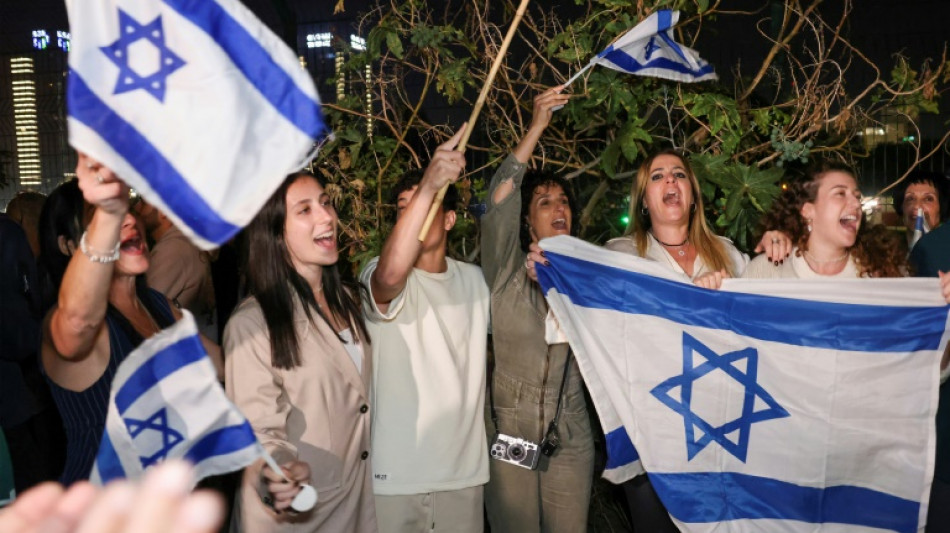
In a Tel Aviv suburb, people applauded and held up Israeli flags as helicopters flew in the freed captives.
At Israel's Wolfson Medical Center, which received five elderly women hostages, Dr Shoshi Goldner said "there was no one in the room that could hold his feelings and stop crying".
"You are finally home in a safe place," Goldner said.
"Today we are excited about the returnees, but I want us not to forget all those who have not yet returned," Yael Adar, daughter-in-law of former hostage Yaffa Adar, 85, told Israel's Ynet news website.
Hamas is expected to free a total of 50 hostages during the truce in exchange for 150 Palestinian prisoners, under an agreement brokered by Qatar, Egypt and the United States.
Egypt said that it had received positive feedback from both sides about the idea of extending the truce for a day or two and releasing more hostages and prisoners.
"It's only a start, but so far it's gone well," US President Joe Biden told reporters, adding "the chances are real" for extending the truce.
Jordan's Foreign Minister Ayman Safadi called for "a permanent ceasefire and a complete end to this aggression".
But Israeli armed forces chief Lieutenant General Herzi Halevi insisted Saturday that the war to eliminate Hamas would resume as soon as the pause in fighting ends.
"We will return immediately at the end of the ceasefire to attack Gaza," Halevi said.
"We will also do this in order to dismantle Hamas, also to create a great deal of pressure to return as quickly as possible and as many abductees as possible, every last one of them," he added.
- Palestinians celebrate -
In the Israeli-occupied West Bank, fireworks exploded and crowds filled the streets. The freed prisoners waved Palestinian and Hamas flags.
"I was just waiting for the day I would be released from prison so I could hug my mother like this," said Rawan Abu Matar, who served eight years for attempting to stab an Israeli soldier.
In Israel, authorities asked the media to let the newly freed hostages reunite with loved ones in privacy.
Among those released was Hannah Katzir, 76, who according to her family uses a walking frame and needs medication.
Mothers and their children were also freed, including Doron Katz-Asher, 34, and her two young daughters.
In an emotional reunion at an Israeli hospital, nine-year-old Ohad ran to hug his father after he was released along with his mother and grandmother.
- More aid -
The pause in fighting in Gaza opened the way for more aid to Palestinians struggling to survive with shortages of water and other essentials. Israel had placed Gaza under near-total siege.
Trucks carrying supplies including fuel, food and medicines began moving into Gaza through the Rafah crossing from Egypt on Friday, and more entered on Saturday.
In Rafah, many waited to fill gas canisters for cooking. "All the people are hoping and ready for it to make their lives easier," said one resident, Ezzeddine Abu Omeira.
The UN estimates that 1.7 million of Gaza's 2.4 million people have been displaced by the fighting.
Since the truce, thousands have been returning to what is left of their homes.
"We are civilians," said Mahmud Masood, standing in front of flattened buildings in Jabalia, northern Gaza. "Why have they destroyed our houses?"
In southern Gaza, AFPTV drone images showed people walking or riding in donkey carts along paths cleared through piles of rubble.
I.Mertens--LCdB