France's Macron faces anger over prices on campaign trail
French President Emmanuel Macron faced voters worried about their incomes and rising energy prices on Monday as he hit the campaign trail less than two weeks from elections.
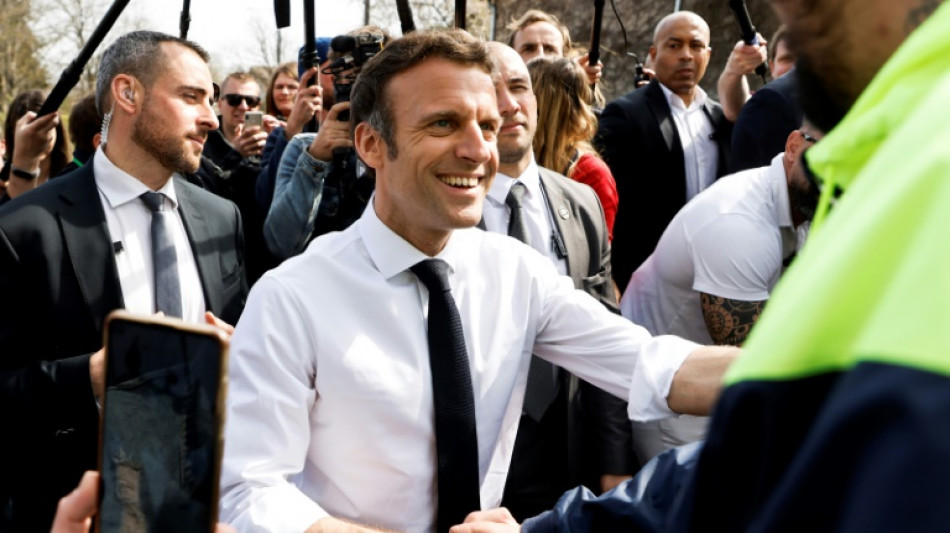
Switching from his lofty perch as head of state to the rough and tumble of domestic politics, Macron travelled to the eastern town of Dijon for a classic pre-election walkabout and a visit to a high school.
"Do you find it normal that I can't live off my income?" a 46-year-old salesman asked him during one stop. "Everything is going up... put yourself in the position of a French family. It can't carry on, people will go nuts."
Macron pointed to a government-ordered cut of petrol prices by 18 centimes ($0.20 cents) that will come into force on Friday, as well as caps on gas and electricity prices at a cost of 20 billion euros ($22 billion).
"There isn't magic money," he explained, while claiming that he was "the one who is doing the most" in Europe to try to lessen the impact of inflation on households.
Macron has so far largely shunned the presidential campaign, insisting that he has had to focus on the Covid-19 pandemic and more recently the war in Ukraine.
Monday marked the start of the official campaign period running up to the first round of voting on April 10, with all 12 candidates now entitled to equal time and space in the domestic media.
The top two candidates in the first round will go through to a run-off on April 24.
- 'Things can still change' -
The 44-year-old head of state is the current favourite to win, with the war in Ukraine seen as helping raise his profile, while veteran far-right candidate Marine Le Pen is running in second place, polls suggest.
A new survey by the Ipsos/Sopra Steria group published in Le Monde newspaper on Monday showed Macron at 28 percent ahead of the first round, down a point, while Le Pen gained 1.5 points to 17.5 percent.
In a runoff between the two, the poll suggested Le Pen had closed the gap to 47 percent versus 53 percent for Macron, a much smaller margin than most other surveys.
"Victory is so close, if the people vote, the people will win," her National Rally party wrote on Twitter as it highlighted the survey.
Le Pen continues to run a low-key campaign that has seen her tone down her usual hardline rhetoric on immigration in favour of focusing on household income, voters' biggest priority according to polls.
Macron also took aim at rival far-right opponent Eric Zemmour on Monday after weekend images from his rally in Paris in which the crowd can be heard chanting "Killer Macron."
Zemmour, a former TV pundit running an anti-immigrant campaign, was criticising the government at the time for letting what he called foreign criminals into the country, a small number of which have been involved in murders.
Macron allies have criticised Zemmour for failing to condemn the chants, while Zemmour's team has said he did not hear them.
"There are two theories: the first is that it is a shameful act, which seems to be the most credible, but is not a surprise," Macron told reporters in bright spring sunshine.
"The second one is that there's a lack of knowledge about a very important reform during my term in office," he added, explaining how the cost of hearing aids was now fully covered by the social security system.
"I invite the hard-of-hearing candidate to get himself sorted out at lower cost," he added.
Zemmour, who soared in opinion polls last autumn while teasing his presidential ambitions, has since slipped to fourth or fifth.
Frederic Dabi, a leading polling expert at the Ifop group, stressed that the race remained unpredictable despite Macron's apparent strength in voter surveys.
Q.Ceulemans--LCdB