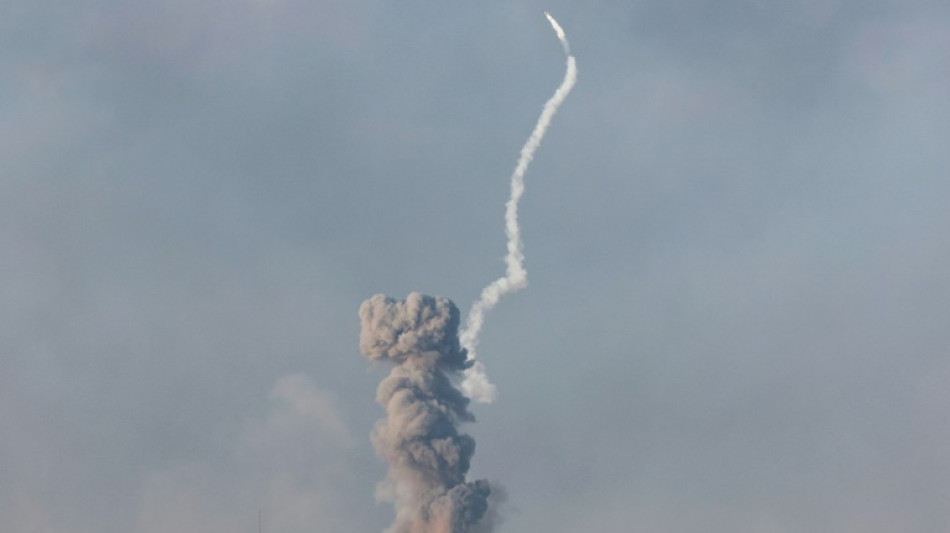
Israel-Hamas battles rage in south Gaza city / Photo: JACK GUEZ - AFP
Israeli forces battled Hamas militants in Gaza's main southern city on Wednesday, as the UN warned a complete breakdown in public order was imminent after nearly two months of war sparked by deadly attacks on Israel.
Israeli troops, tanks, armoured personnel carriers and bulldozers have rolled into Khan Yunis, Gaza's second-largest city, forcing already displaced civilians to flee again, witnesses said.
Sources in Hamas and Islamic Jihad, another Palestinian militant group, told AFP their fighters were battling to control entry into the city.
But the Israeli army said it had pierced defensive lines and carried out "targeted raids in the heart of the city", where they found and destroyed 30 tunnel shafts.
Prime Minister Benjamin Netanyahu said in a video statement that Israeli forces were closing in on the home of Hamas chief Yahya Sinwar, with a spokesman saying it is "underground" in the Khan Yunis area.
"We are devastated, mentally overwhelmed," said Khan Yunis resident Amal Mahdi, who survived an overnight Israeli strike. "We need someone to find us a solution so we can get out of this situation."
Israel declared war on Hamas after the militant group's October 7 attacks that killed 1,200 people, mostly civilians, according to Israeli authorities, and saw around 240 hostages taken.
The latest toll from the Hamas government said 16,248 people in the Palestinian territory, most of them women and children, have been killed in the war.
- 'Public order to completely break down' -
Much of northern Gaza has already been reduced to rubble by fierce fighting and bombardment, displacing 1.9 million people according to UN figures.
"We, too, want this war to end," Israeli government spokesman Eylon Levy told reporters, "But it can only end in a way that ensures that Hamas can never attack our people again."
Israel has vowed to destroy Hamas and free 138 hostages still held in Gaza after scores were released during a week-long truce that ended Friday.
But mass civilian casualties have sparked global concern, heightened by dire shortages caused by an Israeli siege that has seen only limited supplies of food, water, fuel and medicines enter.
"The entire north of the Gaza Strip is left without health services," said Munir al-Bursh, director of the Hamas-run health ministry.
With mediation efforts seemingly stalled, multiple United Nations bodies are pleading for a ceasefire and the release of hostages.
UN Secretary-General Antonio Guterres said he expects "public order to completely break down soon due to the desperate conditions" in Gaza, with "potentially irreversible implications for Palestinians as a whole."
The UN's rights chief, Volker Turk, warned of "utter, deepening horror" for Gazans, who are being "collectively punished".
G7 leaders said they "remain committed to a Palestinian state as part of a two-state solution" following a virtual meeting.
- 'No shelter, no bread' -
Many civilians fled to Khan Yunis when Israel ordered them to evacuate the north of the densely populated Strip earlier in the offensive.
They are now being pushed further south to Rafah on the closed border with Egypt.
"We arrived here with no shelter and got rained on last night. There isn't anything to eat -- no bread, no flour," Ghassan Bakr told AFP.
And Israeli bombardments have followed them.
A strike on a residential district in Rafah left 17 dead and dozens injured late Wednesday, the Hamas health ministry said, and an AFP journalist saw the wounded, including children, being taken to a local Kuwaiti hospital.
Meanwhile, pan-Arab television network Al Jazeera said one of its journalists had lost 22 members of his family in a strike in the northern refugee camp of Jabalia.
The Israeli army said Wednesday it had struck about 250 targets in Gaza over the past 24 hours and that troops had found a major arms depot "in the heart of a civilian population" near a clinic and school in the north of the territory.
"The depot contained hundreds of RPG missiles and launchers of various types, dozens of anti-tank missiles," explosives and drones, it said in a statement.
International aid groups have condemned the successive Israeli orders to flee, saying civilians were running out of options.
- 'Survivors must be heard' -
Israel's army has published a map it said could enable Gazans to "evacuate from specific places for their safety if required".
But the UN children's agency, UNICEF, said it was "not possible" to create adequate safe zones in a tiny territory with some 2.4 million people.
The UN has responded to criticism that it had failed to focus on reports of sexual violence by Hamas during the October 7 attack, which the Palestinian group has dismissed as "unfounded lies".
UNICEF head Catherine Russell said the accounts were "horrific" and "survivors must be heard, supported, and provided with care", but Israel said it was too little, too late.
The war has sparked fears of a wider regional conflict, with near-daily exchanges of fire with Iran-backed Hezbollah across Israel's border with Lebanon and a surge of deadly violence in the occupied West Bank.
In the occupied West Bank, Israeli troops raided two refugee camps and killed three Palestinians, one aged 16, according to the Palestinian health ministry and Wafa news agency.
Palestinian authorities say more than 250 Palestinians have been killed by Israeli fire or settler attacks since the war began.
G.Hendrickx--LCdB