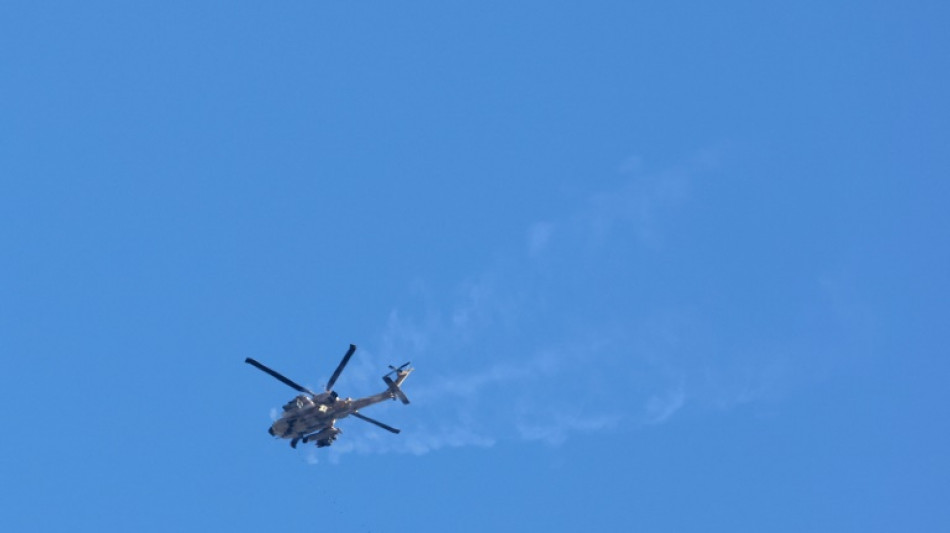
Israel bombs Gaza targets after US vetoes rare UN ceasefire bid / Photo: JACK GUEZ - AFP
Israel bombarded targets in Gaza on Saturday after the United States blocked an extraordinary UN bid for a ceasefire in the war with Hamas that has triggered alerts of an "apocalyptic" humanitarian situation.
Aid workers say Gaza's humanitarian system is on the verge of collapse, as disease and starvation threaten.
Washington's veto was swiftly condemned by the Palestinian Authority and Hamas, whose health ministry put the latest death toll in Gaza at 17,490, mostly women and children.
An Israeli strike on the southern city of Khan Yunis killed six people, while five others died in a separate attack in Rafah, the ministry said Saturday.
It added that, over a 24-hour period, 71 dead and 160 wounded had arrived at Al-Aqsa hospital in Deir al-Balah city following persistent bombings.
Repeated volleys of automatic weapons fire was heard Saturday in Gaza's north, in live footage aired by AFPTV.
The Ezzedine al-Qassam Brigades, Hamas's armed wing, said it fired rockets Saturday towards Reim in southern Israel, where Hamas gunmen killed 364 people, Israel says, at a musical festival on October 7.
Israel has vowed to eradicate Hamas after its unprecedented attacks of that day, when militants broke through Gaza's militarised border to kill around 1,200 people and seize hostages, 138 of whom remain captive, according to Israel.
Vast areas of Gaza have been reduced to rubble and the UN says about 80 percent of the population has been displaced, with dire shortages of food, fuel, water and medicine reported.
"It's so cold, and the tent is so small. All I have are the clothes I wear," said Mahmud Abu Rayan, displaced from Beit Lahia in the north.
- 'Into the abyss' -
UN Secretary-General Antonio Guterres triggered the rare Security Council vote by invoking a measure unused in decades.
He sought the council's endorsement of a ceasefire because, he said, rapidly deteriorating current conditions make it "impossible for meaningful humanitarian operations", with potentially irreversible implications for regional peace and security.
The United States on Friday vetoed the Security Council resolution.
US envoy Robert Wood said it was "divorced from reality" and "would leave Hamas in place able to repeat what it did on October 7".
Israeli Foreign Minister Eli Cohen said the ceasefire "would prevent the collapse of the Hamas terrorist organisation, which is committing war crimes and crimes against humanity, and would enable it to continue ruling the Gaza Strip".
Humanitarian groups swiftly condemned the veto.
Hamas denounced it as "a direct participation of the occupation in killing our people", while Palestinian prime minister Mohammed Shtayyeh called it "a disgrace and another blank cheque given to the occupying state to massacre, destroy and displace".
On Saturday Iran, which backs Hamas, warned about the possible "uncontrollable explosion in the situation of the region" after the US veto.
Guterres said Friday that "the people of Gaza are looking into the abyss", with "a spiralling humanitarian nightmare".
Many of the 1.9 million Gazans displaced by the war have headed south, turning Rafah near the Egyptian border into a vast camp.
- 'Apocalyptic' situation -
The World Health Organization's executive board is to convene Sunday to discuss Gaza's health situation. Ahead of a meeting, more than a dozen WHO member states expressed "grave concern about the catastrophic humanitarian situation".
Their draft resolution also urged Israel to protect aid workers in Gaza.
One of only two partially operating hospitals in Gaza's north, Al-Awda, "is surrounded by Israeli troops and tanks, and fighting is ongoing in its vicinity", the UN said.
Aid groups emphasised the worsening conditions for people struggling to survive in overcrowded Gaza, where fuel and medical supplies are critically low, people sleep in the streets, and essentials like diapers are unavailable.
Alexandra Saieh, of Save the Children, spoke of "maggots being picked from wounds and children undergoing amputations without anaesthetic."
The situation "is not just a catastrophe, it's apocalyptic," said Bushra Khalidi of Oxfam.
With the civilian toll mounting, US National Security Council spokesman John Kirby reiterated Washington's calls for Israel to do more to protect civilians.
"We certainly all recognise more can be done to... reduce civilian casualties. And we're going to keep working with our Israeli counterparts to that end," he said.
Washington provides billions of dollars in military aid to Israel.
Israel says 93 of its soldiers have been killed in Gaza, and two others were severely injured in a failed bid to rescue hostages.
"Numerous" militants were killed in the operation, the army said on Friday.
- Lebanon border strikes -
Hamas earlier said a hostage was killed in the operation, and released a video purporting to show the body.
AFP was unable to immediately verify its authenticity.
Strikes in neighbouring countries reinforced worries over a potentially wider war.
Israel's army on Saturday said it had fired overnight "toward the source of" unspecified launches from Lebanon towards Israeli territory.
Fighter jets also struck targets of Lebanon's Iran-backed Hezbollah movement in Lebanon, the military said.
In south Syria, three Hezbollah fighters and a Syrian were killed Friday in an Israeli drone strike, said the Syrian Observatory for Human Rights.
Hezbollah said three of its fighters had been killed, without giving any further details.
Washington blamed Iran-aligned militias, who have conducted dozens of similar strikes since the start of the Israel-Hamas war.
This was the first such attempt against the US embassy. There were no reported casualties or damage.
H.Vermeulen--LCdB