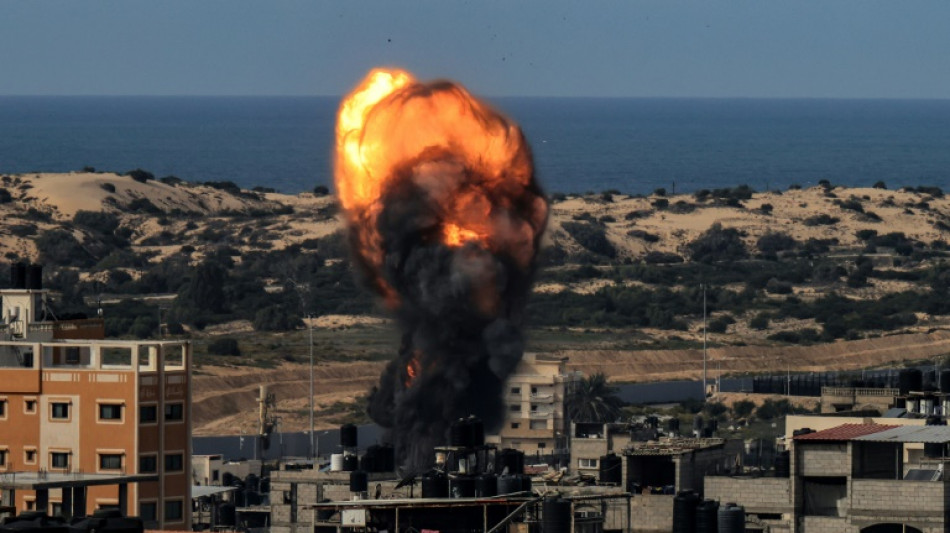
Israel pounds Gaza targets after US vetos rare UN ceasefire bid / Photo: MAHMUD HAMS - AFP
Israel bombarded targets in Gaza on Saturday after the United States blocked an extraordinary UN bid for a ceasefire in the war with Hamas that has triggered alerts of an "apocalyptic" humanitarian situation.
Aid workers say Gaza's humanitarian system is on the verge of collapse, as disease and starvation threaten.
Washington's veto was swiftly condemned by the Palestinian Authority and Hamas, whose health ministry put the latest death toll in Gaza at 17,490, mostly women and children.
An Israeli strike on the southern city of Khan Yunis killed six people, while five others died in a separate attack in Rafah, the ministry said Saturday.
It added that, over a 24-hour period, 71 dead and 160 wounded had arrived at Al-Aqsa hospital in Deir al-Balah after persistent bombings. Gunfire was heard and flashes of light that silhouetted palm trees were seen overnight in the city's Al-Zawaida district.
The Ezzedine al-Qassam Brigades, Hamas's armed wing, said it fired rockets Saturday towards Reim in southern Israel, where Hamas gunmen killed 364 people, Israel says, at a music festival on October 7.
Israel has vowed to eradicate Hamas after its unprecedented attacks of that day, when militants broke through Gaza's militarised border to kill about 1,200 people and seize hostages, 138 of whom remain captive, according to Israel.
Vast areas of Gaza have been reduced to rubble and the UN says about 80 percent of the population has been displaced, with dire shortages of food, fuel, water and medicine reported.
At Nasser hospital in the central city of Khan Yunis, an AFP correspondent saw a child on a makeshift stretcher and others simply sitting on the floor waiting to receive care.
Outside, firefighters poured water onto the flames of a burning building partly destroyed by an Israeli strike.
- 'Into the abyss' -
UN Secretary-General Antonio Guterres triggered the rare Security Council vote by invoking a measure unused in decades.
He sought the council's endorsement of a ceasefire because, he said, rapidly deteriorating conditions make it "impossible for meaningful humanitarian operations", with potentially irreversible implications for regional peace and security.
The United States on Friday vetoed the Security Council resolution.
US envoy Robert Wood said it was "divorced from reality" and "would leave Hamas in place able to repeat what it did on October 7".
Israeli Foreign Minister Eli Cohen said a ceasefire "would prevent the collapse" of Hamas "which is committing war crimes and crimes against humanity, and would enable it to continue ruling the Gaza Strip".
Palestinian president Mahmud Abbas said he "holds the United States responsible for the bloodshed of Palestinian children, women and elderly people" in Gaza after the US veto.
Avril Benoit, head of the Doctors Without Borders charity, described the US veto as a "sharp contrast to the values it professes to uphold".
There was anger, too, at a residential area of Rafah destroyed in an Israeli strike.
"What resolution did the Security Council ever approve and was implemented for our cause and Palestinian people?" Mohammed al-Khatib asked from among the rubble.
Hamas denounced the veto as "a direct participation of the occupation in killing our people".
Iran, which backs Hamas, warned about the possible "uncontrollable explosion in the situation of the region" after US move.
Many of the 1.9 million Gazans displaced by the war have headed south, turning Rafah near the Egyptian border into a vast camp.
- 'Apocalyptic' situation -
One of only two partially operating hospitals in Gaza's north, Al-Awda, "is surrounded by Israeli troops and tanks, and fighting is ongoing in its vicinity", the UN said.
Nearby in Jabalia district, the soil in front of shuttered shops has been dug up and turned into a cemetery where men buried more bodies.
Aid groups emphasised the worsening conditions in Gaza, where people sleep in the streets, and essentials like diapers are unavailable.
Alexandra Saieh, of Save the Children, spoke of "maggots being picked from wounds and children undergoing amputations without anaesthetic."
The situation "is not just a catastrophe, it's apocalyptic," said Bushra Khalidi of Oxfam.
US National Security Council spokesman John Kirby reiterated Washington's calls for Israel to do more to protect civilians.
"And we're going to keep working with our Israeli counterparts to that end," he said.
Washington provides billions of dollars in military aid to Israel.
- Weapons 'in a school' -
Israel says 93 of its soldiers have been killed in Gaza, and two others were severely injured in a failed bid to rescue hostages. "Numerous" militants were killed in the operation, the army said Friday.
With air, naval and ground combat continuing, the military on Saturday said troops found weapons "in a school" in Gaza City's Shejaiya district.
In Beit Hanun, close to the northern boundary with Israel, troops struck militants "who shot at them from "an UNRWA school and a mosque," the military said. UNRWA is the UN's agency for Palestinian refugees.
Since the Israel-Hamas war began there have been regular cross-border exchanges of fire between Israel and Lebanon's Iran-backed Hezbollah movement, contributing to fears of a potentially wider conflict.
Israel's army said it had retaliated on Saturday after unspecified "launches" from Lebanon toward the Misgav Am area on Israel's northern border.
Earlier, the army said it had fired overnight "toward the source of" other launches from Lebanon towards Israeli territory. Fighter jets also struck targets of Hezbollah in Lebanon, the military said.
Violence has also surged in the Israeli-occupied West Bank, where the military says it has arrested 2,200 people, 1,800 of them Hamas members, since the Israel-Hamas war began.
C.Timmermans--LCdB