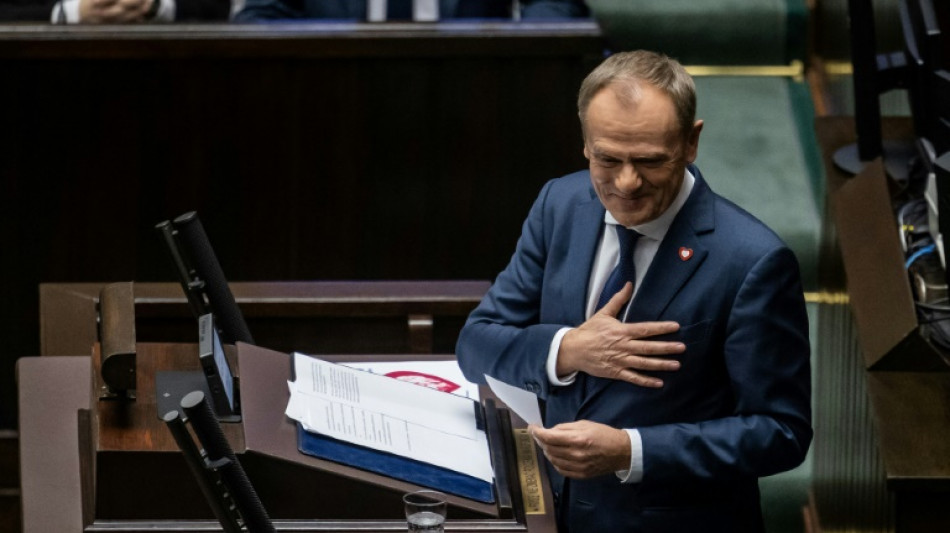
Tusk back as Polish PM, vows Ukraine support / Photo: Wojtek Radwanski - AFP
Donald Tusk was sworn in Wednesday as Polish premier, marking a break from years of right-wing rule and Poland's vowed restoration of strong EU ties.
Ex-European Council president Tusk made his return as head of government in a coalition that succeeded the Law and Justice (PiS) party, which was at odds with the bloc since taking power in 2015.
Poland's previous government became embroiled in a row with Ukraine over grain exports, but among Tusk's first acts as prime minister was a trip to Brussels for a summit to discuss new aid and EU talks for Kyiv.
Poland's Foreign Minister Radoslaw Sikorski on Wednesday stressed that supporting Ukraine would be a "priority" for the new administration.
"We will continue the policy of supporting Ukraine, both in defending against Russian imperialism and in its European aspirations," Sikorski said.
Earlier this week, Tusk slammed Western leaders for voicing "fatigue" with the situation in Ukraine, as aid packages for the war-torn country were being held up in the US and EU.
Ukraine's President Volodymyr Zelensky tweeted his "congratulations" Monday after Tusk was tapped as premier.
Tusk has also promised to unblock funds earmarked for Poland as a share of the EU post-pandemic recovery aid and blocked due to the rule-of-law infringements by the Law and Justice party.
On Wednesday, German Chancellor Olaf Scholz hailed Tusk for his intention to "lead Poland back to the heart of the EU".
Poland's ties with neighbouring Germany were also strained, with PiS playing an anti-German card in the run-up to the election and launching repeated verbal attacks on Tusk personally and at his party.
On Monday, PiS leader Jaroslaw Kaczynski accused Tusk in the parliament of being a "German agent".
The new government is likely to face daily battles with the PiS, which still has allies in the central bank and the supreme court, as well as in several important judicial and financial state institutions.
- 'Repair' the judiciary -
PiS won the most seats in October's general election but failed to find viable coalition partners and secure backing for their minority government on Monday.
Tusk's Civic Coalition came second in the ballot but forged an alliance together with two smaller political groups, winning backing in the parliament in a vote of confidence Tuesday.
"Our homeland is a place of political and civic miracles," Tusk said after his cabinet was sworn in.
He feted the record-high turnout of the October vote that brought political change to the NATO member of 38 million people.
After being appointed, Tusk pledged his government "will remain faithful to the provisions of the constitution", referring to accusations levied against his predecessors in power.
Tusk's cabinet includes former ombudsman Adam Bodnar -- a vocal critic of the PiS judiciary overhaul -- as justice minister.
"I will do everything in my power to repair what has been broken," Bodnar told reporters.
- Open to cooperate -
Polish President Andrzej Duda, also allied with the PiS, could potentially block reforms drafted by the new coalition by using his vetoing right. His term ends in 2025.
"I can assure you that I will certainly not oppose anything that serves the good of citizens and the Polish republic," Duda said.
But Duda, an avowed Catholic, did not say whether he would back potential amendments to liberalise the near-total abortion ban or legislation on civil partnerships.
On Tuesday, as the pro-EU coalition was taking over power, the European rights court condemned Poland for violating citizens' rights by failing to recognise and protect same-sex couples.
"I want this to be one of the first bills I will oversee," Equality Minister Katarzyna Kotula said Wednesday, referring to legislation to recognise civil partnerships.
F.Claes--LCdB