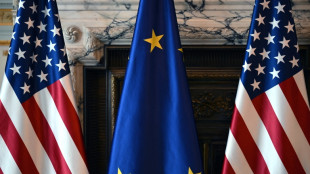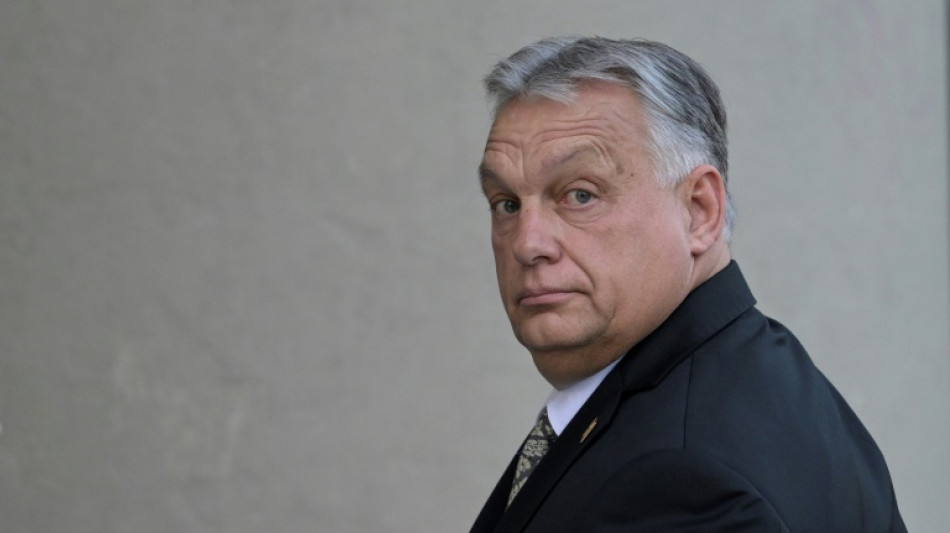
EU leaders battle Orban over Ukraine support / Photo: JUAN MABROMATA - AFP
EU leaders met Thursday to boost their long-term support for Ukraine in its fightback against Russia's invasion and secure a European future, but faced a defiant challenge from Hungary's Prime Minister Viktor Orban.
The summit was called to decide a four-year 50-billion-euro ($55-billion) funding package for Kyiv and an agreement to launch formal EU membership talks for Ukraine and its neighbour Moldova, both partially occupied by Moscow's forces.
But Orban, an authoritarian nationalist already embroiled in a row with Brussels over democratic standards in his own country, arrived apparently determined to make good on his threat to derail proceedings by using his veto to block both measures.
"There is no reason to discuss anything because preconditions were not met," Orban said. "We're not going to move away from this."
The European Commission has advised the 27 leaders that Ukraine is making good progress towards enacting the necessary judicial reforms to meet EU standards.
They also want to approve the financial aid package for Kyiv.
But any decisions must be unanimous and Orban said that firstly any aid would have to enacted outside the EU budget and that secondly he would not allow membership talks to begin.
- 'Historic chance' -
He said Ukraine might meet more of the reform criteria needed to hit EU standards by March, but suggested that a decision on funding could wait until after June's European elections.
Other EU leaders stressed the need for unity and to send a strong signal of support for Ukraine, which has already seen Washington's support threatened by manoeuvres in the US Congress.
The situation on the battlefield in Ukraine is no more promising for Kyiv. Russia's President Vladimir Putin boasted on Thursday that he has 617,000 troops in Ukraine, and that their positions are improving.
But unless Orban backs down quickly, the EU summit -- slated for Thursday and Friday -- could fail or drag on into the weekend.
"I have packed many shirts," Finnish premier Petteri Orpo said.
Lithuania's President Gitanas Nauseda said the summit was "a historic chance to take a credible decision regarding the start of negotiations with Ukraine and Moldova".
He accused Hungary of abusing the European summits unanimity rules, and insisted that Ukrainians and Moldovans deserve their chance to begin EU accession talks.
"We must make progress in this accession process," Germany's Chancellor Olaf Scholz said.
Across Brussels, at NATO HQ, alliance secretary general Jens Stoltenberg warned that the West must continue supporting Ukraine in order to protect the rest of Europe.
"If Putin wins in Ukraine, there is real risk that his aggression will not end there. Our support is not charity -- it is an investment in our security," he said.
Kyiv is desperately seeking to improve the narrative after President Volodymyr Zelensky failed in Washington to win over Republican lawmakers blocking support from the United States.
But Orban -- Russia's closest ally in the European Union -- stands in the way of Ukraine's hopes.
Critics have accused the Hungarian leader of holding Kyiv's survival hostage in a bid to force Brussels to release billions of euros of EU funds frozen over a rule of law dispute.
In what some saw as a last-minute concession the European Commission, the EU's executive, agreed on Wednesday to unblock 10 billion euros of that cash.
But, arriving at the summit, Orban insisted that, for Hungary, Ukraine and the funding are not linked. "That's not our style," he said.
Another 21 billion euros still remain out of Orban's grasp and he warned opening accession talks with Ukraine would be a "terrible mistake" and that he would not budge.
- 'Not that optimistic' -
"I'm not that optimistic, having talked to Viktor Orban about these issues," Estonia's Prime Minister Kaja Kallas told AFP on the eve of the summit.
The Baltic leader said the focus was on getting the "plan A" across the line rather than the "plan B" of the EU's other 26 countries having to find the money for Kyiv outside EU structures.
The summit also has to consider the membership dreams of Moldova and Georgia, two other ex-Soviet states menaced by Moscow.
Moldova is hoping leaders will green light its starting talks to join as well. Georgia is aiming to reach the step behind that, becoming an official candidate for membership.
Even if Ukraine and Moldova are granted talks, the protracted process of joining the EU would involve years -- if not decades -- of major reforms and vetting.
burs-dc/rmb
G.Wouters--LCdB