EU calls Orban's bluff and strikes deal to open Ukraine talks / Photo: Miguel MEDINA - AFP
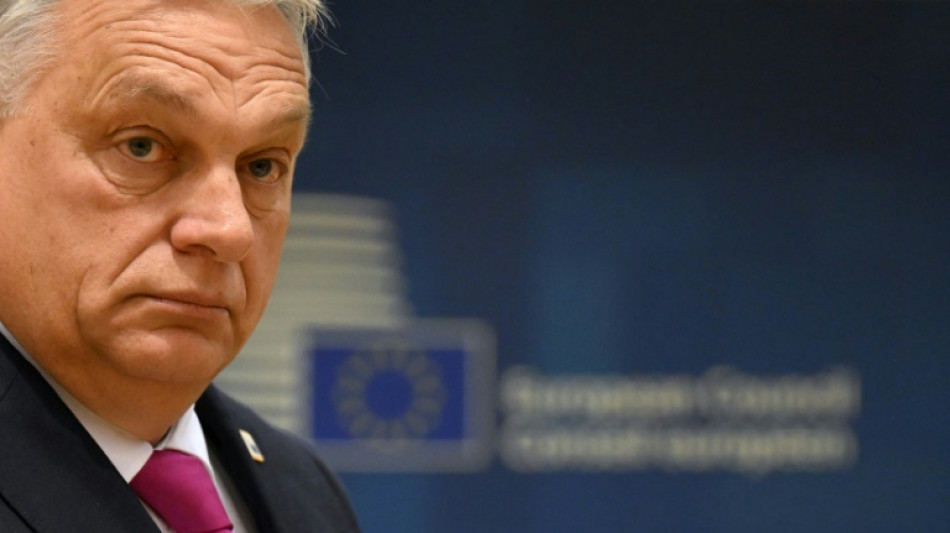
EU leaders agreed Thursday to open talks with Ukraine and Moldova on joining the bloc, despite an earlier threat from Hungary's Prime Minister Viktor Orban to veto the plan.
European Council President Charles Michel announced the decision to launch formal accession talks as "a clear signal of hope for their people and for our continent".
A European diplomatic source told AFP that Orban had agreed not to be present in the room when the other leaders made a consensus decision, and Orban said he had abstained.
In a video posted to social media, Orban denounced "a completely senseless, irrational and wrong decision" but complained that "26 other countries have insisted this decision be taken".
If he had chosen to use his veto Orban could have derailed the summit, but he backed down one day after the European Commission unlocked 10 billion euros ($10.4 billion) in frozen funds for Hungary.
"Orban made his case, made it very strongly," said Irish premier Leo Varadkar.
"He disagrees with this decision and he's changing his opinion in that sense, but essentially decided not to use the veto power."
Alongside the decision on Ukraine, which has been invaded and part-occupied by Russia, the EU summit also granted candidate status to Georgia -- one step behind formal negotiations.
Ukraine's President Volodymyr Zelensky, who did not attend the knife-edge summit and was in Germany, hailed the decision as "a victory that motivates, inspires, and strengthens".
And Moldova's President Maia Sandu declared: "Moldova turns a new page today with the EU's go-ahead for accession talks. Moldova is ready to rise to the challenge."
Earlier, Zelensky had warned that if the EU leaders had bowed to Orban's stance, they would hand Russia's President Vladimir Putin an easy political victory.
- 50-billion-euro question -
Attention at the summit now turns to a plan to grant Ukraine a four-year 50-billion-euro funding package from the EU budget that Orban has also threatened to block.
Kyiv desperately needs the money to prop up its war-torn economy, and to change the narrative that Western support is waning.
But any decisions must be unanimous -- or at least unopposed -- and Orban initially insisted a decision on funding could wait until after June's European elections.
Critics have accused the Hungarian leader of holding Kyiv's survival hostage in a bid to force Brussels to release billions of euros of EU funds frozen over a rule of law dispute.
In what some saw as a last-minute concession, the European Commission, the EU's executive, agreed on Wednesday to unblock 10 billion euros of that cash.
Another 21 billion euros still remain out of Orban's grasp, but Orban denied that Hungary was making a link between the cash and its Ukraine stance. "That's not our style," he said.
- No 'victory' for Putin -
Zelensky, in an impassioned plea via video link, earlier told the leaders "now is not the time for half-measures or hesitation".
He said failure to open membership talks with Ukraine would be used by Putin "against you personally, and against all of Europe.
"Don't give him this first -- and only -- victory of the year," he urged.
Beyond Orban, other EU leaders stressed the need for unity and to send a strong signal of support for Ukraine, which has already seen Washington's support threatened by manoeuvres in the US Congress.
The situation on the battlefield in Ukraine does not look promising for Kyiv after a counter-offensive failed. Putin boasted on Thursday that he has 617,000 troops in Ukraine, and that their positions are improving.
Across Brussels, at NATO HQ, alliance secretary general Jens Stoltenberg warned that the West must continue supporting Ukraine in order to protect the rest of Europe.
"If Putin wins in Ukraine, there is real risk that his aggression will not end there. Our support is not charity -- it is an investment in our security," he said.
burs-dc/del/imm
B.Janssens--LCdB