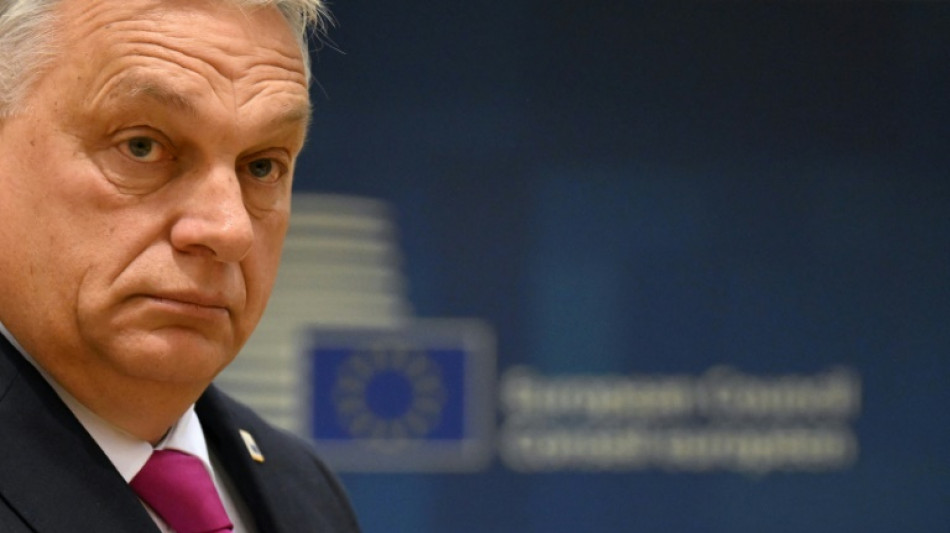
Orban blocks EU aid for Ukraine after membership talks agreed / Photo: Miguel MEDINA - AFP
Hungarian Prime Minister Viktor Orban on Friday blocked 50 billion euros in EU aid for Ukraine, after leaders side-stepped his opposition to agree to open talks with Kyiv on joining the bloc.
A crunch summit in Brussels broke up after a day of wrangling as the Hungarian authoritarian leader refused to greenlight funding to help prop up Ukraine's government over the next four years.
"Summary of the nightshift: veto for the extra money to Ukraine," Orban wrote on social media.
The EU's other 26 leaders agreed to come back to the debate at a fresh meeting early next year to try to thrash out an agreement on the desperately needed support for Kyiv.
"With 26 countries we agree. There is no agreement from Hungary at the moment, but I am very confident for next year," Dutch Prime Minister Mark Rutte said.
The blockage from the Hungarian nationalist -- Russia's best friend in the EU -- dealt a blow to Kyiv and its backers only hours after they had celebrated the bloc taking the symbolic step of agreeing to open membership talks.
Kyiv is urgently trying to change the narrative that backing from its Western allies is waning as doubts swirl over support from the United States.
Orban had also opposed starting talks, but agreed to step out of the negotiating room to allow the other EU leaders to take a consensus decision without him.
In a video posted to social media, the veteran leader denounced "a completely senseless, irrational and wrong decision" but complained that "26 other countries have insisted this decision be taken".
The other EU leaders hailed the move -- which also included agreeing to launch accession talks with Moldova -- as a crucial moment.
"Historic day! Against all odds, we achieved a decision," wrote Estonian Prime Minister Kaja Kallas.
Ukraine's President Volodymyr Zelensky, who did not attend the knife-edge summit, called the decision "a victory that motivates, inspires, and strengthens".
And Moldova's President Maia Sandu said her country had turned "a new page today with the EU's go-ahead for accession talks. Moldova is ready to rise to the challenge".
The White House -- which faces opposition from US Republicans to support for Ukraine -- hailed a "historic decision".
The agreement to open membership negotiations with Kyiv does not mean that Ukraine will be joining the EU anytime soon.
Before the talks can be launched, EU states must agree on a negotiating framework -- giving Orban ample opportunity to stall the process again.
- Cash for Orban -
Most EU leaders wanted this week's summit to send a sign of solidarity with Ukraine 22 months after Russia launched an all-out invasion.
Critics have accused the Hungarian leader of holding Kyiv's survival hostage in a bid to force Brussels to release billions of euros of EU funds frozen over a rule of law dispute.
In what some saw as a last-minute concession, the European Commission, the EU's executive, agreed on Wednesday to unblock 10 billion euros of that cash.
Another 21 billion euros still remain out of Orban's grasp, but he denied that Hungary was making a link between the cash and its Ukraine stance. "That's not our style," he said.
- No 'victory' for Putin -
Zelensky, in an impassioned plea via video link, earlier told the leaders "now is not the time for half-measures or hesitation".
He said failure to open membership talks with Ukraine would be used by Putin "against you personally, and against all of Europe.
"Don't give him this first -- and only -- victory of the year," he urged.
Beyond Orban, other EU leaders stressed the need for unity and to send a strong signal of support for Ukraine, which has already seen Washington's support threatened by manoeuvres in the US Congress.
The leaders said the bloc had agreed to a 12th round of sanctions on Moscow, targeting Russia's lucrative diamond exports and aiming to tighten an oil price cap.
But the situation on the battlefield in Ukraine does not look promising for Kyiv after a summer counter-offensive failed. Putin boasted on Thursday that he has 617,000 troops in Ukraine, and that their positions are improving.
Across Brussels, at NATO HQ, alliance secretary-general Jens Stoltenberg warned that the West must continue supporting Ukraine in order to protect the rest of Europe.
"If Putin wins in Ukraine, there is real risk that his aggression will not end there. Our support is not charity -- it is an investment in our security," he said.
burs-del/dc/lb
K.Cox--LCdB